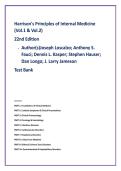
Harrison's Principles of Internal Medicine
(Vol.1 & Vol.2)
22nd Edition
• Author(s)Joseph Loscalzo; Anthony S.
Fauci; Dennis L. Kasper; Stephen Hauser;
Dan Longo; J. Larry Jameson
Test Bank
Covered
PART 1: Foundations of Clinical Medicine
PART 2: Cardinal Symptoms & Clinical Presentations
PART 3: Clinical Pharmacology
PART 4: Oncology & Hematology
PART 5: Infectious Diseases
PART 6: Cardiovascular Disorders
PART 7: Respiratory Disorders
PART 8: Critical Care Medicine
PART 9: Kidney & Urinary Tract Disorders
PART 10: Gastrointestinal & Hepatobiliary Disorders
,PART 11: Immune-Mediated & Rheumatologic Disorders
PART 12: Endocrinology & Metabolism
PART 13: Neurologic & Psychiatric Disorders
PART 14: Toxicology & Environmental Injury
PART 15: Environmental & Occupational Medicine
PART 16: Genetics, Precision & Systems Medicine
PART 17–20: Special & Emerging Topics
1. The Practice of Medicine
1. Which principle best defines evidence-based medical
practice?
A. Reliance on expert opinion alone
B. Use of randomized trials without clinical judgment
C. Integration of best research evidence with clinical expertise
and patient values
D. Application of population data without individualization
Correct Answer: C
Rationale: Evidence-based medicine integrates scientific
evidence, clinician expertise, and patient preferences to
optimize care.
Citation: Harrison’s Principles of Internal Medicine, 22nd ed.,
The Practice of Medicine
,2. Promoting Good Health
2. Which intervention has the greatest population-level impact
on reducing chronic disease burden?
A. Advanced diagnostic imaging
B. Lifestyle modification targeting diet, exercise, and tobacco
use
C. Specialty referral
D. Pharmacologic therapy alone
Correct Answer: B
Rationale: Preventive strategies addressing modifiable risk
factors yield the greatest long-term health benefits.
Citation: Harrison’s Principles of Internal Medicine, 22nd ed.,
Promoting Good Health
3. Vaccine Opposition and Hesitancy
3. The most effective clinician strategy for addressing vaccine
hesitancy is:
A. Providing extensive epidemiologic data
B. Dismissing patient concerns
C. Engaging in respectful dialogue and addressing specific fears
D. Deferring vaccination indefinitely
Correct Answer: C
Rationale: Trust-based communication tailored to patient
concerns improves vaccine acceptance.
, Citation: Harrison’s Principles of Internal Medicine, 22nd ed.,
Vaccine Opposition and Hesitancy
4. Decision-Making in Clinical Medicine
4. Shared decision-making is most appropriate when:
A. One option is clearly superior
B. Outcomes are uncertain and patient values differ
C. Emergency care is required
D. Guidelines mandate a single therapy
Correct Answer: B
Rationale: Shared decision-making aligns care with patient
preferences when trade-offs exist.
Citation: Harrison’s Principles of Internal Medicine, 22nd ed.,
Decision-Making in Clinical Medicine
5. Precision Medicine and Clinical Care
5. Precision medicine primarily aims to:
A. Replace clinical assessment with genetic testing
B. Tailor prevention and treatment based on individual
variability
C. Standardize therapy across populations
D. Eliminate environmental risk assessment
Correct Answer: B
Rationale: Precision medicine integrates genetic,
(Vol.1 & Vol.2)
22nd Edition
• Author(s)Joseph Loscalzo; Anthony S.
Fauci; Dennis L. Kasper; Stephen Hauser;
Dan Longo; J. Larry Jameson
Test Bank
Covered
PART 1: Foundations of Clinical Medicine
PART 2: Cardinal Symptoms & Clinical Presentations
PART 3: Clinical Pharmacology
PART 4: Oncology & Hematology
PART 5: Infectious Diseases
PART 6: Cardiovascular Disorders
PART 7: Respiratory Disorders
PART 8: Critical Care Medicine
PART 9: Kidney & Urinary Tract Disorders
PART 10: Gastrointestinal & Hepatobiliary Disorders
,PART 11: Immune-Mediated & Rheumatologic Disorders
PART 12: Endocrinology & Metabolism
PART 13: Neurologic & Psychiatric Disorders
PART 14: Toxicology & Environmental Injury
PART 15: Environmental & Occupational Medicine
PART 16: Genetics, Precision & Systems Medicine
PART 17–20: Special & Emerging Topics
1. The Practice of Medicine
1. Which principle best defines evidence-based medical
practice?
A. Reliance on expert opinion alone
B. Use of randomized trials without clinical judgment
C. Integration of best research evidence with clinical expertise
and patient values
D. Application of population data without individualization
Correct Answer: C
Rationale: Evidence-based medicine integrates scientific
evidence, clinician expertise, and patient preferences to
optimize care.
Citation: Harrison’s Principles of Internal Medicine, 22nd ed.,
The Practice of Medicine
,2. Promoting Good Health
2. Which intervention has the greatest population-level impact
on reducing chronic disease burden?
A. Advanced diagnostic imaging
B. Lifestyle modification targeting diet, exercise, and tobacco
use
C. Specialty referral
D. Pharmacologic therapy alone
Correct Answer: B
Rationale: Preventive strategies addressing modifiable risk
factors yield the greatest long-term health benefits.
Citation: Harrison’s Principles of Internal Medicine, 22nd ed.,
Promoting Good Health
3. Vaccine Opposition and Hesitancy
3. The most effective clinician strategy for addressing vaccine
hesitancy is:
A. Providing extensive epidemiologic data
B. Dismissing patient concerns
C. Engaging in respectful dialogue and addressing specific fears
D. Deferring vaccination indefinitely
Correct Answer: C
Rationale: Trust-based communication tailored to patient
concerns improves vaccine acceptance.
, Citation: Harrison’s Principles of Internal Medicine, 22nd ed.,
Vaccine Opposition and Hesitancy
4. Decision-Making in Clinical Medicine
4. Shared decision-making is most appropriate when:
A. One option is clearly superior
B. Outcomes are uncertain and patient values differ
C. Emergency care is required
D. Guidelines mandate a single therapy
Correct Answer: B
Rationale: Shared decision-making aligns care with patient
preferences when trade-offs exist.
Citation: Harrison’s Principles of Internal Medicine, 22nd ed.,
Decision-Making in Clinical Medicine
5. Precision Medicine and Clinical Care
5. Precision medicine primarily aims to:
A. Replace clinical assessment with genetic testing
B. Tailor prevention and treatment based on individual
variability
C. Standardize therapy across populations
D. Eliminate environmental risk assessment
Correct Answer: B
Rationale: Precision medicine integrates genetic,