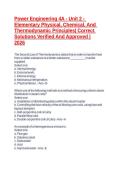
Power Engineering 4A - Unit 2 -
Elementary Physical, Chemical, And
Thermodynamic Principles| Correct
Solutions Verified And Approved |
2026
The Second Law of Thermodynamics states that in order to transfer heat
from a colder substance to a hotter substance, _________ must be
supplied.
Select one:
a. Internal energy.
b. External work.
c. Intense energy.
d. Mechanical refrigeration.
e. Physical labour. - Ans--B
Which one of the following methods is a method of ensuring uniform steam
distribution in steam coils?
Select one:
a. Installation of distributing plates within the steam header
b. Controlling the face velocity of the air flowing over coils, using face and
bypass dampers
c. Half-serpentine coil circuitry
d. Parallel flow coils
e. Double-serpentine coil circuitry - Ans--A
An example of a heterogeneous mixture is:
Select one:
a. Flue gas
b. Stainless steel
c. Soda water
d. Acid
e. Sand and water - Ans--E
,Which of the following statements is TRUE?
Select one:
a. In general, coefficients of expansion of solids are greater than those of
liquids.
b. Liquids do not contract when cooled.
c. The Coefficient of Expansion for a liquid changes if the liquid temperature
changes
d. Solids contract when heated.
e. Water will only expand when its temperature is increased. - Ans--C
Find the quantity of heat required to raise the temperature of 6.3 kg of glass
from 6°C to 210°C if the specific heat of glass is 670 J/kg K.
Select one:
a. 886.4 kJ
b. 861.2 kJ
c. 25.3 kJ
d. 911.7 kJ
e. 75.3 kJ - Ans--B
In the Steam Tables, the numbers given for the specific volume of steam are
in what units?
Select one:
a. cubic centimeters
b. cubic centimeters per gram
c. cubic meters per kilogram
d. kilograms per cubic meter
e. grams per cubic centimeter - Ans--B
If a substance goes through a process that changes its composition so that it
is no longer the same substance, then the substance has undergone a:
Select one:
a. Mechanical change
b. Chemical change
c. Homogeneous change
d. Heterogeneous change
e. Physical change - Ans--B
With counter flow arrangement of air and water in a cooling or heating coil:
, Select one:
a. The water supply connection is on the same side as the entering air
b. The heat transfer efficiency is the same as with parallel arrangement of air
and water
c. The water supply connection is on the same side as the air leaving the coil
d. The water return connection is on the same side as the leaving air
e. It decreases the heat transfer efficiency - Ans--C
Which of the following is NOT a form of refrigeration evaporator
construction?
Select one:
a. Bare tube
b. Plate surface
c. Shell and tube
d. Finned tube
e. Double-tube - Ans--E
In fin coil type heaters, individual room temperature is controlled by
Select one:
a. Switches
b. Automatic valves
c. Dampers
d. Air relays
e. Supply ducts - Ans--C
Which of the following is a limiting factor for the fin spacing of an HVAC coil
Select one:
a. Temperature of steam in coils
b. Temperature of chilled water in the coils
c. Fin material
d. Resistance to airflow
e. Face velocity - Ans--D
When heat flows from molecule to molecule within a substance, or between
bodies that are in direct contact, the method of heat transfer is called:
Select one:
a. Convection
b. Induction
Elementary Physical, Chemical, And
Thermodynamic Principles| Correct
Solutions Verified And Approved |
2026
The Second Law of Thermodynamics states that in order to transfer heat
from a colder substance to a hotter substance, _________ must be
supplied.
Select one:
a. Internal energy.
b. External work.
c. Intense energy.
d. Mechanical refrigeration.
e. Physical labour. - Ans--B
Which one of the following methods is a method of ensuring uniform steam
distribution in steam coils?
Select one:
a. Installation of distributing plates within the steam header
b. Controlling the face velocity of the air flowing over coils, using face and
bypass dampers
c. Half-serpentine coil circuitry
d. Parallel flow coils
e. Double-serpentine coil circuitry - Ans--A
An example of a heterogeneous mixture is:
Select one:
a. Flue gas
b. Stainless steel
c. Soda water
d. Acid
e. Sand and water - Ans--E
,Which of the following statements is TRUE?
Select one:
a. In general, coefficients of expansion of solids are greater than those of
liquids.
b. Liquids do not contract when cooled.
c. The Coefficient of Expansion for a liquid changes if the liquid temperature
changes
d. Solids contract when heated.
e. Water will only expand when its temperature is increased. - Ans--C
Find the quantity of heat required to raise the temperature of 6.3 kg of glass
from 6°C to 210°C if the specific heat of glass is 670 J/kg K.
Select one:
a. 886.4 kJ
b. 861.2 kJ
c. 25.3 kJ
d. 911.7 kJ
e. 75.3 kJ - Ans--B
In the Steam Tables, the numbers given for the specific volume of steam are
in what units?
Select one:
a. cubic centimeters
b. cubic centimeters per gram
c. cubic meters per kilogram
d. kilograms per cubic meter
e. grams per cubic centimeter - Ans--B
If a substance goes through a process that changes its composition so that it
is no longer the same substance, then the substance has undergone a:
Select one:
a. Mechanical change
b. Chemical change
c. Homogeneous change
d. Heterogeneous change
e. Physical change - Ans--B
With counter flow arrangement of air and water in a cooling or heating coil:
, Select one:
a. The water supply connection is on the same side as the entering air
b. The heat transfer efficiency is the same as with parallel arrangement of air
and water
c. The water supply connection is on the same side as the air leaving the coil
d. The water return connection is on the same side as the leaving air
e. It decreases the heat transfer efficiency - Ans--C
Which of the following is NOT a form of refrigeration evaporator
construction?
Select one:
a. Bare tube
b. Plate surface
c. Shell and tube
d. Finned tube
e. Double-tube - Ans--E
In fin coil type heaters, individual room temperature is controlled by
Select one:
a. Switches
b. Automatic valves
c. Dampers
d. Air relays
e. Supply ducts - Ans--C
Which of the following is a limiting factor for the fin spacing of an HVAC coil
Select one:
a. Temperature of steam in coils
b. Temperature of chilled water in the coils
c. Fin material
d. Resistance to airflow
e. Face velocity - Ans--D
When heat flows from molecule to molecule within a substance, or between
bodies that are in direct contact, the method of heat transfer is called:
Select one:
a. Convection
b. Induction