

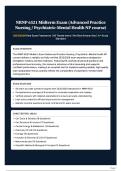
NRNP 6521 Midterm Exam (Advanced Practice
Nursing / Psychiatric-Mental Health NP course)
2025/2026 Real Exam Framework | 93 Tested Items | Verified Answer Key | A+ Study
Standard
EXAM OVERVIEW
The NRNP 6521 Midterm Exam (Advanced Practice Nursing / Psychiatric-Mental Health NP
course) delivers a realistic and fully verified 2025/2026 exam experience designed to
strengthen mastery and test readiness. Featuring 93 carefully structured questions and
professional-level accuracy, this resource enhances critical reasoning and supports
confident performance, making it an essential tool for students seeking reliable, high-quality
exam preparation that accurately reflects the complexities of psychiatric-mental health
nursing practice.
EXAM FEATURES
• 93 exam-accurate questions aligned with 2025/2026 standards for NRNP 6521
• Comprehensive coverage of 8 domains for complete preparation and mastery
• Verified answers with detailed explanations to ensure accurate understanding
• High-yield content for efficient study and time management
• Realistic practice questions to build confidence for exam success
CORE TESTING AREAS
→ Cell Cycle & Genetics (8 Questions)
→ Cell Structure & Function (11 Questions)
→ Cellular Energy & Metabolism (14 Questions)
→ Chemistry Of Life (12 Questions)
→ Ecology (10 Questions)
→ Evolution & Diversity Of Life (11 Questions)
→ Macromolecules (15 Questions)
→ Scientific Method & Biological Principles (12 Questions)
Page 1
,Scientific Method & Biological Principles (12 Questions)
Question 1
What is the primary function of the scientific method in biology?
A. To provide a theoretical framework for understanding biological phenomena
B. To develop new technologies for biological research
C. To test hypotheses and explain biological observations
D. To describe the structure and function of living organisms
Correct Answer
To test hypotheses and explain biological observations
Rationale:
The scientific method is a systematic process used to develop and test scientific knowledge, and in biology, it is
used to test hypotheses and explain biological observations.
Question 2
Which of the following is an example of a scientific principle in biology?
A. The theory of evolution
B. The law of conservation of energy
C. The concept of homeostasis
D. The process of photosynthesis
Correct Answer
The concept of homeostasis
Rationale:
Homeostasis is a scientific principle in biology that refers to the ability of living organisms to maintain a stable
internal environment despite changes in the external environment.
Page 2
,Question 3
What is the role of the nucleus in a cell?
A. To provide energy for the cell
B. To synthesize proteins
C. To store genetic information
D. To regulate cell growth and division
Correct Answer
To store genetic information
Rationale:
The nucleus is the control center of a cell and contains most of the cell's genetic material in the form of DNA.
Question 4
Which organelle is responsible for generating energy for a cell?
A. Mitochondria
B. Chloroplasts
C. Endoplasmic reticulum
D. Golgi apparatus
Correct Answer
Mitochondria
Rationale:
Mitochondria are often referred to as the powerhouses of a cell because they generate most of the energy that a
cell needs to function.
Page 3
, Question 5
What is the purpose of the scientific theory of evolution?
A. To explain the diversity of life on Earth
B. To describe the structure and function of living organisms
C. To develop new technologies for biological research
D. To test hypotheses and explain biological observations
Correct Answer
To explain the diversity of life on Earth
Rationale:
The scientific theory of evolution provides a framework for understanding the diversity of life on Earth and how
species have changed over time through the process of natural selection.
Question 6
What is the role of the endoplasmic reticulum in a cell?
A. To generate energy for the cell
B. To synthesize proteins
C. To store genetic information
D. To transport materials throughout the cell
Correct Answer
To transport materials throughout the cell
Rationale:
The endoplasmic reticulum is a network of membranous tubules and cisternae that is responsible for transporting
materials throughout the cell.
Page 4
Nursing / Psychiatric-Mental Health NP course)
2025/2026 Real Exam Framework | 93 Tested Items | Verified Answer Key | A+ Study
Standard
EXAM OVERVIEW
The NRNP 6521 Midterm Exam (Advanced Practice Nursing / Psychiatric-Mental Health NP
course) delivers a realistic and fully verified 2025/2026 exam experience designed to
strengthen mastery and test readiness. Featuring 93 carefully structured questions and
professional-level accuracy, this resource enhances critical reasoning and supports
confident performance, making it an essential tool for students seeking reliable, high-quality
exam preparation that accurately reflects the complexities of psychiatric-mental health
nursing practice.
EXAM FEATURES
• 93 exam-accurate questions aligned with 2025/2026 standards for NRNP 6521
• Comprehensive coverage of 8 domains for complete preparation and mastery
• Verified answers with detailed explanations to ensure accurate understanding
• High-yield content for efficient study and time management
• Realistic practice questions to build confidence for exam success
CORE TESTING AREAS
→ Cell Cycle & Genetics (8 Questions)
→ Cell Structure & Function (11 Questions)
→ Cellular Energy & Metabolism (14 Questions)
→ Chemistry Of Life (12 Questions)
→ Ecology (10 Questions)
→ Evolution & Diversity Of Life (11 Questions)
→ Macromolecules (15 Questions)
→ Scientific Method & Biological Principles (12 Questions)
Page 1
,Scientific Method & Biological Principles (12 Questions)
Question 1
What is the primary function of the scientific method in biology?
A. To provide a theoretical framework for understanding biological phenomena
B. To develop new technologies for biological research
C. To test hypotheses and explain biological observations
D. To describe the structure and function of living organisms
Correct Answer
To test hypotheses and explain biological observations
Rationale:
The scientific method is a systematic process used to develop and test scientific knowledge, and in biology, it is
used to test hypotheses and explain biological observations.
Question 2
Which of the following is an example of a scientific principle in biology?
A. The theory of evolution
B. The law of conservation of energy
C. The concept of homeostasis
D. The process of photosynthesis
Correct Answer
The concept of homeostasis
Rationale:
Homeostasis is a scientific principle in biology that refers to the ability of living organisms to maintain a stable
internal environment despite changes in the external environment.
Page 2
,Question 3
What is the role of the nucleus in a cell?
A. To provide energy for the cell
B. To synthesize proteins
C. To store genetic information
D. To regulate cell growth and division
Correct Answer
To store genetic information
Rationale:
The nucleus is the control center of a cell and contains most of the cell's genetic material in the form of DNA.
Question 4
Which organelle is responsible for generating energy for a cell?
A. Mitochondria
B. Chloroplasts
C. Endoplasmic reticulum
D. Golgi apparatus
Correct Answer
Mitochondria
Rationale:
Mitochondria are often referred to as the powerhouses of a cell because they generate most of the energy that a
cell needs to function.
Page 3
, Question 5
What is the purpose of the scientific theory of evolution?
A. To explain the diversity of life on Earth
B. To describe the structure and function of living organisms
C. To develop new technologies for biological research
D. To test hypotheses and explain biological observations
Correct Answer
To explain the diversity of life on Earth
Rationale:
The scientific theory of evolution provides a framework for understanding the diversity of life on Earth and how
species have changed over time through the process of natural selection.
Question 6
What is the role of the endoplasmic reticulum in a cell?
A. To generate energy for the cell
B. To synthesize proteins
C. To store genetic information
D. To transport materials throughout the cell
Correct Answer
To transport materials throughout the cell
Rationale:
The endoplasmic reticulum is a network of membranous tubules and cisternae that is responsible for transporting
materials throughout the cell.
Page 4


