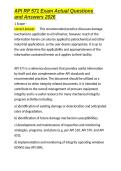
API RP 571 Exam Actual Questions
and Answers 2026
1 Scope -
correct answer ✅This recommended practice discusses damage
mechanisms applicable to oil refineries; however, much of the
information herein can also be applied to petrochemical and other
industrial applications, as the user deems appropriate. It is up to
the user determine the applicability and appropriateness of the
information contained herein as it applies to their facility.
API 571 is a reference document that provides useful information
by itself and also complements other API standards and
recommended practices. The document should be utilized as a
reference to other integrity related documents. It is intended to
contribute to the overall management of pressure equipment
integrity and is a useful resource for many mechanical integrity
program activities including:
a) identification of existing damage or deterioration and anticipated
rates of degradation,
b) identification of future damage mechanism susceptibilities,
c) development and maintenance of inspection and monitoring
strategies, programs, and plans (e.g. per API 510, API 570, and API
653),
d) implementation and monitoring of integrity operating windows
(IOWS) (see API 584),
, API RP 571 Exam Actual Questions
and Answers 2026
e) development of corrosion control documents (CCDs) (See API
970),
f) implementation of Risk-Based Inspection (RBI) programs (see API
580 and API 581),
g) conducting Fitness-For-Service (FFS) assessments (see API 579-
1/ASME FFS-1).
h) application of proper examination techniques, and
i) conducting pressure equipment integrity incident investigations
(see API 585).
The information for each damage mechanism provided in a set
format as shown below.
--- Name of the Mechanism--- The term commonly used to describe
or name the mechanism
--- Description of Damage--- A basic description of the damage
mechanism.
--- Affected Materials--- A list of the materials prone to the damage
mechanism.
--- Critical Fa
2-
correct answer ✅Terms and Definitions
and Answers 2026
1 Scope -
correct answer ✅This recommended practice discusses damage
mechanisms applicable to oil refineries; however, much of the
information herein can also be applied to petrochemical and other
industrial applications, as the user deems appropriate. It is up to
the user determine the applicability and appropriateness of the
information contained herein as it applies to their facility.
API 571 is a reference document that provides useful information
by itself and also complements other API standards and
recommended practices. The document should be utilized as a
reference to other integrity related documents. It is intended to
contribute to the overall management of pressure equipment
integrity and is a useful resource for many mechanical integrity
program activities including:
a) identification of existing damage or deterioration and anticipated
rates of degradation,
b) identification of future damage mechanism susceptibilities,
c) development and maintenance of inspection and monitoring
strategies, programs, and plans (e.g. per API 510, API 570, and API
653),
d) implementation and monitoring of integrity operating windows
(IOWS) (see API 584),
, API RP 571 Exam Actual Questions
and Answers 2026
e) development of corrosion control documents (CCDs) (See API
970),
f) implementation of Risk-Based Inspection (RBI) programs (see API
580 and API 581),
g) conducting Fitness-For-Service (FFS) assessments (see API 579-
1/ASME FFS-1).
h) application of proper examination techniques, and
i) conducting pressure equipment integrity incident investigations
(see API 585).
The information for each damage mechanism provided in a set
format as shown below.
--- Name of the Mechanism--- The term commonly used to describe
or name the mechanism
--- Description of Damage--- A basic description of the damage
mechanism.
--- Affected Materials--- A list of the materials prone to the damage
mechanism.
--- Critical Fa
2-
correct answer ✅Terms and Definitions