

Written by students who passed Immediately available after payment Read online or as PDF Wrong document? Swap it for free 4.6 TrustPilot
logo-home
Document preview thumbnail
Preview 3 out of 29 pages
Exam (elaborations)

BIOCHEM 2288 Midterm Test Bank | Western University

Document preview thumbnail
Preview 3 out of 29 pages

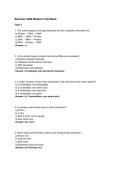
BIOCHEM 2288 Midterm Test Bank | Western University 1. The central dogma of biology describes the flow of genetic information as: a) Protein → RNA → DNA b) RNA → DNA → Protein c) DNA → RNA → Protein d) RNA → Protein → DNA Answer: c) 2. In the central dogma, proteins and some RNAs are considered: a) Genetic storage molecules b) Catalysts and structural molecules c) DNA templates d) Replication intermediates Answer: b) Catalysts and structural molecules 3. A codon consists of how many nucleotides, and what does each codon specify? a) 2 nucleotides; one polypeptide b) 3 nucleotides; one amino acid c) 4 nucleotides; one base pair d) 3 nucleotides; one gene Answer: b) 3 nucleotides; one amino acid 4. In animals, amino acids exist in which chiral form? a) D form b) L form c) Both D and L forms equally d) Non-chiral form Answer: b) L form 5. Amino acids are extended at which end during protein synthesis? a) Amino end b) Carboxyl end c) Either end d) Randomly along the chain Answer: b) Carboxyl end 6. Which of the following is NOT one of the four major types of amino acids listed? a) Polar: Negative b) Polar: Positive c) Hydrophobic: Aromatic d) Non-polar Answer: c) Hydrophobic: Aromatic 7. The notes list three amino acids that can be phosphorylated. Which of the following is one of them? a) Glycine b) Alanine c) Serine d) Proline Answer: c) Serine 8. How can you test if phosphorylation is essential for a protein's function? a) Add extra phosphate groups to all residues. b) Replace phosphorylatable residues with non-phosphorylatable ones. c) Increase the pH of the environment. d) Remove all proline residues. Answer: b) Replace phosphorylatable residues with non-phosphorylatable ones. 9. The protonation state of the amino and carboxyl ends of an amino acid is dependent on what? a) Temperature b) Pressure c) pH d) Salt concentration Answer: c) pH 10. Which amino acid is classified as an "imino" acid and is known for its inflexibility? a) Lysine b) Serine c) Proline d) Cysteine Answer: c) Proline 11. Charged, acidic (Lewis acidic) amino acids can mimic what post-translational modification? a) Glycosylation b) Acetylation c) Phosphorylation d) Methylation Answer: c) Phosphorylation 12. At a pH equal to the pKa of a functional group, what is the ratio of protonated to deprotonated molecules? a) 100:0 b) 0:100 c) 25:75 d) 50:50 Answer: d) 50:50 13. Which amino acid from the "8 to know" list has a single hydrogen as its R-group, making it the smallest and most flexible? a) (A) Alanine b) (G) Glycine c) (P) Proline d) (S) Serine Answer: b) (G) Glycine 14. Which amino acid from the list contains a sulfur atom and can form disulfide bonds? a) (C) Cysteine b) (S) Serine c) (F) Phenylalanine d) (K) Lysine Answer: a) (C) Cysteine 15. Which amino acid has a hydrophobic, aromatic ring in its side chain? a) (P) Proline b) (D) Aspartic Acid c) (F) Phenylalanine d) (A) Alanine Answer: c) (F) Phenylalanine 16. Which amino acid has a positively charged side chain at physiological pH? a) (D) Aspartic Acid b) (K) Lysine c) (S) Serine d) (G) Glycine Answer: b) (K) Lysine 17. Which amino acid has a negatively charged side chain at physiological pH? a) (A) Alanine b) (K) Lysine c) (D) Aspartic Acid d) (P) Proline Answer: c) (D) Aspartic Acid 18. The property of an amino acid that describes its aversion to water is: a) Hydrophilic b) Polar c) Hydrophobic d) Charged Answer: c) Hydrophobic 19. According to the notes, amino acids are only ever extended (added to a chain) on which end? a) The amino end b) The carboxylic end c) The R-group end d) The nitrogen end Answer: b) The carboxylic end 20. The central dogma fundamentally describes the process of: a) How cells produce energy. b) How cells divide. c) How genetic information is stored and retrieved. d) How proteins are degraded. Answer: c) How genetic information is stored and retrieved. Topic 2: 21. What unique type of bond can the sulfur in cysteine form? a) Hydrogen bonds b) Peptide bonds c) Disulfide bonds d) Ionic bonds Answer: c) Disulfide bonds 22. In a folded, water-soluble protein, where would you typically find hydrophobic amino acids? a) On the outside, facing the water b) On the inside, away from the water c) Evenly distributed throughout d) Only at the amino terminus Answer: b) On the inside, away from the water 23. What is the primary role of disulfide bonds formed by cysteine residues? a) To attract water molecules to the protein's surface b) To bind polypeptides to themselves, stabilizing structure c) To act as phosphorylation sites d) To release protons into the solution Answer: b) To bind polypeptides to themselves, stabilizing structure 24. Which three parts of an amino acid can affect its overall charge? a) The carbon, hydrogen, and oxygen atoms b) The amino terminus, carboxyl terminus, and R-group c) The peptide bond and the two adjacent R-groups d) The alpha carbon and the chiral center Answer: b) The amino terminus, carboxyl terminus, and R-group 25. Which of the following amino acids can be phosphorylated by kinases? a) Glycine, Alanine, Proline b) Serine, Threonine, Tyrosine c) Lysine, Arginine, Histidine d) Aspartic Acid, Glutamic Acid Answer: b) Serine, Threonine, Tyrosine 26. How does the addition of a phosphate group affect a serine residue? a) It makes the residue more hydrophobic. b) It makes the residue basic. c) It makes the residue acidic. d) It has no effect on the charge. Answer: c) It makes the residue acidic. 27. In an aqueous solution, what is the behavior of protons (H⁺)? a) They are static and do not move. b) They bind permanently to water molecules. c) They move continuously. d) They are only present at high pH. Answer: c) They move continuously. 28. The pKa value of a functional group is a measure of its what? a) The speed at which it reacts. b) Its overall size and shape. c) Its strength to attract H⁺. d) The pH of the solution it's in. Answer: c) Its strength to attract H⁺. 29. What does the pH of a solution represent? a) The strength of acids present. b) The amount of H⁺ in the solution. c) The concentration of all ions. d) The pKa of the weakest acid. Answer: b) The amount of H⁺ in the solution. 30. The Henderson-Hasselbalch equation is given as: a) pH = pKa * log([A⁻]/[HA]) b) pH = pKa + log([HA]/[A⁻]) c) pH = pKa - log([A⁻]/[HA]) d) pH = pKa + log([A⁻]/[HA]) Answer: d) pH = pKa + log([A⁻]/[HA]) 31. What is the typical pKa value for the carboxyl terminus (α-COOH) of a free amino acid? a) ~2 b) ~7 c) ~10 d) ~12 Answer: a) ~2 32. What is the typical pKa value for the amino terminus (α-NH₃⁺) of a free amino acid? a) ~2 b) ~7 c) ~10 d) ~12 Answer: c) ~10 33. If the pH of a solution changes by 1 unit, what is the approximate resulting change in the ratio of [A⁻] to [HA]? a) A 2-fold shift b) A 5-fold shift c) A 10-fold shift d) A 100-fold shift Answer: c) A 10-fold shift 34. At a pH of 2, what is the predominant state of the amino acid's carboxyl group (pKa ~2)? a) Fully deprotonated (-COO⁻) b) Fully protonated (-COOH) c) A 50:50 mixture of protonated and deprotonated d) It varies for each amino acid. Answer: c) A 50:50 mixture of protonated and deprotonated 35. At a pH of 10, what is the predominant state of the amino acid's amino group (pKa ~10)? a) Fully deprotonated (-NH₂) b) Fully protonated (-NH₃⁺) c) A 50:50 mixture of protonated and deprotonated d) It is always charged. Answer: c) A 50:50 mixture of protonated and deprotonated 36. How is the net charge of an amino acid in a solution of varying pH calculated? a) It is the charge of the R-group only. b) It is the sum of the charges on the amino and carboxyl termini. c) It is the sum of all the ratios of protonated/deprotonated states multiplied by their charge. d) It is always zero at neutral pH. Answer: c) It is the sum of all the ratios of protonated/deprotonated states multiplied by their charge. 37. If the pH is much lower than the pKa of a functional group, that group will be: a) Mostly deprotonated. b) Mostly protonated. c) Completely uncharged. d) A perfect 1:1 ratio. Answer: b) Mostly protonated. 38. The primary purpose of a dissociation equation for an amino acid is to: a) Calculate its molecular weight. b) Show how it forms a peptide bond. c) Show the equilibrium between its protonated and deprotonated states. d) Determine its hydrophobic character. Answer: c) Show the equilibrium between its protonated and deprotonated states. 39. A kinase is an enzyme that catalyzes what reaction? a) The hydrolysis of a peptide bond. b) The formation of a disulfide bond. c) The addition of a phosphate group. d) The removal of a carboxyl group. Answer: c) The addition of a phosphate group. 40. The conformational change in a protein caused by phosphorylation is primarily due to: a) A change in the protein's primary sequence. b) The introduction of a large, charged group that can interact with other residues. c) The protein becoming completely hydrophobic. d) The cleavage of the polypeptide chain. Answer: b) The introduction of a large, charged group that can interact with other residues. Topic 3 41. What is the general length distinction between a peptide and a polypeptide? a) Peptides are over 50 amino acids long. b) Polypeptides are 50 amino acids long or less. c) Peptides are 50 amino acids long or less. d) There is no distinction; the terms are interchangeable. Answer: c) Peptides are 50 amino acids long or less. 42. Why are electrostatic interactions weaker in an aqueous environment? a) Water molecules break covalent bonds. b) Water molecules form covalent bonds with ions. c) Water molecules interfere with and shield the charged groups. d) The high temperature of water denatures the interactions. Answer: c) Water molecules interfere with and shield the charged groups. 43. What is the primary stabilizing force for secondary protein structures like alpha-helices and beta-sheets? a) Disulfide bonds b) Hydrophobic interactions c) Hydrogen bonding between backbone N-H and C=O groups d) Peptide bonds Answer: c) Hydrogen bonding between backbone N-H and C=O groups 44. Which of the following best describes a key structural feature of a peptide bond? a) It allows for free rotation. b) It has partial double-bond character, making it planar and rigid. c) It is a weak, ionic bond. d) It involves the side chains (R-groups) of amino acids. Answer: b) It has partial double-bond character, making it planar and rigid. 45. What is the repeating pattern of atoms in a protein's backbone? a) N-C-C-N-C-C b) C-C-N-C-C-N c) C-N-C-C-N-C d) N-C-C-C-N-C Answer: a) N-C-C-N-C-C 46. The linear sequence of amino acids joined by peptide bonds defines a protein's: a) Secondary structure b) Tertiary structure c) Primary structure d) Quaternary structure Answer: c) Primary structure 47. Why is proline often disruptive to an alpha-helix? a) Its side chain is too large. b) It is hydrophobic and prefers beta-sheets. c) Its rigid ring structure causes a kink in the chain. d) It cannot form hydrogen bonds. Answer: c) Its rigid ring structure causes a kink in the chain. 48. How many amino acid residues are there per turn of a classic alpha-helix? a) 2.0 b) 3.6 c) 4.2 d) 5.0 Answer: b) 3.6 49. In a beta-sheet, the side chains of the amino acids point: a) Inward, towards the center of the sheet. b) Upwards and downwards, perpendicular to the plane of the sheet. c) Alternately towards the N-terminus and C-terminus. d) They are hidden within the hydrogen-bonded backbone. Answer: b) Upwards and downwards, perpendicular to the plane of the sheet. 50. Which level of protein structure refers to the overall three-dimensional shape of a single polypeptide chain? a) Primary structure b) Secondary structure c) Tertiary structure d) Quaternary structure Answer: c) Tertiary structure 51. What is the most important driving force for the formation of tertiary structure? a) Disulfide bonds b) Hydrogen bonding c) Hydrophobic interactions d) Ionic bonds Answer: c) Hydrophobic interactions 52. Which of the following is a covalent bond that stabilizes tertiary and quaternary structure? a) Hydrogen bond b) Van der Waals force c) Disulfide bond d) Ionic bond Answer: c) Disulfide bond 53. Disulfide bonds can only form in what kind of cellular environment? a) Acidic b) Reducing c) Oxidizing d) Cold Answer: c) Oxidizing 54. Van der Waals forces are defined as: a) The covalent sharing of electrons between atoms. b) The strong electrostatic attraction between two ions. c) The sum of attractive or repulsive forces between molecules, excluding covalent and ionic bonds. d) The bonding between a hydrogen atom and an electronegative atom. Answer: c) The sum of attractive or repulsive forces between molecules, excluding covalent and ionic bonds. 55. A distinct region of a protein that can often fold independently and provide a specific function is called a: a) Subunit b) Domain c) Helix d) Motif Answer: b) Domain 56. The level of structure that describes the assembly of multiple polypeptide chains into a single protein complex is: a) Secondary structure b) Tertiary structure c) Quaternary structure d) Primary structure Answer: c) Quaternary structure 57. In a coiled-coil quaternary structure, what is special about the 'a' and 'd' positions in the heptad repeat (abcdefg)? a) They are always charged amino acids. b) They are always proline. c) They are hydrophobic and form the core of the interaction. d) They form disulfide bonds. Answer: c) They are hydrophobic and form the core of the interaction. 58. Which method of visualizing protein structure is best for identifying which amino acids are on the surface and predicting interactions with other molecules? a) Wire model b) Ribbon diagram c) Space-filling model d) Primary sequence Answer: c) Space-filling model 59. A post-translational modification like myristylation or farnesylation primarily affects a protein's: a) Stability b) Cellular location c) Phosphorylation state d) Primary sequence Answer: b) Cellular location 60. What is the role of molecular chaperones in protein folding? a) They denature misfolded proteins. b) They catalyze the formation of disulfide bonds. c) They provide the energy for folding through ATP hydrolysis. d) They assist proteins in achieving their correct three-dimensional structure. Answer: d) They assist proteins in achieving their correct three-dimensional structure. Topic 4 60. A protein that catalyzes covalent bond breakage or formation, such as a protein kinase, is classified as what functional type? a) Structural b) Transport c) Enzyme d) Signal Answer: c) Enzyme 61. What protein, given as an example, provides mechanical support as its primary function? a) Hemoglobin b) Insulin c) Keratin d) Myosin Answer: c) Keratin 62. The huge variety of protein surface shapes and electronic properties is primarily due to: a) The uniform nature of peptide bonds. b) The variety of amino acid side chains and their arrangements. c) The consistent formation of alpha-helices. d) The presence of a hydrophobic core in all proteins. Answer: b) The variety of amino acid side chains and their arrangements. 63. A molecule that specifically binds to a protein, forming a complex, is known as a: a) Subunit b) Protease c) Ligand d) Antibody Answer: c) Ligand 64. The dissociation constant (Kd) is a measure of what? a) The speed of a reaction. b) The strength or affinity of an interaction between a protein and its ligand. c) The molecular weight of a protein-ligand complex. d) The catalytic efficiency of an enzyme. Answer: b) The strength or affinity of an interaction between a protein and its ligand. 65. For the reaction P + L ⇌ PL, what is the correct formula for the dissociation constant (Kd)? a) Kd = [PL] / [P][L] b) Kd = [P][L] / [PL] c) Kd = [P] + [L] d) Kd = 1 / [PL] Answer: b) Kd = [P][L] / [PL] 66. Which of the following pairs has the highest binding affinity, based on having the smallest Kd? a) Calmodulin/Calcium (Kd = 10⁻⁶ M) b) Antibody/Antigen (Kd = 10⁻¹² M) c) Estrogen/Estrogen receptor (Kd = μM) d) Biotin/Streptavidin (Kd = 10⁻¹⁵ M) Answer: d) Biotin/Streptavidin (Kd = 10⁻¹⁵ M) 67. What is the primary function of the proteasome? a) To synthesize new proteins b) To bind hormones and carry signals c) To unfold and degrade proteins, using ATP d) To provide structural support in the extracellular matrix Answer: c) To unfold and degrade proteins, using ATP 68. What is the most abundant protein in animals, making up about 25-30% of their total protein? a) Keratin b) Myosin c) Hemoglobin d) Collagen Answer: d) Collagen 69. What is the characteristic higher-order structure of a mature collagen molecule?

Content preview

Biochem 2288 Midterm Test Bank

Topic 1​

1. The central dogma of biology describes the flow of genetic information as:​
a) Protein → RNA → DNA​
b) RNA → DNA → Protein​
c) DNA → RNA → Protein​
d) RNA → Protein → DNA​
Answer: c)


2. In the central dogma, proteins and some RNAs are considered:​
a) Genetic storage molecules​
b) Catalysts and structural molecules​
c) DNA templates​
d) Replication intermediates​
Answer: b) Catalysts and structural molecules


3. A codon consists of how many nucleotides, and what does each codon specify?​
a) 2 nucleotides; one polypeptide​
b) 3 nucleotides; one amino acid​
c) 4 nucleotides; one base pair​
d) 3 nucleotides; one gene​
Answer: b) 3 nucleotides; one amino acid


4. In animals, amino acids exist in which chiral form?​
a) D form​
b) L form​
c) Both D and L forms equally​
d) Non-chiral form​
Answer: b) L form


5. Amino acids are extended at which end during protein synthesis?​
a) Amino end​
b) Carboxyl end​
c) Either end​
d) Randomly along the chain​
Answer: b) Carboxyl end

,6. Which of the following is NOT one of the four major types of amino acids listed?
a) Polar: Negative
b) Polar: Positive
c) Hydrophobic: Aromatic
d) Non-polar
Answer: c) Hydrophobic: Aromatic

7. The notes list three amino acids that can be phosphorylated. Which of the following is one
of them?
a) Glycine
b) Alanine
c) Serine
d) Proline
Answer: c) Serine

8. How can you test if phosphorylation is essential for a protein's function?
a) Add extra phosphate groups to all residues.
b) Replace phosphorylatable residues with non-phosphorylatable ones.
c) Increase the pH of the environment.
d) Remove all proline residues.
Answer: b) Replace phosphorylatable residues with non-phosphorylatable ones.

9. The protonation state of the amino and carboxyl ends of an amino acid is dependent on
what?
a) Temperature
b) Pressure
c) pH
d) Salt concentration
Answer: c) pH

10. Which amino acid is classified as an "imino" acid and is known for its inflexibility?
a) Lysine
b) Serine
c) Proline
d) Cysteine
Answer: c) Proline

11. Charged, acidic (Lewis acidic) amino acids can mimic what post-translational
modification?
a) Glycosylation
b) Acetylation
c) Phosphorylation
d) Methylation
Answer: c) Phosphorylation

12. At a pH equal to the pKa of a functional group, what is the ratio of protonated to
deprotonated molecules?
a) 100:0

, b) 0:100
c) 25:75
d) 50:50
Answer: d) 50:50

13. Which amino acid from the "8 to know" list has a single hydrogen as its R-group, making
it the smallest and most flexible?
a) (A) Alanine
b) (G) Glycine
c) (P) Proline
d) (S) Serine
Answer: b) (G) Glycine

14. Which amino acid from the list contains a sulfur atom and can form disulfide bonds?
a) (C) Cysteine
b) (S) Serine
c) (F) Phenylalanine
d) (K) Lysine
Answer: a) (C) Cysteine

15. Which amino acid has a hydrophobic, aromatic ring in its side chain?
a) (P) Proline
b) (D) Aspartic Acid
c) (F) Phenylalanine
d) (A) Alanine
Answer: c) (F) Phenylalanine

16. Which amino acid has a positively charged side chain at physiological pH?
a) (D) Aspartic Acid
b) (K) Lysine
c) (S) Serine
d) (G) Glycine
Answer: b) (K) Lysine

17. Which amino acid has a negatively charged side chain at physiological pH?
a) (A) Alanine
b) (K) Lysine
c) (D) Aspartic Acid
d) (P) Proline
Answer: c) (D) Aspartic Acid

18. The property of an amino acid that describes its aversion to water is:
a) Hydrophilic
b) Polar
c) Hydrophobic
d) Charged
Answer: c) Hydrophobic


Document information

Uploaded on
January 20, 2026
Number of pages
29
Written in
2025/2026
Type
Exam (elaborations)
Contains
Questions & answers
$25.99

Wrong document? Swap it for free Within 14 days of purchase and before downloading, you can choose a different document. You can simply spend the amount again.
Written by students who passed
Immediately available after payment
Read online or as PDF

Seller avatar
Reputation scores are based on the amount of documents a seller has sold for a fee and the reviews they have received for those documents. There are three levels: Bronze, Silver and Gold. The better the reputation, the more your can rely on the quality of the sellers work.
Bri254
4.0
(181)
Sold
919
Followers
738
Items
3550
Last sold
1 month ago


Why students choose Stuvia

Created by fellow students, verified by reviews

Quality you can trust: written by students who passed their tests and reviewed by others who've used these notes.

Didn't get what you expected? Choose another document

No worries! You can instantly pick a different document that better fits what you're looking for.

Pay as you like, start learning right away

No subscription, no commitments. Pay the way you're used to via credit card and download your PDF document instantly.

Student with book image

“Bought, downloaded, and aced it. It really can be that simple.”

Alisha Student

Working on your references?

Create accurate citations in APA, MLA and Harvard with our free citation generator.

Working on your references?

Frequently asked questions
