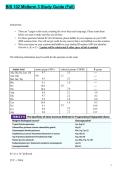
BIS 102 Midterm 3 Study Guide (Fall)
Instructions:
• There are 7 pages in this exam, counting the cover sheet and scrap page. Please count them
before you start to make sure they are all there.
• For those questions labeled SC (for SCantron), please bubble in your response on your UCD
2000 scantron form. You will not get credit for any answer that is not bubbled in on the scantron.
• Write your name on your scantron and bubble in your student ID number AND test identifier
(Version A, B, or C) - 2 points will be subtracted if either piece of info is omitted
The following information may be useful for the questions on the exam.
Amino Acid amino group (-NH3) carboxyl group (-COOH) R-group
Ala, Gly, Ile, Leu, Val 9.7 2.3 ----
Asn, Gln 9.0 2.1 ----
Met, Ser, Trp 9.3 2.3 ----
Phe 9.1 1.8 ----
Pro 10.6 2.0 ----
Thr 10.4 2.6 ----
Asp 9.8 2.1 3.9
Glu 9.7 2.2 4.2
His 9.2 1.8 6.0
Cys 10.8 1.8 8.3
Tyr 9.1 2.2 10.0
Lys 9.0 2.2 10.5
Arg 9.0 2.2 12.5
R= 8.3 x 10⁻³ kJ/K•mol
25°C = 298 K
1
, 37°C = 310
For the multiple choice questions, please select the BEST answer and bubble in on your scantron.
SC1. (2 points) A scientist successfully purifies a membrane-associated protein by treating isolated cell
membranes with a buffer containing a high concentration of NaCl. Which of the following is most likely
true about this protein?
A. It is an integral membrane protein with seven transmembrane helices.
B. It is a lipid-anchored protein attached via a covalently bonded lipid.
C. It is a peripheral membrane protein that interacts with the charged head groups of
phospholipids.
D. It is a glycoprotein with extensive N-linked oligosaccharides facing the extracellular space.
SC2. (2 points) During the initial stages of apoptosis (programmed cell death), the phospholipid
phosphatidylserine (PS), which is normally restricted to the inner leaflet of the plasma membrane,
becomes exposed on the outer leaflet. This event signals to phagocytic cells that the cell is dying. This
change is most likely due to:
A. Increased activity of Flippases.
B. Increased activity of Floppases.
C. Inhibition of Flippases.
D. The action of a Scramblases.
E. Both C and D could likely be contributing factors.
SC3. (2 points) You are tasked with separating two proteins of identical molecular weight and overall
shape. However, Protein A is rich in aspartate and glutamate residues, while Protein B is rich in lysine and
arginine residues. Which technique would be most effective for separating them in preparative scale?
A. SDS-PAGE
B. Ion Exchange Chromatography
C. Size Exclusion (Gel Filtration) Chromatography
D. Affinity Chromatography using an ATP-linked resin E. Isoelectric Focusing
SC4. (2 points) To determine if your purified protein exists as a 120 kDa monomer or a dimer of two 60
kDa subunits, which two techniques would be most informative to compare?
A. Ion Exchange Chromatography and Affinity Chromatography
B. Size Exclusion Chromatography and SDS-PAGE
C. Isoelectric Focusing and SDS-PAGE
D. Size Exclusion Chromatography and Isoelectric Focusing
E. Affinity Chromatography and SDS-PAGE
2
Instructions:
• There are 7 pages in this exam, counting the cover sheet and scrap page. Please count them
before you start to make sure they are all there.
• For those questions labeled SC (for SCantron), please bubble in your response on your UCD
2000 scantron form. You will not get credit for any answer that is not bubbled in on the scantron.
• Write your name on your scantron and bubble in your student ID number AND test identifier
(Version A, B, or C) - 2 points will be subtracted if either piece of info is omitted
The following information may be useful for the questions on the exam.
Amino Acid amino group (-NH3) carboxyl group (-COOH) R-group
Ala, Gly, Ile, Leu, Val 9.7 2.3 ----
Asn, Gln 9.0 2.1 ----
Met, Ser, Trp 9.3 2.3 ----
Phe 9.1 1.8 ----
Pro 10.6 2.0 ----
Thr 10.4 2.6 ----
Asp 9.8 2.1 3.9
Glu 9.7 2.2 4.2
His 9.2 1.8 6.0
Cys 10.8 1.8 8.3
Tyr 9.1 2.2 10.0
Lys 9.0 2.2 10.5
Arg 9.0 2.2 12.5
R= 8.3 x 10⁻³ kJ/K•mol
25°C = 298 K
1
, 37°C = 310
For the multiple choice questions, please select the BEST answer and bubble in on your scantron.
SC1. (2 points) A scientist successfully purifies a membrane-associated protein by treating isolated cell
membranes with a buffer containing a high concentration of NaCl. Which of the following is most likely
true about this protein?
A. It is an integral membrane protein with seven transmembrane helices.
B. It is a lipid-anchored protein attached via a covalently bonded lipid.
C. It is a peripheral membrane protein that interacts with the charged head groups of
phospholipids.
D. It is a glycoprotein with extensive N-linked oligosaccharides facing the extracellular space.
SC2. (2 points) During the initial stages of apoptosis (programmed cell death), the phospholipid
phosphatidylserine (PS), which is normally restricted to the inner leaflet of the plasma membrane,
becomes exposed on the outer leaflet. This event signals to phagocytic cells that the cell is dying. This
change is most likely due to:
A. Increased activity of Flippases.
B. Increased activity of Floppases.
C. Inhibition of Flippases.
D. The action of a Scramblases.
E. Both C and D could likely be contributing factors.
SC3. (2 points) You are tasked with separating two proteins of identical molecular weight and overall
shape. However, Protein A is rich in aspartate and glutamate residues, while Protein B is rich in lysine and
arginine residues. Which technique would be most effective for separating them in preparative scale?
A. SDS-PAGE
B. Ion Exchange Chromatography
C. Size Exclusion (Gel Filtration) Chromatography
D. Affinity Chromatography using an ATP-linked resin E. Isoelectric Focusing
SC4. (2 points) To determine if your purified protein exists as a 120 kDa monomer or a dimer of two 60
kDa subunits, which two techniques would be most informative to compare?
A. Ion Exchange Chromatography and Affinity Chromatography
B. Size Exclusion Chromatography and SDS-PAGE
C. Isoelectric Focusing and SDS-PAGE
D. Size Exclusion Chromatography and Isoelectric Focusing
E. Affinity Chromatography and SDS-PAGE
2