BIS 102 Midterm Practice Exam/Questions & Answers
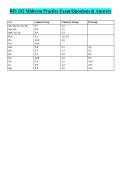
AA Amino Group Carboxyl Group R Group
Ala, Gly, Ile, Leu, Val 9.7 2.3
Asn, Gln 9.0 2.1
Met, Ser, Trp 9.3 2.3
Phe 9.1 1.8 2.0
Pro 10.6 2.6
Thr 10.4
Asp 9.8 2.1 3.9
Glu 9.7 2.2 4.2
His 9.2 1.8 6.0
Cys 10.8 1.8 8.3
Tyr 9.1 2.2 10.0
Lys 9.0 2.2 10.5
Arg 9.0 2.2 12.5
, Section 1: Multiple Choice. Select the best answer for each of the following questions. There is only one
correct
answer per question. A
1. Examine the membrane to the right. What phenomenon occurs when a
cell dies?
a. The green protein’s function will increase, resulting in more
phosphatidylserine (PS) at location A.
b. The green protein’s function will decrease, resulting in more inside B
PS at location A.
c. The green protein’s function will increase, resulting in more PS at location B.
d. The green protein’s function will decrease, resulting in more PS at location B.
2. Regarding the diagram from question 1, which protein, along with the correct explanation, requires ATP
hydrolysis to function?
a. The green protein because moving phospholipids against the concentration gradient between the
leaflets requires energy.
b. The green protein because randomizing PS in the membrane requires an energy input.
c. The blue protein because achieving equilibrium in a reaction always requires an energy input.
d. The blue protein because it primarily switches PS from the outer leaflet to the inner leaflet. e.
None of the above.
3. Provide the correct fatty acid nomenclature for the following molecule.
O O
a. 18:2(∆8,12,17)
b. 20:3(∆3,8,11)
c. 20:3(∆9,12,17)
d. 21:3(∆9,12,17)
4. Examine the lipid to the right. Which of the
following statements is correct?
a. The part of the molecule highlighted
purple refers to the variable HeadGroup
substituent.
b. This lipid would likely be used for energy storage.
c. This lipid would be acted on by lipases to extract stored cellular energy.
d. The section highlighted in yellow would aggregate together with other hydrophobic lipid
molecules to increase the entropy of surrounding hydrophilic molecules.
5. Which of the following techniques for protein purification would be UNFIT for preparative scale?
I. Ion Exchange Chromatography VI. SDS-PAGE
II. Size Exclusion Chromatography V. Isoelectric Focusing
III. Affinity Chromatography
a. I, II, VI.
b. VI. V.
c. II, VI.
d. II. III
AA Amino Group Carboxyl Group R Group
Ala, Gly, Ile, Leu, Val 9.7 2.3
Asn, Gln 9.0 2.1
Met, Ser, Trp 9.3 2.3
Phe 9.1 1.8 2.0
Pro 10.6 2.6
Thr 10.4
Asp 9.8 2.1 3.9
Glu 9.7 2.2 4.2
His 9.2 1.8 6.0
Cys 10.8 1.8 8.3
Tyr 9.1 2.2 10.0
Lys 9.0 2.2 10.5
Arg 9.0 2.2 12.5
, Section 1: Multiple Choice. Select the best answer for each of the following questions. There is only one
correct
answer per question. A
1. Examine the membrane to the right. What phenomenon occurs when a
cell dies?
a. The green protein’s function will increase, resulting in more
phosphatidylserine (PS) at location A.
b. The green protein’s function will decrease, resulting in more inside B
PS at location A.
c. The green protein’s function will increase, resulting in more PS at location B.
d. The green protein’s function will decrease, resulting in more PS at location B.
2. Regarding the diagram from question 1, which protein, along with the correct explanation, requires ATP
hydrolysis to function?
a. The green protein because moving phospholipids against the concentration gradient between the
leaflets requires energy.
b. The green protein because randomizing PS in the membrane requires an energy input.
c. The blue protein because achieving equilibrium in a reaction always requires an energy input.
d. The blue protein because it primarily switches PS from the outer leaflet to the inner leaflet. e.
None of the above.
3. Provide the correct fatty acid nomenclature for the following molecule.
O O
a. 18:2(∆8,12,17)
b. 20:3(∆3,8,11)
c. 20:3(∆9,12,17)
d. 21:3(∆9,12,17)
4. Examine the lipid to the right. Which of the
following statements is correct?
a. The part of the molecule highlighted
purple refers to the variable HeadGroup
substituent.
b. This lipid would likely be used for energy storage.
c. This lipid would be acted on by lipases to extract stored cellular energy.
d. The section highlighted in yellow would aggregate together with other hydrophobic lipid
molecules to increase the entropy of surrounding hydrophilic molecules.
5. Which of the following techniques for protein purification would be UNFIT for preparative scale?
I. Ion Exchange Chromatography VI. SDS-PAGE
II. Size Exclusion Chromatography V. Isoelectric Focusing
III. Affinity Chromatography
a. I, II, VI.
b. VI. V.
c. II, VI.
d. II. III