
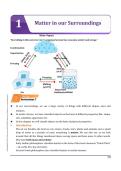
"Everything in this universe can be organised around two concepts, matter and energy."
Condensation
Vaporisation
Water vapour
Freezing
Melting
(at 0°C)
Water
Ice
Deposition
Sublimation
★ In our surroundings, we see a large variety of things with different shapes, sizes and
textures.
★ In earlier classes, we have classified objects on the basis of different properties like- shape,
size, solubility, appearance etc.
★ In this chapter, we will classify objects on the basis of physical properties.
1. Introduction
The air we breathe, the food we eat, stones, clouds, stars, plants and animals, even a small
drop of water or a particle of sand, everything is matter. We can also see, as we look
around that all the things mentioned above occupy space and have mass. In other words,
they have both mass and volume.
Early Indian philosophers classified matter in the form of five basic elements "Panch Tatva"
– air, earth, fire, sky and water.
Ancient Greek philosophers also classified matter in similar manner.
[1]
, Definition
Matter: Anything which occupies space (or have volume) and has mass is called matter.
Some examples of matter are water, air, metals, plants, animals, etc.
The perception of joy, love, hate, thought, cold, hot, pain is not considered as matter.
2. Physical nature of matter
From a long time, there were two views about the physical nature of matter
(i) Continuous nature, like a block of wood or a sheet of glass.
(ii) Particulate nature, that matter is made up of particles like sand.
Matter is made up of particles (Particulate nature)
The particle nature of matter can be demonstrated by a simple activity.
Aim
To show the particulate nature of matter.
Materials required
Beaker (100 mL), water, glass rod, salt.
Method
(a) Take about 50 mL water in 100 mL beaker.
(b) Mark the level of water.
(c) Add some salt to the beaker.
(d) Stir with the help of a glass rod.
Add
Salt
Stir
Glass rod
Salt solution
Water
[2]
, Dissolution of salt in water
Now answer
(a) What happened to the common salt initially?
(b) What happened to the common salt on stirring?
(c) What happened to the level of water in the beaker after the activity is over?
(d) Where does the common salt disappear?
Observation and conclusion
(a) The common salt settled at the base of the beaker, it appears like it is a continuous form
of matter.
(b) On stirring, the common salt disappeared i.e. it get dissolved in water. This dissolving or
disappearance of common salt in water suggests that common salt is not a continuous
state of matter. Instead, it is made up of extremely small particles. The water breaks
down the common salt into small particles that they are no longer visible to the eye.
(c) The level of water in the beaker does not rise or fall. This suggests that particles of
common salt got dispersed in water. This also suggests that there must be some hollow
spaces in water. This implies that water by itself is not continuous, but is made of
extremely small particles, which are not visible to the eye.
(d) The extremely small particles of common salt positioned themselves in the small spaces
between the particles of water. This also accounts for the fact that level of water does
not rise, because the particles of common salt do not displace it but occupy the small
spaces in between the particles of water.
Size of the particles
The following activity demonstrates that the constituent particles of matter are very small.
Aim
To show that the constituent particles of matter is very small.
Materials required
Beakers (250 mL), water, glass rod, potassium permanganate.
Method
(a) Take a 250 mL beaker and add 100 mL water to it.
(b) Now add 2-3 crystals of potassium permanganate (KMnO4) and stir with a glass rod in
order to dissolve the crystals.
(c) Take 10 mL of this solution and add to 90 mL of water taken in another beaker.
(d) Take 10 mL of this diluted solution and put into 90 mL of water taken in another beaker.
(e) Repeat this process two more times. Observe the colour of the solution in the last
beaker.
[3]
, Potassium permanganate colour fades on dilution with water
Observation
This experiment shows that just a few crystals of potassium permanganate can change
colour of large volume of water. So, we conclude that there must be millions of tiny
particles in just one crystal of potassium permanganate which keep on dividing themselves
into smaller and smaller particles with each dilution thereby making the colour lighter and
lighter. The same activity can be done using 2 mL of Dettol instead of potassium
permanganate. The smell can be detected even on repeated dilution.
The particles of matter are very small, they are small beyond our imagination!!
Conclusion
The matter is made up of extremely small particles which cannot be seen even with a
powerful microscope what we actually see is an aggregate of tiny particles.
3. Characteristics of particles of matter
(i) Particles of matter have space between them
When sugar is dissolved in water, the volume of the
liquid remains unchanged because during
dissolution, the particles of sugar get into the
spaces between the particles of water.
As a result, they get evenly distributed and there is
no noticeable change in volume. Similarly, when
potassium permanganate is dissolved in water, its particles get evenly distributed
throughout the bulk of water. This is indicated by uniform colour of the solution.
This indicates that there are spaces between particles of matter. The particles of
potassium permanganate get uniformly distributed in the spaces between water
molecules.
Similarly, when we prepare tea, coffee or lemonade (nimbu pani) we observe that
particles of one type of matter get into the spaces between particles of other.
[4]


