

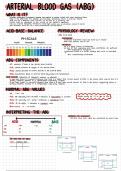
AR -
P- 300) G-S (- 3G)
NHAT S T?
-
a common investigation in emergency3 intensive care medicine to monitor patients with acute respiratory failure
-
helps in the assessment of a patient's gas exchange ventilatory , control 3 acid-base balance
-
does not give a diagnosis alone I should not be used as a screening test
-
results must be considered in the context of the patient's symptoms
-
can also measure hemoglobin , hematocrit electrolyte values such as potassium ,
calcium sodium
-
also measures blood pH , CO2 ' HCOs (bicarbonate) concentrations
ACID-BASE BALANCE PHYSIOLOGY REVIEW
-
CO2 is an acid
-
RESPIRATORY :
·
insufficient respirations cause [O2 build-up in tissues
·
binds with carbonic acid i ↓ PH
-
METABOLIC :
·
CO2 is a waste product of metabolism
·
we blow off this respiratory acid when ventilations are sufficient
-
fast compensatory mechanism
·
bicarbonate (HCO3) is a buffer binding with acid to neutralize
it
-
slow compensatory mechanism
ABG COMPONENTS
PH blood (acidity)
*
- :
measures H levels in the arterial
-
Pa02 :
partial pressure of oxygen in the arterial blood
-
PaCO2 :
partial pressure of carbon dioxide in the arterial blood
-
HCO3 bicarbonate
:
levels in arterial blood (by product of metabolism)
BASE EXCESS :
indication of metabolic acidosis or alkalosis
-
a high base excess() + 2 mmol/L) indicates that there is a higher than normal amount of HCO3 in the blood ,
which may be due to a
primary metabolic alkalosis or a compensated respiratory acidosis
-
a low base excess ()-Immol/L) indicates that there is a lower than normal amount of HCO3 in the blood , suggesting either a
primary metabolic acidosis or a compensated respiratory alkalosis
NORMAL ABG VALUES
pH : 7 35-7 45
minmmHg
-
. .
-
Pa0z :
80-100mmHg (10 . 6-13 .
3kPa) -> indicates if hypoxemia is present by 7 5 to
.
get to kPa
-
PaCO2 : 35-45 mmHg (4 . 7 -
6kPa) + indicates a ventilation issue
-
# [03 :
22-26 meg) - indicates a metabolic issue
-
Base excess : -2- + 2 mmol (
INTERPRETING THE ABG
ACIDOSIS OR ALKALOSIS ?
S > determine when these values are considered an acid or base
-
ACID NORMAL BASE
pH :
. 35
7 7 .
40 7 45
.
CO2 : 45 35
↓) [Oz : 22 26
TIC-TAC-TOE Of ABGS
A CID NORMAL BASE
P- 300) G-S (- 3G)
NHAT S T?
-
a common investigation in emergency3 intensive care medicine to monitor patients with acute respiratory failure
-
helps in the assessment of a patient's gas exchange ventilatory , control 3 acid-base balance
-
does not give a diagnosis alone I should not be used as a screening test
-
results must be considered in the context of the patient's symptoms
-
can also measure hemoglobin , hematocrit electrolyte values such as potassium ,
calcium sodium
-
also measures blood pH , CO2 ' HCOs (bicarbonate) concentrations
ACID-BASE BALANCE PHYSIOLOGY REVIEW
-
CO2 is an acid
-
RESPIRATORY :
·
insufficient respirations cause [O2 build-up in tissues
·
binds with carbonic acid i ↓ PH
-
METABOLIC :
·
CO2 is a waste product of metabolism
·
we blow off this respiratory acid when ventilations are sufficient
-
fast compensatory mechanism
·
bicarbonate (HCO3) is a buffer binding with acid to neutralize
it
-
slow compensatory mechanism
ABG COMPONENTS
PH blood (acidity)
*
- :
measures H levels in the arterial
-
Pa02 :
partial pressure of oxygen in the arterial blood
-
PaCO2 :
partial pressure of carbon dioxide in the arterial blood
-
HCO3 bicarbonate
:
levels in arterial blood (by product of metabolism)
BASE EXCESS :
indication of metabolic acidosis or alkalosis
-
a high base excess() + 2 mmol/L) indicates that there is a higher than normal amount of HCO3 in the blood ,
which may be due to a
primary metabolic alkalosis or a compensated respiratory acidosis
-
a low base excess ()-Immol/L) indicates that there is a lower than normal amount of HCO3 in the blood , suggesting either a
primary metabolic acidosis or a compensated respiratory alkalosis
NORMAL ABG VALUES
pH : 7 35-7 45
minmmHg
-
. .
-
Pa0z :
80-100mmHg (10 . 6-13 .
3kPa) -> indicates if hypoxemia is present by 7 5 to
.
get to kPa
-
PaCO2 : 35-45 mmHg (4 . 7 -
6kPa) + indicates a ventilation issue
-
# [03 :
22-26 meg) - indicates a metabolic issue
-
Base excess : -2- + 2 mmol (
INTERPRETING THE ABG
ACIDOSIS OR ALKALOSIS ?
S > determine when these values are considered an acid or base
-
ACID NORMAL BASE
pH :
. 35
7 7 .
40 7 45
.
CO2 : 45 35
↓) [Oz : 22 26
TIC-TAC-TOE Of ABGS
A CID NORMAL BASE


