

For Expert help and assignment handling,
1
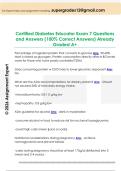
Certified Diabetes Educator Exam 7 Questions
and Answers (100% Correct Answers) Already
Graded A+
Percentage of ingested protein that converts to glucose Ans: 50-60%.
Most is stored as glycogen. Protein consumption directly affects BG levels
more for those who have poorly controlled T2DM.
© 2026 Assignment Expert
Does consuming protein w CHO help to lower glycemic response? Ans:
No.
Guru01 - Stuvia
What are the ADA recommendations for dietary protein? Ans: -Should
not exceed 20% of total daily energy intake.
-microalbuminuria: 0.8-1.0 g/kg bw
-nephropathy: 0.8 g/kg bw
ADA guideline for alcohol Ans: -drink in moderation
-consume alcohol w food to reduce risk for nocturnal hypoglycemia
-avoid high carb mixers (juice or soda)
Nutritional considerations during pregnancy Ans: -achieve
normoglycemia and prevent ketosis
-carbs during pregnancy should be at least 175g/d distributed btw 3
meals and 2-4 snacks.
,For Expert help and assignment handling,
2
-regular physical activity may be helpful to normalize BGs
Effects of exercise on insulin sensitivity Ans: -post-exercise= increase
uptake of glucose by the muscles
-insulin secretion decreases during exercise, but insulin sensitivity
significantly increases
-meds may need to be reduced
© 2026 Assignment Expert
-insulin sensitivity post-exercise may last 24-72 hrs
Aerobic exercise recommendations for T2DM Ans: -at least 150 min/wk
Guru01 - Stuvia
of moderate aerobic activity
-at least 90 min/wk of vigorous aerobic activity
-distribute time over 3 days/wk
- no more than 2 consecutive days should lapse w/o activity
-greater cardiovascular benefits achieved with 4+ hrs/wk
Resistance training recommendations for T2DM Ans: -safe and
beneficial (w regard to lowering A1c)
-3x/wk, targeting all major muscle groups
-progress to 3 sets of 8-10 reps
,For Expert help and assignment handling,
3
Exercise precautions for T1DM w hyperglycemia Ans: -hyperglycemia +
ketosis can worsen if exercising when BG is >250 mg/dL. Advise client to
avoid until BG improves.
-If BG is 250-300 mg/dl without ketones, exercise is probably safe.
-Delay exercise if BG is >300 mg/dL, regardless of ketones
Exercise precautions for T2DM w hyperglycemia Ans: -if BG is >300
© 2026 Assignment Expert
mg/dL, it is NOT necessary to abstain from exercise (especially if in
postprandial state).
-advise client to remain well-hydrated
Guru01 - Stuvia
-if ketones are present, STRENOUS exercise should be avoided.
Exercise and microvascular complications (proliferative retinopathy &
peripheral neuropathy) Ans: Proliferative retinopathy- avoid vigorous or
resistance exercises to prevent vitreous hemorrhage and retinal
detachment.
Peripheral neuropathy-avoid exercises that increase risk for skin
breakdown, joint injury, and charcot fracture. Protective, well-fitting
shoes and socks should be worn. In cases of severe loss of sensation,
non-weight-bearing activities are preferred.
Exercise and microvascular complications (autonomic neuropathy &
microalbuminuria) Ans: Autonomic neuropathy- risk for decreased
cardiac response to exercise, postural hypotension, silent angina, and
impaired thirst sensation. Thorough cardiac eval should be done.
, For Expert help and assignment handling,
4
Microalbuminuria-exercise can increase urinary protein excretion.
Presence of microalbuminuria should not limit exercise. Cardiovascular
status should be evaluated prior to activity.
Exercise recommendations for patients w PVD Ans: With less severe PVD,
a walking program is indicated. It should include low intensity walking
intervals, alternating with rest.
With severe PVD, a walking program is NOT indicated.
© 2026 Assignment Expert
What is intermittent claudication? Ans: PVD-related ischemic pain
resulting from an inadequate oxygen supply to the muscles of the lower
extremities. Pain is exacerbated by walking and alleviated by rest
Guru01 - Stuvia
(eventhough it is recommended for tx of mild PVD). BUT, when a person
has pain at rest or during the night, the PVD is severe and a walking
program is contraindicated.
How to prevent exercise-induced hypogylcemia Ans: -test BG prior to
activity
-if BG is <100 mg/dL, risk for hypoglycemia is high.
-if pt uses insulin or a secretagogue, supplemental CHO is needed if BG is
<100 mg/dL. Pt should be warned about post-exercise low BG (PEL).
Learning needs assessment includes... Ans: -previous learning/level of
knowledge and health beliefs
-patient goals
-attitudes and feelings about diabetes education
1
Certified Diabetes Educator Exam 7 Questions
and Answers (100% Correct Answers) Already
Graded A+
Percentage of ingested protein that converts to glucose Ans: 50-60%.
Most is stored as glycogen. Protein consumption directly affects BG levels
more for those who have poorly controlled T2DM.
© 2026 Assignment Expert
Does consuming protein w CHO help to lower glycemic response? Ans:
No.
Guru01 - Stuvia
What are the ADA recommendations for dietary protein? Ans: -Should
not exceed 20% of total daily energy intake.
-microalbuminuria: 0.8-1.0 g/kg bw
-nephropathy: 0.8 g/kg bw
ADA guideline for alcohol Ans: -drink in moderation
-consume alcohol w food to reduce risk for nocturnal hypoglycemia
-avoid high carb mixers (juice or soda)
Nutritional considerations during pregnancy Ans: -achieve
normoglycemia and prevent ketosis
-carbs during pregnancy should be at least 175g/d distributed btw 3
meals and 2-4 snacks.
,For Expert help and assignment handling,
2
-regular physical activity may be helpful to normalize BGs
Effects of exercise on insulin sensitivity Ans: -post-exercise= increase
uptake of glucose by the muscles
-insulin secretion decreases during exercise, but insulin sensitivity
significantly increases
-meds may need to be reduced
© 2026 Assignment Expert
-insulin sensitivity post-exercise may last 24-72 hrs
Aerobic exercise recommendations for T2DM Ans: -at least 150 min/wk
Guru01 - Stuvia
of moderate aerobic activity
-at least 90 min/wk of vigorous aerobic activity
-distribute time over 3 days/wk
- no more than 2 consecutive days should lapse w/o activity
-greater cardiovascular benefits achieved with 4+ hrs/wk
Resistance training recommendations for T2DM Ans: -safe and
beneficial (w regard to lowering A1c)
-3x/wk, targeting all major muscle groups
-progress to 3 sets of 8-10 reps
,For Expert help and assignment handling,
3
Exercise precautions for T1DM w hyperglycemia Ans: -hyperglycemia +
ketosis can worsen if exercising when BG is >250 mg/dL. Advise client to
avoid until BG improves.
-If BG is 250-300 mg/dl without ketones, exercise is probably safe.
-Delay exercise if BG is >300 mg/dL, regardless of ketones
Exercise precautions for T2DM w hyperglycemia Ans: -if BG is >300
© 2026 Assignment Expert
mg/dL, it is NOT necessary to abstain from exercise (especially if in
postprandial state).
-advise client to remain well-hydrated
Guru01 - Stuvia
-if ketones are present, STRENOUS exercise should be avoided.
Exercise and microvascular complications (proliferative retinopathy &
peripheral neuropathy) Ans: Proliferative retinopathy- avoid vigorous or
resistance exercises to prevent vitreous hemorrhage and retinal
detachment.
Peripheral neuropathy-avoid exercises that increase risk for skin
breakdown, joint injury, and charcot fracture. Protective, well-fitting
shoes and socks should be worn. In cases of severe loss of sensation,
non-weight-bearing activities are preferred.
Exercise and microvascular complications (autonomic neuropathy &
microalbuminuria) Ans: Autonomic neuropathy- risk for decreased
cardiac response to exercise, postural hypotension, silent angina, and
impaired thirst sensation. Thorough cardiac eval should be done.
, For Expert help and assignment handling,
4
Microalbuminuria-exercise can increase urinary protein excretion.
Presence of microalbuminuria should not limit exercise. Cardiovascular
status should be evaluated prior to activity.
Exercise recommendations for patients w PVD Ans: With less severe PVD,
a walking program is indicated. It should include low intensity walking
intervals, alternating with rest.
With severe PVD, a walking program is NOT indicated.
© 2026 Assignment Expert
What is intermittent claudication? Ans: PVD-related ischemic pain
resulting from an inadequate oxygen supply to the muscles of the lower
extremities. Pain is exacerbated by walking and alleviated by rest
Guru01 - Stuvia
(eventhough it is recommended for tx of mild PVD). BUT, when a person
has pain at rest or during the night, the PVD is severe and a walking
program is contraindicated.
How to prevent exercise-induced hypogylcemia Ans: -test BG prior to
activity
-if BG is <100 mg/dL, risk for hypoglycemia is high.
-if pt uses insulin or a secretagogue, supplemental CHO is needed if BG is
<100 mg/dL. Pt should be warned about post-exercise low BG (PEL).
Learning needs assessment includes... Ans: -previous learning/level of
knowledge and health beliefs
-patient goals
-attitudes and feelings about diabetes education


