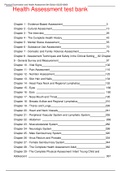
Health Assessment test bank over 100 questions and answers from different chapters
Health Assessment test bank Chapter 1 - Evidence-Based Assessment 3 Chapter 2 - Cultural Assessment 13 Chapter 3 - The Interview 26 Chapter 4 - The Complete Health History 43 Chapter 5 - Mental Status Assessment 55 Chapter 6 - Substance Use Assessment 70 Chapter 7 - Domestic and Family Violence Assessment 76 Chapter 8 - Assessment Techniques and Safety in the Clinical Setting 82 Chapter 9 - General Survey and Measurement 97 Chapter 10 - Vital Signs 102 Chapter 11 - Pain Assessment 116 Chapter 12 - Nutrition Assessment 123 Chapter 13 - Skin Hair and Nails 134 Chapter 14 - Head Face Neck and Regional Lymphatics 152 Chapter 15 - Eyes 166 Chapter 16 - Ears 180 Chapter 17 - Nose Mouth and Throat 195 Chapter 18 - Breasts Axillae and Regional Lymphatics 210 Chapter 19 - Thorax and Lungs 226 Chapter 20 - Heart and Neck Vessels 241 Chapter 21 - Peripheral Vascular System and Lymphatic System 255 Chapter 22 - Abdomen 269 Chapter 23 - Musculoskeletal System 282 Chapter 24 - Neurologic System 299 Chapter 25 - Male Genitourinary System 320 Chapter 26 - Anus Rectum and Prostate 334 Chapter 27 - Female Genitourinary System 344 Chapter 28 - The Complete Health Assessment Adult 362 Chapter 29 - The Complete Physical Assessment Infant Young Child and Adolescent 367 Chapter 30 - Bedside Assessment and Electronic Documentation 369 Chapter 31 - The Pregnant Woman 374 Chapter 32 - Functional Assessment of the Older Adult 385 Chapter 01: Evidence-Based Assessment Jarvis: Physical Examination and Health Assessment, 8th Edition MULTIPLE CHOICE 1. After completing an initial assessment of a patient, the nurse has charted that his respirations are eupneic and his pulse is 58 beats per minute. What type of assessment data is this? 2. A patient tells the nurse that he is very nervous, nauseous, and “feels hot.” What type of assessment data is this? 3. What do the patient’s record, laboratory studies, objective data, and subjective data combine to form? 4. When listening to a patient’s breath sounds, the nurse is unsure of a sound that is heard. Which action should the nurse take next? 5. The nurse is conducting a class for new graduate nurses. While teaching the class, what should the nurse keep in mind regarding what novice nurses, without a background of skills and experience from which to draw upon, are more likely to base their decisions on? 6. The nurse is reviewing information about evidence-based practice (EBP). Which statement best reflects EBP? 7. The nurse is conducting a class on priority setting for a group of new graduate nurses. Which is an example of a first-level priority problem? 8. When considering priority setting of problems, the nurse keeps in mind that second-level priority problems include which of these aspects? 9. Which critical-thinking skill helps the nurse see relationships among the data? 10. The nursing process is a sequential method of problem solving that nurses use and includes which steps? 11. A newly admitted patient is in acute pain, has not been sleeping well lately, and is having difficulty breathing. How should the nurse prioritize these problems? 12. Which is a barrier to incorporating EBP? 13. During a staff meeting, nurses discuss the problems with accessing research studies to incorporate evidence-based clinical decision making into their practice. Which suggestion by the nurse manager would best help these problems? 14. When reviewing the concepts of health, the nurse recalls that the components of holistic health include which of these? 15. The nurse recognizes that which concept of prevention is essential in describing health? 16. The nurse is performing a physical assessment on a newly admitted patient. Which is an example of objective information obtained during the physical assessment? 17. A visiting nurse is making an initial home visit for a patient who has several chronic medical problems. Which type of database is most appropriate to collect in this setting? 18. In which situation is it most appropriate for the nurse to perform a focused or problem-centered history? .................................CONTINUED.....................................
Document information
- Uploaded on
- March 11, 2021
- Number of pages
- 390
- Written in
- 2020/2021
- Type
- Exam (elaborations)
- Contains
- Questions & answers