,TABLE OF CONTENTS
1. The Science of Psychology
2. The Biological Perspective
3. Sensation and Perception
4. Consciousness
5. Learning
6. Memory
7. Cognition: Thinking, Intelligence, and Language
8. Development Across the Life Span
9. Motivation and Emotion
10. Sexuality and Gender
11. Stress and Health
12. Social Psychology
13. Theories of Personality
14. Psychological Disorders
15. Psychological Therapies
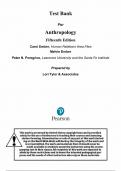
,Test Bank For Psychology By Saundra K.Ciccarelli J. Noland White 6th
Edition|
Name
Chapter 1 – Quick Quiz 1
1. The goals of psychology are to .
a) explore the conscious and unconscious functions of the human mind
b) understand, compare, and analyze human behavior
c) improve psychological well-being in all individuals from birth until death
d) describe, explain, predict, and control behavior
2. was an early proponent of functionalism.
a) Ivan Pavlov c) Wilhelm Wundt
b) William James d) Max Wertheimer
3. Freud said phobias were , whereas Watson said phobias were .
a) learned; inherited c) sexual; unconscious
b) repressed conflicts; learned d) conditioned; unconditioned
4. Which perspective focuses on free will and self-actualization?
a) psychoanalysis c) cognitive perspective
b) humanism d) behaviorism
5. The class is playing a game of Jeopardy! and it is your turn. “I’ll take Specialties in Psychology for $300.” The
revealed answer is, “These psychological professionals work with situations in which environmental conditions
may have an impact on mental health.” What will you say?
a) “What is a neuropsychologist?”
b) “What is a forensic psychologist?”
c) “What is a psychiatric social worker?”
d) “What is a developmental psychologist?”
6. When you watch dogs play in the park or watch how your professors conduct their classes, you are engaging in a
form of .
a) case study research c) survey research
b) naturalistic observation d) psychometric study
7. A detailed description of a particular individual being studied or treated is called a .
a) representative sample c) single-blind study
b) case study d) naturalistic observation
8. A negative correlation means that .
a) high values of one variable are associated with low values of the other
b) high values of one variable are associated with high values of the other
c) low values of one variable are associated with low values of the other
d) there is no relationship between the two variables
9. is an experiment in which participants do not know if they are in the experimental or the control
group, but the experimenters do know which participants are part of which group.
a) The double-blind study c) The single-blind study
b) Field research d) Correlational research
10. Experimenters can justify the use of deception because .
, a) there is informed consent c) it may be necessary for the experiment to work
b) research is more important than people d) it is not that harmful
Chapter 1 – Quick Quiz 1
Answer Key
1. d Explanation: These goals adequately help uncover the mysteries of behavior. (Topic: 1.6 The
Scientific Approach, Skill Level: Remember the Facts, Difficulty Level: Easy, Learning
Objective: 1.6 Recall the five steps of the scientific approach, APA Learning Objective: 1.1
Describe key concepts, principles, and overarching themes in psychology.)
2. b Explanation: William James was a functionalist. (Topic: 1.1 In the Beginning: Wundt, Titchener,
and James, Skill Level: Remember the Facts, Difficulty Level: Easy, Learning Objective: 1.1
Describe the contributions of some of the early pioneers in psychology, APA Learning Objective:
1.2 Develop a working knowledge of psychology’s content domains.)
3. b Explanation: Freud studied repressed conflict and Watson studied observable behavior. (Topic: 1.2
Three Influential Approaches: Gestalt, Psychoanalysis, and Behaviorism, Skill Level: Analyze It,
Difficulty Level: Moderate, Learning Objective: 1.2 Summarize the basic ideas and the im portant
people behind the early approaches known as Gestalt, psychoanalysis, and behaviorism, APA
Learning Objective: 1.2 Develop a working knowledge of psychology’s content domains.)
4. b Explanation: The humanistic perspective focuses on free will and self-actualization. (Topic: 1.3
Modern Perspectives, Skill Level: Remember the Facts, Difficulty Level: Easy, Learning
Objective: 1.3 Summarize the basic ideas behind the seven modern perspectives in psychology,
APA Learning Objective: 1.1 Describe key concepts, principles, and overarching themes in
psychology.)
5. c Explanation: Psychiatric social workers work with people in conditions of poverty or other types
of environmental situations leading to mental disorders. (Topic: 1.4 Psychological Professionals
and Areas of Specialization, Skill Level: Apply What You Know, Difficulty Level: Easy,
Learning Objective: 1.4 Differentiate between the various types of professionals within the field of
psychology, APA Learning Objectives: 1.2 Develop a working knowledge of psychology’s
content domains; 1.3 Describe applications of psychology.)
6. b Explanation: In naturalistic observation, you are just watching—that is, observing. (Topic: 1.7
Descriptive Methods, Skill Level: Apply What You Know, Difficulty Level: Easy, Learning
Objective: 1.7 Compare and contrast some of the methods used to describe behavior, APA
Learning Objectives: 1.3 Describe applications of psychology; 2.4 Interpret, design, and conduct
basic psychological research.)
7. b Explanation: A case study involves a detailed description of a particular individual. (Topic: 1.7
Descriptive Methods, Skill Level: Remember the Facts, Difficulty Level: Easy, Learning
Objective: 1.7 Compare and contrast some of the methods used to describe behavior, APA
Learning Objective: 2.4 Interpret, design, and conduct basic psychological research.)
8. a Explanation: A negative correlation means that high values of one variable are associated with low
values of the other. (Topic: 1.8 Correlations: Finding Relationships, Skill Level: Remember the
Facts, Difficulty Level: Easy, Learning Objective: 1.8 Explain how researchers use the
correlational technique to study relationships between two or more variables, APA Learning
Objective: 1.1 Describe key concepts, principles, and overarching themes in psychology.)
9. c Explanation: The single-blind study is an experiment in which participants do not know if they are
in the experimental or the control group, but the experimenters do know which participants are
part of which group. (Topic: 1.10 Experimental Hazards and Controlling for Effects, Skill Level:
Remember the Facts, Difficulty Level: Easy, Learning Objective: 1.10 Recall two common
sources of problems in an experiment and some ways to control for these effects, APA Learning
Objective: 2.4 Interpret, design, and conduct basic psychological research.)
10. c Explanation: Deception is justified if the study wouldn’t work any other way. (Topic: 1.11 The
Guidelines for Doing Research with People, Skill Level: Analyze It, Difficulty Level: Moderate,
1. The Science of Psychology
2. The Biological Perspective
3. Sensation and Perception
4. Consciousness
5. Learning
6. Memory
7. Cognition: Thinking, Intelligence, and Language
8. Development Across the Life Span
9. Motivation and Emotion
10. Sexuality and Gender
11. Stress and Health
12. Social Psychology
13. Theories of Personality
14. Psychological Disorders
15. Psychological Therapies
,Test Bank For Psychology By Saundra K.Ciccarelli J. Noland White 6th
Edition|
Name
Chapter 1 – Quick Quiz 1
1. The goals of psychology are to .
a) explore the conscious and unconscious functions of the human mind
b) understand, compare, and analyze human behavior
c) improve psychological well-being in all individuals from birth until death
d) describe, explain, predict, and control behavior
2. was an early proponent of functionalism.
a) Ivan Pavlov c) Wilhelm Wundt
b) William James d) Max Wertheimer
3. Freud said phobias were , whereas Watson said phobias were .
a) learned; inherited c) sexual; unconscious
b) repressed conflicts; learned d) conditioned; unconditioned
4. Which perspective focuses on free will and self-actualization?
a) psychoanalysis c) cognitive perspective
b) humanism d) behaviorism
5. The class is playing a game of Jeopardy! and it is your turn. “I’ll take Specialties in Psychology for $300.” The
revealed answer is, “These psychological professionals work with situations in which environmental conditions
may have an impact on mental health.” What will you say?
a) “What is a neuropsychologist?”
b) “What is a forensic psychologist?”
c) “What is a psychiatric social worker?”
d) “What is a developmental psychologist?”
6. When you watch dogs play in the park or watch how your professors conduct their classes, you are engaging in a
form of .
a) case study research c) survey research
b) naturalistic observation d) psychometric study
7. A detailed description of a particular individual being studied or treated is called a .
a) representative sample c) single-blind study
b) case study d) naturalistic observation
8. A negative correlation means that .
a) high values of one variable are associated with low values of the other
b) high values of one variable are associated with high values of the other
c) low values of one variable are associated with low values of the other
d) there is no relationship between the two variables
9. is an experiment in which participants do not know if they are in the experimental or the control
group, but the experimenters do know which participants are part of which group.
a) The double-blind study c) The single-blind study
b) Field research d) Correlational research
10. Experimenters can justify the use of deception because .
, a) there is informed consent c) it may be necessary for the experiment to work
b) research is more important than people d) it is not that harmful
Chapter 1 – Quick Quiz 1
Answer Key
1. d Explanation: These goals adequately help uncover the mysteries of behavior. (Topic: 1.6 The
Scientific Approach, Skill Level: Remember the Facts, Difficulty Level: Easy, Learning
Objective: 1.6 Recall the five steps of the scientific approach, APA Learning Objective: 1.1
Describe key concepts, principles, and overarching themes in psychology.)
2. b Explanation: William James was a functionalist. (Topic: 1.1 In the Beginning: Wundt, Titchener,
and James, Skill Level: Remember the Facts, Difficulty Level: Easy, Learning Objective: 1.1
Describe the contributions of some of the early pioneers in psychology, APA Learning Objective:
1.2 Develop a working knowledge of psychology’s content domains.)
3. b Explanation: Freud studied repressed conflict and Watson studied observable behavior. (Topic: 1.2
Three Influential Approaches: Gestalt, Psychoanalysis, and Behaviorism, Skill Level: Analyze It,
Difficulty Level: Moderate, Learning Objective: 1.2 Summarize the basic ideas and the im portant
people behind the early approaches known as Gestalt, psychoanalysis, and behaviorism, APA
Learning Objective: 1.2 Develop a working knowledge of psychology’s content domains.)
4. b Explanation: The humanistic perspective focuses on free will and self-actualization. (Topic: 1.3
Modern Perspectives, Skill Level: Remember the Facts, Difficulty Level: Easy, Learning
Objective: 1.3 Summarize the basic ideas behind the seven modern perspectives in psychology,
APA Learning Objective: 1.1 Describe key concepts, principles, and overarching themes in
psychology.)
5. c Explanation: Psychiatric social workers work with people in conditions of poverty or other types
of environmental situations leading to mental disorders. (Topic: 1.4 Psychological Professionals
and Areas of Specialization, Skill Level: Apply What You Know, Difficulty Level: Easy,
Learning Objective: 1.4 Differentiate between the various types of professionals within the field of
psychology, APA Learning Objectives: 1.2 Develop a working knowledge of psychology’s
content domains; 1.3 Describe applications of psychology.)
6. b Explanation: In naturalistic observation, you are just watching—that is, observing. (Topic: 1.7
Descriptive Methods, Skill Level: Apply What You Know, Difficulty Level: Easy, Learning
Objective: 1.7 Compare and contrast some of the methods used to describe behavior, APA
Learning Objectives: 1.3 Describe applications of psychology; 2.4 Interpret, design, and conduct
basic psychological research.)
7. b Explanation: A case study involves a detailed description of a particular individual. (Topic: 1.7
Descriptive Methods, Skill Level: Remember the Facts, Difficulty Level: Easy, Learning
Objective: 1.7 Compare and contrast some of the methods used to describe behavior, APA
Learning Objective: 2.4 Interpret, design, and conduct basic psychological research.)
8. a Explanation: A negative correlation means that high values of one variable are associated with low
values of the other. (Topic: 1.8 Correlations: Finding Relationships, Skill Level: Remember the
Facts, Difficulty Level: Easy, Learning Objective: 1.8 Explain how researchers use the
correlational technique to study relationships between two or more variables, APA Learning
Objective: 1.1 Describe key concepts, principles, and overarching themes in psychology.)
9. c Explanation: The single-blind study is an experiment in which participants do not know if they are
in the experimental or the control group, but the experimenters do know which participants are
part of which group. (Topic: 1.10 Experimental Hazards and Controlling for Effects, Skill Level:
Remember the Facts, Difficulty Level: Easy, Learning Objective: 1.10 Recall two common
sources of problems in an experiment and some ways to control for these effects, APA Learning
Objective: 2.4 Interpret, design, and conduct basic psychological research.)
10. c Explanation: Deception is justified if the study wouldn’t work any other way. (Topic: 1.11 The
Guidelines for Doing Research with People, Skill Level: Analyze It, Difficulty Level: Moderate,