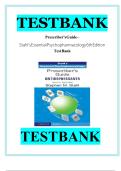
STAHL'S ESSENTIAL PSYCHOPHARMACOLOGY
NEUROSCIENTIFIC BASIS AND PRACTICAL
APPLICATIONS
5TH EDITION
AUTHOR(S)STEPHEN M. STAHL
TEST BANK
1
Reference
Ch. 1 — Chemical Neurotransmission — Synaptic release &
vesicular storage
Stem
A 56-year-old woman with recurrent major depressive disorder
has partial response to an SSRI (persistent anergia and cognitive
slowing). She reports orthostatic lightheadedness on dose
increases and takes an antihypertensive that may lower blood
pressure. You consider a strategy to boost synaptic monoamine
availability while minimizing further orthostatic risk. Which
pharmacologic approach best aligns with presynaptic vesicular
and reuptake mechanisms discussed by Stahl?
,Options
A. Switch to a tricyclic antidepressant (TCA) with strong
norepinephrine reuptake inhibition.
B. Add a reversible MAO-A inhibitor to increase cytosolic and
synaptic monoamines.
C. Augment with a norepinephrine–dopamine reuptake
inhibitor (NDRI) to increase synaptic catecholamines without
anticholinergic/alpha-blockade.
D. Increase the SSRI dose to more fully block serotonin
reuptake.
Correct answer
C
Rationale — Correct (C)
NDRIs increase synaptic NE and DA by blocking their plasma
membrane transporters without causing strong antagonism at
α1-adrenergic or muscarinic receptors that produce orthostasis
or anticholinergic effects. Stahl’s chapter explains that altering
transporter function changes synaptic neurotransmitter
clearance; selecting an agent that selectively blocks reuptake
preserves vesicular release dynamics while avoiding receptor-
mediated orthostatic hypotension. For a patient with
orthostatic risk, increasing catecholaminergic tone with minimal
α1 blockade is preferable.
Rationale — Incorrect
A. TCAs block NE reuptake but also have strong α1 and
anticholinergic antagonism, increasing orthostatic hypotension
,and anticholinergic burden.
B. MAO-A inhibitors increase cytosolic monoamines broadly
and carry dietary and drug interaction risks; reversible MAO-A
inhibition could raise NE enough to worsen orthostasis and
risks.
D. Increasing SSRI dose targets serotonin transporter saturation
but may not address catecholaminergic deficits causing anergia
and cognitive slowing.
Teaching Point
Choose transporter-selective augmentation to boost
catecholamines while avoiding α1/muscarinic side effects.
Citation
Stahl, S. M. (2021). Essential Psychopharmacology (5th ed.). Ch.
1.
2
Reference
Ch. 1 — Chemical Neurotransmission — Ionotropic vs
metabotropic receptors
Stem
A 28-year-old man with panic disorder has acute severe anxiety
and tremulousness. He was treated previously with a short-
acting benzodiazepine which helped but caused daytime
sedation interfering with his night-shift job. You need a rapid
anxiolytic that minimizes daytime sedation by leveraging
, receptor kinetics. Based on ionotropic versus metabotropic
receptor properties in Stahl, which choice is most appropriate?
Options
A. Use a benzodiazepine with rapid onset and short half-life to
provide fast GABA_A positive allosteric modulation.
B. Start a beta-blocker for acute anxiolysis via adrenergic β-
receptor blockade.
C. Prescribe a buspirone (5-HT1A partial agonist) for immediate
anxiolysis.
D. Begin a low-dose antipsychotic antagonizing D2 receptors to
reduce anxiety.
Correct answer
A
Rationale — Correct (A)
Benzodiazepines modulate the ionotropic GABA_A receptor to
rapidly enhance chloride conductance and neuronal inhibition;
agents with fast onset and short half-lives provide immediate
symptom relief and wear off to limit daytime sedation. Stahl
emphasizes ionotropic receptor mechanisms produce rapid
electrophysiologic effects, making short-acting benzodiazepines
appropriate for acute panic while minimizing daytime
impairment when dosing is timed.
Rationale — Incorrect
B. Beta-blockers reduce peripheral adrenergic symptoms but act
indirectly and are less effective for severe central panic; they
don’t rapidly enhance central inhibitory ionotropic
NEUROSCIENTIFIC BASIS AND PRACTICAL
APPLICATIONS
5TH EDITION
AUTHOR(S)STEPHEN M. STAHL
TEST BANK
1
Reference
Ch. 1 — Chemical Neurotransmission — Synaptic release &
vesicular storage
Stem
A 56-year-old woman with recurrent major depressive disorder
has partial response to an SSRI (persistent anergia and cognitive
slowing). She reports orthostatic lightheadedness on dose
increases and takes an antihypertensive that may lower blood
pressure. You consider a strategy to boost synaptic monoamine
availability while minimizing further orthostatic risk. Which
pharmacologic approach best aligns with presynaptic vesicular
and reuptake mechanisms discussed by Stahl?
,Options
A. Switch to a tricyclic antidepressant (TCA) with strong
norepinephrine reuptake inhibition.
B. Add a reversible MAO-A inhibitor to increase cytosolic and
synaptic monoamines.
C. Augment with a norepinephrine–dopamine reuptake
inhibitor (NDRI) to increase synaptic catecholamines without
anticholinergic/alpha-blockade.
D. Increase the SSRI dose to more fully block serotonin
reuptake.
Correct answer
C
Rationale — Correct (C)
NDRIs increase synaptic NE and DA by blocking their plasma
membrane transporters without causing strong antagonism at
α1-adrenergic or muscarinic receptors that produce orthostasis
or anticholinergic effects. Stahl’s chapter explains that altering
transporter function changes synaptic neurotransmitter
clearance; selecting an agent that selectively blocks reuptake
preserves vesicular release dynamics while avoiding receptor-
mediated orthostatic hypotension. For a patient with
orthostatic risk, increasing catecholaminergic tone with minimal
α1 blockade is preferable.
Rationale — Incorrect
A. TCAs block NE reuptake but also have strong α1 and
anticholinergic antagonism, increasing orthostatic hypotension
,and anticholinergic burden.
B. MAO-A inhibitors increase cytosolic monoamines broadly
and carry dietary and drug interaction risks; reversible MAO-A
inhibition could raise NE enough to worsen orthostasis and
risks.
D. Increasing SSRI dose targets serotonin transporter saturation
but may not address catecholaminergic deficits causing anergia
and cognitive slowing.
Teaching Point
Choose transporter-selective augmentation to boost
catecholamines while avoiding α1/muscarinic side effects.
Citation
Stahl, S. M. (2021). Essential Psychopharmacology (5th ed.). Ch.
1.
2
Reference
Ch. 1 — Chemical Neurotransmission — Ionotropic vs
metabotropic receptors
Stem
A 28-year-old man with panic disorder has acute severe anxiety
and tremulousness. He was treated previously with a short-
acting benzodiazepine which helped but caused daytime
sedation interfering with his night-shift job. You need a rapid
anxiolytic that minimizes daytime sedation by leveraging
, receptor kinetics. Based on ionotropic versus metabotropic
receptor properties in Stahl, which choice is most appropriate?
Options
A. Use a benzodiazepine with rapid onset and short half-life to
provide fast GABA_A positive allosteric modulation.
B. Start a beta-blocker for acute anxiolysis via adrenergic β-
receptor blockade.
C. Prescribe a buspirone (5-HT1A partial agonist) for immediate
anxiolysis.
D. Begin a low-dose antipsychotic antagonizing D2 receptors to
reduce anxiety.
Correct answer
A
Rationale — Correct (A)
Benzodiazepines modulate the ionotropic GABA_A receptor to
rapidly enhance chloride conductance and neuronal inhibition;
agents with fast onset and short half-lives provide immediate
symptom relief and wear off to limit daytime sedation. Stahl
emphasizes ionotropic receptor mechanisms produce rapid
electrophysiologic effects, making short-acting benzodiazepines
appropriate for acute panic while minimizing daytime
impairment when dosing is timed.
Rationale — Incorrect
B. Beta-blockers reduce peripheral adrenergic symptoms but act
indirectly and are less effective for severe central panic; they
don’t rapidly enhance central inhibitory ionotropic