
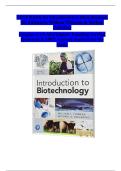
TEST BANK for Introduction to Biotechnology,
4th Edition by William Thieman & Michael
Palladino
Chapter 1-13| All Chapters Entailing Verified
Questions & 100% Correct Answers for the
Study
Gu
ru
40
1
st
ar
, TABLE OF CONTENT
1. The Biotechnology Century and Its Workforce
2. An Introduction to Genes and Genomes
3. Recombinant DNA Technology and Genomics
4. Proteins as Products
5. Microbial Biotechnology
6. Plant Biotechnology
7. Animal Biotechnology
8. DNA Fingerprinting and Forensic Analysis
9. Bioremediation
10. Aquatic Biotechnology
11. Medical Biotechnology
12. Biotechnology Regulations
13. Ethics and Biotechnology
Chapter 1 The Biotechnology Century and Its Workforce
1) Scientists at the biotechnology company Genentech created the first recombinant DNA product for use
in humans. Approved by the Food and Drug Administration in 1982, this product was .
A) a gene chip
B) chymosin
C) insulin
D) human growth hormone
E) erythropoietin Right Answer: C
2) Which area of biotechnology primarily involves using living organisms to process, degrade, and clean
up environmental pollution?
A) Genomics
B) Bioinformatics
Gu
C) Bioremediation
ru
D) Marine biotechnology
40
E) Agricultural biotechnology Right Answer: C
1 st
ar
, 3) The use of computer hardware and software to analyze biological data, such as DNA sequence
comparison data, is known as .
A) genomics
B) bioinformatics
C) bioremediation
D) nanotechnology
E) recombinant DNA technology Right Answer: B
4) Studying the entire complement of DNA in an organism's cells is known as .
A) genomics
B) bioinformatics
C) bioremediation
D) nanotechnology
E) recombinant DNA technology Right Answer: A
5) Combining DNA from different sources is an example of .
A) genomics
B) bioinformatics
C) bioremediation
D) nanotechnology
E) recombinant DNA technology
Right Answer: E
6) is customized medicine based on a person's genetics.
A) Genomics
B) Bioinformatics
C) Bioremediation
Gu
D) Pharmacogenomics
E) Recombinant DNA technology Right Answer: D
ru
40
7) involves farm-raising finfish, shellfish, algae, and other aquatic organisms.
1 st
ar
, A) Biopharming
B) Aquaculture
C) Pharmacogenomics
D) Bioremediation
E) Transgenic technology Right Answer: B
8) is the use of genes for treating human genetic disorders.
A) Genetics
B) Genomics
C) Pharmacogenomics
D) Gene therapy
E) Recombinant DNA technology Right Answer: D
9) Selective breeding involves .
A) genetic engineering of animals and plants to improve growth characteristics
B) mating organisms with desirable characteristics
C) the use of fermentation to produce biotechnology products
D) combining sperm and egg cells from different species to produce hybrid organisms
E) None of these choices Right Answer: B
10) is the use of living organisms or their products to clean up the environment, improve human health,
and provide more nutritious and disease-free food.
A) Bioremediation
B) Biotechnology
C) Genetic engineering
D) Biodegradation
E) Bioprocessing Right Answer: B
Gu
11) Subtle differences in DNA sequences that vary from person to person are called .
A) genomics
ru
B) chromosomes
40
C) DNA microarrays
1 st
ar
4th Edition by William Thieman & Michael
Palladino
Chapter 1-13| All Chapters Entailing Verified
Questions & 100% Correct Answers for the
Study
Gu
ru
40
1
st
ar
, TABLE OF CONTENT
1. The Biotechnology Century and Its Workforce
2. An Introduction to Genes and Genomes
3. Recombinant DNA Technology and Genomics
4. Proteins as Products
5. Microbial Biotechnology
6. Plant Biotechnology
7. Animal Biotechnology
8. DNA Fingerprinting and Forensic Analysis
9. Bioremediation
10. Aquatic Biotechnology
11. Medical Biotechnology
12. Biotechnology Regulations
13. Ethics and Biotechnology
Chapter 1 The Biotechnology Century and Its Workforce
1) Scientists at the biotechnology company Genentech created the first recombinant DNA product for use
in humans. Approved by the Food and Drug Administration in 1982, this product was .
A) a gene chip
B) chymosin
C) insulin
D) human growth hormone
E) erythropoietin Right Answer: C
2) Which area of biotechnology primarily involves using living organisms to process, degrade, and clean
up environmental pollution?
A) Genomics
B) Bioinformatics
Gu
C) Bioremediation
ru
D) Marine biotechnology
40
E) Agricultural biotechnology Right Answer: C
1 st
ar
, 3) The use of computer hardware and software to analyze biological data, such as DNA sequence
comparison data, is known as .
A) genomics
B) bioinformatics
C) bioremediation
D) nanotechnology
E) recombinant DNA technology Right Answer: B
4) Studying the entire complement of DNA in an organism's cells is known as .
A) genomics
B) bioinformatics
C) bioremediation
D) nanotechnology
E) recombinant DNA technology Right Answer: A
5) Combining DNA from different sources is an example of .
A) genomics
B) bioinformatics
C) bioremediation
D) nanotechnology
E) recombinant DNA technology
Right Answer: E
6) is customized medicine based on a person's genetics.
A) Genomics
B) Bioinformatics
C) Bioremediation
Gu
D) Pharmacogenomics
E) Recombinant DNA technology Right Answer: D
ru
40
7) involves farm-raising finfish, shellfish, algae, and other aquatic organisms.
1 st
ar
, A) Biopharming
B) Aquaculture
C) Pharmacogenomics
D) Bioremediation
E) Transgenic technology Right Answer: B
8) is the use of genes for treating human genetic disorders.
A) Genetics
B) Genomics
C) Pharmacogenomics
D) Gene therapy
E) Recombinant DNA technology Right Answer: D
9) Selective breeding involves .
A) genetic engineering of animals and plants to improve growth characteristics
B) mating organisms with desirable characteristics
C) the use of fermentation to produce biotechnology products
D) combining sperm and egg cells from different species to produce hybrid organisms
E) None of these choices Right Answer: B
10) is the use of living organisms or their products to clean up the environment, improve human health,
and provide more nutritious and disease-free food.
A) Bioremediation
B) Biotechnology
C) Genetic engineering
D) Biodegradation
E) Bioprocessing Right Answer: B
Gu
11) Subtle differences in DNA sequences that vary from person to person are called .
A) genomics
ru
B) chromosomes
40
C) DNA microarrays
1 st
ar



