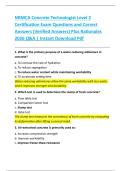
NRMCA Concrete Technologist Level 2
Certification Exam Questions and Correct
Answers (Verified Answers) Plus Rationales
2026 Q&A | Instant Download Pdf
1. What is the primary purpose of a water-reducing admixture in
concrete?
a. To increase the rate of hydration
b. To reduce segregation
c. To reduce water content while maintaining workability
d. To accelerate setting time
Water-reducing admixtures allow the same workability with less water,
which improves strength and durability.
2. Which test is used to determine the slump of fresh concrete?
a. Flow table test
b. Compaction factor test
c. Slump test
d. Vebe test
The slump test measures the consistency of fresh concrete by evaluating
its deformation after lifting a conical mold.
3. Air-entrained concrete is primarily used to:
a. Increase compressive strength
b. Improve workability
c. Improve freeze-thaw resistance
,d. Reduce cement content
Entrained air forms small bubbles that relieve internal stress from
freezing water, preventing cracking.
4. The nominal maximum size of aggregate is defined as:
a. 10% passing sieve
b. Largest sieve through which all the aggregate passes
c. 50% passing sieve
d. Mean size of aggregates
Nominal maximum size refers to the smallest sieve that all the
aggregate passes, controlling concrete workability and aggregate
gradation.
5. Which of the following is true about high-range water reducers
(superplasticizers)?
a. They reduce set time
b. They can significantly increase workability without additional water
c. They decrease compressive strength
d. They are not compatible with air-entraining agents
Superplasticizers allow concrete to be highly workable for extended
periods without increasing water content.
6. Which ASTM standard covers the compressive strength of
cylindrical concrete specimens?
a. ASTM C143
b. ASTM C231
c. ASTM C39
d. ASTM C172
, ASTM C39 specifies procedures for testing concrete cylinders to
determine compressive strength.
7. Proper curing of concrete is essential because it:
a. Reduces segregation
b. Maintains adequate moisture and temperature to allow hydration
c. Accelerates drying
d. Increases air content
Curing ensures hydration continues, which improves strength and
durability.
8. What effect does increasing the water-cement ratio have on
concrete strength?
a. Increases strength
b. Decreases strength
c. No effect
d. Only affects workability
Higher water content increases porosity, reducing the compressive
strength of hardened concrete.
9. Which type of cement is commonly used for structures exposed to
sulfate soils?
a. Type I
b. Type II
c. Type V
d. Type III
Type V cement is specifically formulated to resist high sulfate attack,
preventing deterioration.
Certification Exam Questions and Correct
Answers (Verified Answers) Plus Rationales
2026 Q&A | Instant Download Pdf
1. What is the primary purpose of a water-reducing admixture in
concrete?
a. To increase the rate of hydration
b. To reduce segregation
c. To reduce water content while maintaining workability
d. To accelerate setting time
Water-reducing admixtures allow the same workability with less water,
which improves strength and durability.
2. Which test is used to determine the slump of fresh concrete?
a. Flow table test
b. Compaction factor test
c. Slump test
d. Vebe test
The slump test measures the consistency of fresh concrete by evaluating
its deformation after lifting a conical mold.
3. Air-entrained concrete is primarily used to:
a. Increase compressive strength
b. Improve workability
c. Improve freeze-thaw resistance
,d. Reduce cement content
Entrained air forms small bubbles that relieve internal stress from
freezing water, preventing cracking.
4. The nominal maximum size of aggregate is defined as:
a. 10% passing sieve
b. Largest sieve through which all the aggregate passes
c. 50% passing sieve
d. Mean size of aggregates
Nominal maximum size refers to the smallest sieve that all the
aggregate passes, controlling concrete workability and aggregate
gradation.
5. Which of the following is true about high-range water reducers
(superplasticizers)?
a. They reduce set time
b. They can significantly increase workability without additional water
c. They decrease compressive strength
d. They are not compatible with air-entraining agents
Superplasticizers allow concrete to be highly workable for extended
periods without increasing water content.
6. Which ASTM standard covers the compressive strength of
cylindrical concrete specimens?
a. ASTM C143
b. ASTM C231
c. ASTM C39
d. ASTM C172
, ASTM C39 specifies procedures for testing concrete cylinders to
determine compressive strength.
7. Proper curing of concrete is essential because it:
a. Reduces segregation
b. Maintains adequate moisture and temperature to allow hydration
c. Accelerates drying
d. Increases air content
Curing ensures hydration continues, which improves strength and
durability.
8. What effect does increasing the water-cement ratio have on
concrete strength?
a. Increases strength
b. Decreases strength
c. No effect
d. Only affects workability
Higher water content increases porosity, reducing the compressive
strength of hardened concrete.
9. Which type of cement is commonly used for structures exposed to
sulfate soils?
a. Type I
b. Type II
c. Type V
d. Type III
Type V cement is specifically formulated to resist high sulfate attack,
preventing deterioration.