

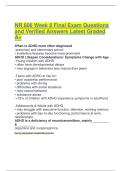
NR 606 Week 8 Final Exam Questions
and Verified Answers Latest Graded
A+
When is ADHD most often diagnosed
-preschool and elementary school
• inattentive features become more prominent
ADHD Lifespan Considerations: Symptoms Change with Age
-Young children with ADHD
• often have developmental delays
• may engage in behaviors less mature than peers
-Teens with ADHD at risk for:
• poor academic performance
• problems with driving
• difficulties with social situations
• risky sexual behavior
• substance abuse
->75% of children with ADHD experience symptoms in adulthood
-Adolescents & Adults with ADHD
• may struggle with executive function, attention, working memory
• problems with day-to-day functioning, performance at work,
relationships
ADHD is a deficiency of neurotransmitters, mainly _________
& _________
dopamine and norepinephrine
,ADHD diagnostic criteria
-A pattern of at least six symptoms of inattention and/or
hyperactivity-impulsivity that interfere with functioning or
development.
-Symptoms persist for six months or longer.
-Symptoms interfere with social, academic, or occupational
functioning.
-Symptoms are present in two or more settings
• for instance, home & school
Kelsey is a 7-year-old first-grader who is the youngest of four
children. During parent-teacher conferences, her teacher
reported that she is polite, respectful, and gets along well
with her peers. She has a hard time keeping her desk neat
and she frequently misplaces her supplies and loses library
books. She must often be told more than once to complete
instructions. Her work is appropriate for her grade level, but
she often makes careless mistakes on her assignments. She
struggles with math and avoids doing arithmetic
assignments. Her parents endorse that Kelsey's room is
"sloppy" but do not notice any of the other concerns in the
home environment.
What is the most likely diagnosis for Kelsey?
ADHD predominantly inattentive presentation
ADHD predominantly hyperactive-impulsive
ADHD combined presentation
unlikely ADHD diagnosis
ADHD predominantly inattentive presentation
Rationale: Kelsey meets diagnostic criteria for ADHD with a
predominantly inattentive presentation. Inattentive symptoms
,include lack of attention to detail, making careless mistakes,
difficulty listening and following instructions, frequent
disorganization and misplacing items, distractibility, avoiding tasks
that require sustained mental effort, and forgetfulness. Although
Kelsey's parents identify only one symptom in the home setting,
she exhibits multiple symptoms in the school setting.
Logan is a 6-year-old kindergartener who has a newborn
sister. His parents are concerned that Logan seems to be
unable to occupy himself quietly when his sister is napping.
Logan interrupts both his parents and other adults in the
home who come to visit his sister. He gets impatient when
his questions are ignored by adults. His parents endorse that
the behaviors began about the same time as his mom's
pregnancy was announced. Logan's teacher does not
endorse the same behaviors at school; his teacher states he
is quiet, reserved, and plays well with others.
What is the most likely diagnosis for Logan?
ADHD predominantly inattentive presentation
ADHD predominantly hyperactive-impulsive presentation
ADHD combined presentation
unlikely ADHD diagnosis
unlikely ADHD diagnosis
Rationale: Although Logan has some symptoms that are
consistent with a diagnosis of ADHD, the symptom onset
coincides with his mother's pregnancy. There are no concerns of
symptoms at school; more information is needed to assign a
diagnosis of ADHD.
Xander is an 8-year-old second-grader who is the youngest
of two children. His mother notes that he acts as if he has
, "non-stop energy." He pesters and interrupts his older sister
to play when she is reading or doing homework, and he has
little patience for completing his homework. Xander's mom
endorses that his behavior has been consistent for the past
few years. Xander's teacher notes that he fidgets during seat
time, speaks out of turn in class, and runs or skips in the
halls.
What is the most likely diagnosis for Xander?
ADHD predominantly inattentive presentation
ADHD predominantly hyperactive-impulsive presentation
ADHD combined presentation
unlikely ADHD diagnosis
ADHD predominantly hyperactive-impulsive presentation
Rationale: Xander meets diagnostic criteria for ADHD with a
hyperactive-impulsive presentation, including fidgeting, "non-stop"
energy, difficulty in engaging in quiet activities, speaking out of
turn, excessive running, and interrupting others. The behaviors
occur in school and at home and have been present consistently
for several years.
Belle is a 10-year-old fourth-grader who is the oldest of two
children. During parent-teacher conferences, her teachers
expressed concerns that she has difficulty listening and
paying attention in class. She plays with her pencil and
eraser constantly during lessons and, when she does pay
attention, she blurts out answers to questions without
waiting to be called upon. She talks to her peers during class
and often interrupts the teacher to share with the class. Belle
often forgets to bring her backpack or lunch to school and
often leaves school without her jacket. Belle's mother notes
and Verified Answers Latest Graded
A+
When is ADHD most often diagnosed
-preschool and elementary school
• inattentive features become more prominent
ADHD Lifespan Considerations: Symptoms Change with Age
-Young children with ADHD
• often have developmental delays
• may engage in behaviors less mature than peers
-Teens with ADHD at risk for:
• poor academic performance
• problems with driving
• difficulties with social situations
• risky sexual behavior
• substance abuse
->75% of children with ADHD experience symptoms in adulthood
-Adolescents & Adults with ADHD
• may struggle with executive function, attention, working memory
• problems with day-to-day functioning, performance at work,
relationships
ADHD is a deficiency of neurotransmitters, mainly _________
& _________
dopamine and norepinephrine
,ADHD diagnostic criteria
-A pattern of at least six symptoms of inattention and/or
hyperactivity-impulsivity that interfere with functioning or
development.
-Symptoms persist for six months or longer.
-Symptoms interfere with social, academic, or occupational
functioning.
-Symptoms are present in two or more settings
• for instance, home & school
Kelsey is a 7-year-old first-grader who is the youngest of four
children. During parent-teacher conferences, her teacher
reported that she is polite, respectful, and gets along well
with her peers. She has a hard time keeping her desk neat
and she frequently misplaces her supplies and loses library
books. She must often be told more than once to complete
instructions. Her work is appropriate for her grade level, but
she often makes careless mistakes on her assignments. She
struggles with math and avoids doing arithmetic
assignments. Her parents endorse that Kelsey's room is
"sloppy" but do not notice any of the other concerns in the
home environment.
What is the most likely diagnosis for Kelsey?
ADHD predominantly inattentive presentation
ADHD predominantly hyperactive-impulsive
ADHD combined presentation
unlikely ADHD diagnosis
ADHD predominantly inattentive presentation
Rationale: Kelsey meets diagnostic criteria for ADHD with a
predominantly inattentive presentation. Inattentive symptoms
,include lack of attention to detail, making careless mistakes,
difficulty listening and following instructions, frequent
disorganization and misplacing items, distractibility, avoiding tasks
that require sustained mental effort, and forgetfulness. Although
Kelsey's parents identify only one symptom in the home setting,
she exhibits multiple symptoms in the school setting.
Logan is a 6-year-old kindergartener who has a newborn
sister. His parents are concerned that Logan seems to be
unable to occupy himself quietly when his sister is napping.
Logan interrupts both his parents and other adults in the
home who come to visit his sister. He gets impatient when
his questions are ignored by adults. His parents endorse that
the behaviors began about the same time as his mom's
pregnancy was announced. Logan's teacher does not
endorse the same behaviors at school; his teacher states he
is quiet, reserved, and plays well with others.
What is the most likely diagnosis for Logan?
ADHD predominantly inattentive presentation
ADHD predominantly hyperactive-impulsive presentation
ADHD combined presentation
unlikely ADHD diagnosis
unlikely ADHD diagnosis
Rationale: Although Logan has some symptoms that are
consistent with a diagnosis of ADHD, the symptom onset
coincides with his mother's pregnancy. There are no concerns of
symptoms at school; more information is needed to assign a
diagnosis of ADHD.
Xander is an 8-year-old second-grader who is the youngest
of two children. His mother notes that he acts as if he has
, "non-stop energy." He pesters and interrupts his older sister
to play when she is reading or doing homework, and he has
little patience for completing his homework. Xander's mom
endorses that his behavior has been consistent for the past
few years. Xander's teacher notes that he fidgets during seat
time, speaks out of turn in class, and runs or skips in the
halls.
What is the most likely diagnosis for Xander?
ADHD predominantly inattentive presentation
ADHD predominantly hyperactive-impulsive presentation
ADHD combined presentation
unlikely ADHD diagnosis
ADHD predominantly hyperactive-impulsive presentation
Rationale: Xander meets diagnostic criteria for ADHD with a
hyperactive-impulsive presentation, including fidgeting, "non-stop"
energy, difficulty in engaging in quiet activities, speaking out of
turn, excessive running, and interrupting others. The behaviors
occur in school and at home and have been present consistently
for several years.
Belle is a 10-year-old fourth-grader who is the oldest of two
children. During parent-teacher conferences, her teachers
expressed concerns that she has difficulty listening and
paying attention in class. She plays with her pencil and
eraser constantly during lessons and, when she does pay
attention, she blurts out answers to questions without
waiting to be called upon. She talks to her peers during class
and often interrupts the teacher to share with the class. Belle
often forgets to bring her backpack or lunch to school and
often leaves school without her jacket. Belle's mother notes


