HC4 Sleep
More than 80% of students wake up feeling tired and unrefreshed
General population: about 25%
Sleep
A “lack of waking”? (Aristotle)
Naturally recurring state of mind and body, in which:
o The senser are inhibited
o Muscles are relaxed
o Heart rate, blood pressure, and body temperature decrease
o Metabolism slows down
o There is no consciousness... but the brain is active
o Biological need
Sleep cycle
There are five stages of sleep
We can measure them using
EEG of EOG
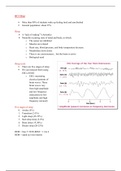
o EEG: measuring
electrical patterns of
brain waves. These
brain waves vary
from high amplitude
and low frequency
(relaxation) to low
amplitude and high
frequency (arousal)
Five stages of sleep
0. Awake (5%)
1. Transition (2-5%)
2. Light sleep (45-55%)
3. Start deep sleep (3-8%)
4. Deep sleep (15-20%)
5. Dream sleep (20-25%)
REM = fase 5. NON-REM = 1 t/m 4
REM = rapid eye movements
, Stage 0:
You feel drowsy
You yawn, our eyes are closing
Alpha waves
Stage 1: transition
Transition from being awake to being asleep
Your consciousness drifts away
Your heartbeat slows down
Your breathing slows down
Alfa-waves with occasional theta waves
Stage 2:
Light sleep
Your temperature drops
Your breathing slows down
Your heartrate slows down
Your muscles relax
Theta waves + beginning of
delta waves
Sleep spindles: short burst of
neural oscillation
K-complex; largest event in
healthy human EEG
Two functions:
o Suppressing cortical
arousal in response to external stimuli. Imagine you’re asleep and there are some
kind of external stimuli (a noise), that causes activation in the cortex. These two
phenomena help to decrease or suppress that arousal.
o Aiding sleep-based memory consolidation.
More than 80% of students wake up feeling tired and unrefreshed
General population: about 25%
Sleep
A “lack of waking”? (Aristotle)
Naturally recurring state of mind and body, in which:
o The senser are inhibited
o Muscles are relaxed
o Heart rate, blood pressure, and body temperature decrease
o Metabolism slows down
o There is no consciousness... but the brain is active
o Biological need
Sleep cycle
There are five stages of sleep
We can measure them using
EEG of EOG
o EEG: measuring
electrical patterns of
brain waves. These
brain waves vary
from high amplitude
and low frequency
(relaxation) to low
amplitude and high
frequency (arousal)
Five stages of sleep
0. Awake (5%)
1. Transition (2-5%)
2. Light sleep (45-55%)
3. Start deep sleep (3-8%)
4. Deep sleep (15-20%)
5. Dream sleep (20-25%)
REM = fase 5. NON-REM = 1 t/m 4
REM = rapid eye movements
, Stage 0:
You feel drowsy
You yawn, our eyes are closing
Alpha waves
Stage 1: transition
Transition from being awake to being asleep
Your consciousness drifts away
Your heartbeat slows down
Your breathing slows down
Alfa-waves with occasional theta waves
Stage 2:
Light sleep
Your temperature drops
Your breathing slows down
Your heartrate slows down
Your muscles relax
Theta waves + beginning of
delta waves
Sleep spindles: short burst of
neural oscillation
K-complex; largest event in
healthy human EEG
Two functions:
o Suppressing cortical
arousal in response to external stimuli. Imagine you’re asleep and there are some
kind of external stimuli (a noise), that causes activation in the cortex. These two
phenomena help to decrease or suppress that arousal.
o Aiding sleep-based memory consolidation.