

Exam #3: Topics 13 - 17
Topic 13: Redox Reactions
Video A: Oxidation and Reduction
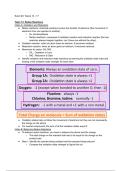
● Redox reactions: chemical reactions involve the transfer of electrons (the movement of
electrons from one species to another)
○ Ex: photosynthesis
○ Redox reactions: composed of oxidation reaction and reduction reaction (the two
reactions always happen together, can’t have one without the other)
● Oxidation reaction: when an atom loses an electron, it becomes oxidized
● Reduction reaction: when an atom gains an electron, it becomes reduced
● Mnemonic for redox: OIL RIG
○ OIL : Oxidation Is Loss
○ RIG : Reduction Is Gain
● Identify oxidation and reduction state reactions by learning the oxidation state rules and
looking at the oxidation state changes for each atom
● Oxidation states help us follow the movement of electrons but they are not necessarily
the charge on the atoms
● For neutral compounds, the sum of all the oxidation states equal 0
Video B: Balancing Redox Reactions
● To balance redox reactions, you have to balance the atoms and the charge
○ The total charge on the reactant side has to be equal to the charge on the
product side
● Step 1: identify the species being oxidized and the species being reduced
○ Compare the oxidation state changes to figure this out
, ● Step 2: Identify and count the number of electrons transferred
● Step 3: balance the number of electrons being transferred
● Step 4: write the coefficient in the reaction
● Step 5: balance the rest of the equation using mass conservation
○ Note: you don’t need to change the coefficient of the species you balanced
through the charge
● Step 6: Check that the mass and charge are balanced appropriately
Video C: Standard Potential (E°)
● The standard potential of a redox reaction is a direct measure of the amount of work (J)
the reaction can do
○ Standard potential: the potential when the reaction is run at standard conditions
○ Standard potential is a voltage (unit is V) and each redox reaction has a specific
voltage
○ Standard potentials are tabulated (like H, S, G)
■ Note: the table lists only reduction potentials and to find oxidation
potentials, you have to reverse the sign in the table
● E° rxn = E° ox + E° red
○ The standard potential of the reaction is the sum of the standard potentials for
each half reaction (oxidation + reduction)
● The number of electrons released during the oxidation half reaction must be equal to the
number of electrons that are consumed by the reduction half reaction (electrons in the
two half-reactions must be balanced)
● E° rxn does not depend on the balanced chemical equation. The voltage produced is
independent of the number of electrons transferred
○ when we multiply the coefficients for the half reactions to balance out the
equation, we do not multiple the corresponding standard potentials
● SUMMARY FOR CALCULATING STANDARD POTENTIAL:
○ Step 1: break the reaction into the two half reactions (oxidation and reduction)
○ Step 2: look at the table of reduction potentials and find the E° for each half
reaction
■ Remember to change the sign of the value given to find the E° for the
oxidation reaction
○ Step 3: calculate the E° rxn by adding the E° values for each half reaction
■ Remember: reaction stoichiometry does not affect E° so you do not need
to multiply the value by the coefficients
○ Step 4 (optional): balance the charge transfer to check if you have a balanced
redox equation, good check for accuracy but has no overall effect on the E° rxn
Video D: Predicting Spontaneity
● The sign of the standard potential (E°) can be used to predict the direction of spontaneity
, ●
● Electrical work: W = charge x voltage
○ Charge = -nF
■ Faraday constant (F): represents the charge in Coulombs for one mole of
electrons
■ The negative sign indicates the negative charge of an electron
○ Voltage = E
○ Thus, the equation is rewritten as ΔG = (-nF)(E)
■ n = number of moles transferred
■ F = faraday’s constant, value = 96,486 Coulombs
● Under standard conditions, ΔG° = (-nF)(E°)
● Note: general ΔG° cannot be used to indicate spontaneity (we will use E° to predict
spontaneity) but for the purposes of this course, ΔG° and ΔG will always have the same
sign
● When a reaction is at equilibrium, it can do no work
Video E: Oxidizing and Reducing Agents
, ● Reducing agent: the species that gives up its electron and is oxidized (E is the oxidation
potential which means you have to reverse the sign of the value from the table)
● Oxidizing agent: the species that accepts electrons and is reduced (E is the reduction
potential found from the table)
● We can also use E° to predict the relative strengths of oxidizing and reducing agents
● A positive potential is always more favorable
● The most positive oxidation potential will be the most negative reduction potential
● The most positive reduction potential will be the most positive reduction potential
Topic 14: Batteries
Video A: Galvanic Cells
● Electrochemistry: study of redox reactions and how these reaction use transfer of
electrons to produce work such as a battery.
● The chemical reactions inside a battery must have a negative free energy
(nonspontaneous chemical reaction) to do work.
● Free energy of a redox reaction can act as a force to move electrons over a distance if
we separate the oxidizing and reducing agents.
Creating a Galvanic Cell
● Concept: Electrons flow from the anode (oxidation) to the cathode (reduction)
Anode:
The electrode called the anode is where oxidation occurs. Oxidation is when the electrons of the
metal are lost and the anode has an overall negative charge. The mass of the anode decreases
as the reaction proceeds.
Cathode:
The electrode called the cathode is where reduction occurs. Reduction is when the electrons of
the metal are gained from the anode and reduces the ions to the metal and the cathode has an
overall positive charge. The mass of the cathode increases as the reaction proceeds.
● The agent is on the reactant side of the half-reaction equation. The reducing agent
oxidized and the oxidizing agent gets reduced.
● Galvanic cells are written using a very succinct line notation that reflects all this
information into one line.
Cu| Cu (1 M)|| Ag+ (1 M)| Ag
2+
Reactant| - || - | Product
The copper electrode that is on the far left side is the anode.
The silver electrode that is on the far right side is the cathode.
● We can determine the reactants and the products of the oxidation and the reduction
reaction as long as the electrode is the reacting species.
Salt Bridge:
● The salt bridge maintains the charge balance. The cathode can be either left or right and
can be only determined by the species.
Topic 13: Redox Reactions
Video A: Oxidation and Reduction
● Redox reactions: chemical reactions involve the transfer of electrons (the movement of
electrons from one species to another)
○ Ex: photosynthesis
○ Redox reactions: composed of oxidation reaction and reduction reaction (the two
reactions always happen together, can’t have one without the other)
● Oxidation reaction: when an atom loses an electron, it becomes oxidized
● Reduction reaction: when an atom gains an electron, it becomes reduced
● Mnemonic for redox: OIL RIG
○ OIL : Oxidation Is Loss
○ RIG : Reduction Is Gain
● Identify oxidation and reduction state reactions by learning the oxidation state rules and
looking at the oxidation state changes for each atom
● Oxidation states help us follow the movement of electrons but they are not necessarily
the charge on the atoms
● For neutral compounds, the sum of all the oxidation states equal 0
Video B: Balancing Redox Reactions
● To balance redox reactions, you have to balance the atoms and the charge
○ The total charge on the reactant side has to be equal to the charge on the
product side
● Step 1: identify the species being oxidized and the species being reduced
○ Compare the oxidation state changes to figure this out
, ● Step 2: Identify and count the number of electrons transferred
● Step 3: balance the number of electrons being transferred
● Step 4: write the coefficient in the reaction
● Step 5: balance the rest of the equation using mass conservation
○ Note: you don’t need to change the coefficient of the species you balanced
through the charge
● Step 6: Check that the mass and charge are balanced appropriately
Video C: Standard Potential (E°)
● The standard potential of a redox reaction is a direct measure of the amount of work (J)
the reaction can do
○ Standard potential: the potential when the reaction is run at standard conditions
○ Standard potential is a voltage (unit is V) and each redox reaction has a specific
voltage
○ Standard potentials are tabulated (like H, S, G)
■ Note: the table lists only reduction potentials and to find oxidation
potentials, you have to reverse the sign in the table
● E° rxn = E° ox + E° red
○ The standard potential of the reaction is the sum of the standard potentials for
each half reaction (oxidation + reduction)
● The number of electrons released during the oxidation half reaction must be equal to the
number of electrons that are consumed by the reduction half reaction (electrons in the
two half-reactions must be balanced)
● E° rxn does not depend on the balanced chemical equation. The voltage produced is
independent of the number of electrons transferred
○ when we multiply the coefficients for the half reactions to balance out the
equation, we do not multiple the corresponding standard potentials
● SUMMARY FOR CALCULATING STANDARD POTENTIAL:
○ Step 1: break the reaction into the two half reactions (oxidation and reduction)
○ Step 2: look at the table of reduction potentials and find the E° for each half
reaction
■ Remember to change the sign of the value given to find the E° for the
oxidation reaction
○ Step 3: calculate the E° rxn by adding the E° values for each half reaction
■ Remember: reaction stoichiometry does not affect E° so you do not need
to multiply the value by the coefficients
○ Step 4 (optional): balance the charge transfer to check if you have a balanced
redox equation, good check for accuracy but has no overall effect on the E° rxn
Video D: Predicting Spontaneity
● The sign of the standard potential (E°) can be used to predict the direction of spontaneity
, ●
● Electrical work: W = charge x voltage
○ Charge = -nF
■ Faraday constant (F): represents the charge in Coulombs for one mole of
electrons
■ The negative sign indicates the negative charge of an electron
○ Voltage = E
○ Thus, the equation is rewritten as ΔG = (-nF)(E)
■ n = number of moles transferred
■ F = faraday’s constant, value = 96,486 Coulombs
● Under standard conditions, ΔG° = (-nF)(E°)
● Note: general ΔG° cannot be used to indicate spontaneity (we will use E° to predict
spontaneity) but for the purposes of this course, ΔG° and ΔG will always have the same
sign
● When a reaction is at equilibrium, it can do no work
Video E: Oxidizing and Reducing Agents
, ● Reducing agent: the species that gives up its electron and is oxidized (E is the oxidation
potential which means you have to reverse the sign of the value from the table)
● Oxidizing agent: the species that accepts electrons and is reduced (E is the reduction
potential found from the table)
● We can also use E° to predict the relative strengths of oxidizing and reducing agents
● A positive potential is always more favorable
● The most positive oxidation potential will be the most negative reduction potential
● The most positive reduction potential will be the most positive reduction potential
Topic 14: Batteries
Video A: Galvanic Cells
● Electrochemistry: study of redox reactions and how these reaction use transfer of
electrons to produce work such as a battery.
● The chemical reactions inside a battery must have a negative free energy
(nonspontaneous chemical reaction) to do work.
● Free energy of a redox reaction can act as a force to move electrons over a distance if
we separate the oxidizing and reducing agents.
Creating a Galvanic Cell
● Concept: Electrons flow from the anode (oxidation) to the cathode (reduction)
Anode:
The electrode called the anode is where oxidation occurs. Oxidation is when the electrons of the
metal are lost and the anode has an overall negative charge. The mass of the anode decreases
as the reaction proceeds.
Cathode:
The electrode called the cathode is where reduction occurs. Reduction is when the electrons of
the metal are gained from the anode and reduces the ions to the metal and the cathode has an
overall positive charge. The mass of the cathode increases as the reaction proceeds.
● The agent is on the reactant side of the half-reaction equation. The reducing agent
oxidized and the oxidizing agent gets reduced.
● Galvanic cells are written using a very succinct line notation that reflects all this
information into one line.
Cu| Cu (1 M)|| Ag+ (1 M)| Ag
2+
Reactant| - || - | Product
The copper electrode that is on the far left side is the anode.
The silver electrode that is on the far right side is the cathode.
● We can determine the reactants and the products of the oxidation and the reduction
reaction as long as the electrode is the reacting species.
Salt Bridge:
● The salt bridge maintains the charge balance. The cathode can be either left or right and
can be only determined by the species.


