

ELECTRONIC CONFIGURATION
Since we have learnt that electrons are arranged in electron shells (also known as energy levels - the nearer to
the nucleus the lower the energy level which means it has more stability), we must also know that those
shells have sub-shells (sub-levels) which is have electron orbitals (approximate location of the electron).
Eg. electronic configuration of sodium
2 2 6 1
Na = 1𝑠 2𝑠 2𝑝 3𝑠
- The numbers represent the energy level (shell)
- The s/p represent the orbital shape within the shell (sub-shell)
- The exponents represent the number of electrons in the atom.
HUND’S Law
Electrons will fill low energy orbitals first before filling ones with higher energy levels unless there is a choice
between orbitals of equal energy (such as 2p, 3p, 3d etc) then they fill the orbitals individually as much as
possible before pairing up (each electron will try and fill a box individually first before pairing up to fill the
shell).
AUFBAU’S PRINCIPLE
When writing an electronic configuration, the electronic structure of the next atom can be determined by
fitting an extra electron into the next available orbital.
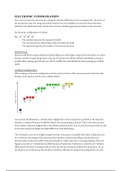
As seen from the illustration, s orbitals always slightly have a lower energy than p orbitals at the same level
therefore s orbitals will always be filled first before the corresponding p orbitals. This is why when an atom
has a number of electrons higher than 4, the orbitals transition from s to p, at each level, because they are still
at the same energy level despite the slight difference in sub-shell energy.
The 3d orbital is seen to be of higher energy level than 4s because it is unstable when there is little electrons
in it. However, this changes when electrons (from transition metals) starts filling it because the more
electrons there are the more stable it becomes therefore it ‘sinks’ lower due to its energy shifting. This only
happens once the 4s^2 orbital has been filled because of hund’s law. Furthermore, when the 4s^2 orbital is
filled and the 3d orbital is starting to fill up, when the last box is going to be filled with an electron, one of
the electrons in 4s will take up that last box in 3d which will lower its energy level making 4s the one with
, higher energy. We can see this happen through the electronic configurations of vanadium, chromium and
manganese:
2 2 6 2 6 3 2
V = 1𝑠 2𝑠 2𝑝 3𝑠 3𝑝 3𝑑 4𝑠
2 2 6 2 6 5 1
Cr = 1𝑠 2𝑠 2𝑝 3𝑠 3𝑝 3𝑑 4𝑠 → its 3d^5 and not 3d^4 because the electron in 4s^2 from V has
transferred to 3d as well as the additional electron that follows aufbau’s principle.
2 2 6 2 6 5 2
Mn= 1𝑠 2𝑠 2𝑝 3𝑠 3𝑝 3𝑑 4𝑠
The 3d orbital will only exist for the transition metals as elements from group 3-0 will take p shape orbitals.
Mass spectrometry
For most elements, their mass number (A) and their relative atomic mass (Ar (refers to an average of the
atomic masses of the isotopes of an element, taking into account their relative abundances)) are virtually
identical. However, if an element consist of two or more isotopes that naturally have significant amounts
35 37
then Ar represents the weighted mean of the individual masses (e.g Chlorine - 𝐶 𝑎𝑛𝑑 𝐶 occurs at
relative abundance of 75% and 25%. Therefore, you would calculate the average mass of each isotope to
calculate the 𝐴𝑟.
Therefore in order to find the mass of an isotope, you need the relative abundance* which can be calculated
through mass spectrometry which is a powerful instrumental method of analysis used to find it as well as
the relative molecular mass of substances made of molecules
(e.g 𝐶𝑂2 = 𝑀𝑟 −> 44 𝑏𝑒𝑐𝑎𝑢𝑠𝑒 𝐶 = 12 𝑂2 = 2(8) )
*The relative amount in which each isotope is present in an element is called its isotopic/relative abundance
There are many different types of mass spectrometry but the most common is Time of flight (ToF)which
is basically measuring the time taken for particles of a substance (which are ionised to make a +1 ion)- that
have also been accelerated so that they have the same kinetic energy- to travel a fixed distance which is then
used to find the mass of each ion in the sample.
There are 4 stages:
Stage 1 - IONISATION
Needs to be a positively charged ion. This can be done by electrospray ionisation (ESI) or electron impact
Electron impact: used for elements/substances with low formula mass
1. Element sample(from gaseous structure) is vaporised in a vacuum chamber with low
pressure.
2. High energy electrons fired at it using an ‘electron gun’ (hot wire filament with a current
that emits electrons) to knock off one electron from each particle to form a +1/+2 ion.
−
→ but mostly +1 ions(AKA molecular ions) are formed because it takes more energy to remove 2𝑒
→ ionisation is done so that they are more attracted towards the negatively charged plate where
they are accelerated
Since we have learnt that electrons are arranged in electron shells (also known as energy levels - the nearer to
the nucleus the lower the energy level which means it has more stability), we must also know that those
shells have sub-shells (sub-levels) which is have electron orbitals (approximate location of the electron).
Eg. electronic configuration of sodium
2 2 6 1
Na = 1𝑠 2𝑠 2𝑝 3𝑠
- The numbers represent the energy level (shell)
- The s/p represent the orbital shape within the shell (sub-shell)
- The exponents represent the number of electrons in the atom.
HUND’S Law
Electrons will fill low energy orbitals first before filling ones with higher energy levels unless there is a choice
between orbitals of equal energy (such as 2p, 3p, 3d etc) then they fill the orbitals individually as much as
possible before pairing up (each electron will try and fill a box individually first before pairing up to fill the
shell).
AUFBAU’S PRINCIPLE
When writing an electronic configuration, the electronic structure of the next atom can be determined by
fitting an extra electron into the next available orbital.
As seen from the illustration, s orbitals always slightly have a lower energy than p orbitals at the same level
therefore s orbitals will always be filled first before the corresponding p orbitals. This is why when an atom
has a number of electrons higher than 4, the orbitals transition from s to p, at each level, because they are still
at the same energy level despite the slight difference in sub-shell energy.
The 3d orbital is seen to be of higher energy level than 4s because it is unstable when there is little electrons
in it. However, this changes when electrons (from transition metals) starts filling it because the more
electrons there are the more stable it becomes therefore it ‘sinks’ lower due to its energy shifting. This only
happens once the 4s^2 orbital has been filled because of hund’s law. Furthermore, when the 4s^2 orbital is
filled and the 3d orbital is starting to fill up, when the last box is going to be filled with an electron, one of
the electrons in 4s will take up that last box in 3d which will lower its energy level making 4s the one with
, higher energy. We can see this happen through the electronic configurations of vanadium, chromium and
manganese:
2 2 6 2 6 3 2
V = 1𝑠 2𝑠 2𝑝 3𝑠 3𝑝 3𝑑 4𝑠
2 2 6 2 6 5 1
Cr = 1𝑠 2𝑠 2𝑝 3𝑠 3𝑝 3𝑑 4𝑠 → its 3d^5 and not 3d^4 because the electron in 4s^2 from V has
transferred to 3d as well as the additional electron that follows aufbau’s principle.
2 2 6 2 6 5 2
Mn= 1𝑠 2𝑠 2𝑝 3𝑠 3𝑝 3𝑑 4𝑠
The 3d orbital will only exist for the transition metals as elements from group 3-0 will take p shape orbitals.
Mass spectrometry
For most elements, their mass number (A) and their relative atomic mass (Ar (refers to an average of the
atomic masses of the isotopes of an element, taking into account their relative abundances)) are virtually
identical. However, if an element consist of two or more isotopes that naturally have significant amounts
35 37
then Ar represents the weighted mean of the individual masses (e.g Chlorine - 𝐶 𝑎𝑛𝑑 𝐶 occurs at
relative abundance of 75% and 25%. Therefore, you would calculate the average mass of each isotope to
calculate the 𝐴𝑟.
Therefore in order to find the mass of an isotope, you need the relative abundance* which can be calculated
through mass spectrometry which is a powerful instrumental method of analysis used to find it as well as
the relative molecular mass of substances made of molecules
(e.g 𝐶𝑂2 = 𝑀𝑟 −> 44 𝑏𝑒𝑐𝑎𝑢𝑠𝑒 𝐶 = 12 𝑂2 = 2(8) )
*The relative amount in which each isotope is present in an element is called its isotopic/relative abundance
There are many different types of mass spectrometry but the most common is Time of flight (ToF)which
is basically measuring the time taken for particles of a substance (which are ionised to make a +1 ion)- that
have also been accelerated so that they have the same kinetic energy- to travel a fixed distance which is then
used to find the mass of each ion in the sample.
There are 4 stages:
Stage 1 - IONISATION
Needs to be a positively charged ion. This can be done by electrospray ionisation (ESI) or electron impact
Electron impact: used for elements/substances with low formula mass
1. Element sample(from gaseous structure) is vaporised in a vacuum chamber with low
pressure.
2. High energy electrons fired at it using an ‘electron gun’ (hot wire filament with a current
that emits electrons) to knock off one electron from each particle to form a +1/+2 ion.
−
→ but mostly +1 ions(AKA molecular ions) are formed because it takes more energy to remove 2𝑒
→ ionisation is done so that they are more attracted towards the negatively charged plate where
they are accelerated


