

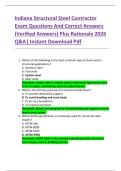
Indiana Structural Steel Contractor
Exam Questions And Correct Answers
(Verified Answers) Plus Rationale 2026
Q&A| Instant Download Pdf
1. Which of the following is the most common type of steel used in
structural applications?
A. Stainless steel
B. Tool steel
C. Carbon steel
D. Alloy steel
Rationale: Carbon steel is widely used in structural applications due
to its strength, availability, and cost-effectiveness.
2. What is the primary purpose of a structural steel beam?
A. To provide decorative support
B. To resist bending and carry loads
C. To act as a foundation
D. To prevent corrosion
Rationale: Beams are designed to resist bending and support vertical
loads across spans.
3. Which ASTM specification is commonly used for structural steel
shapes?
A. ASTM A36
B. ASTM B209
C. ASTM A240
D. ASTM A992
Rationale: ASTM A992 is the standard specification for structural
steel shapes used in building frames.
,4. What is the standard unit of measurement for steel strength in the
U.S.?
A. Pascal (Pa)
B. Pounds per square inch (psi)
C. Newton (N)
D. Kilogram per square meter (kg/m²)
Rationale: Pounds per square inch (psi) is the standard unit for
tensile and yield strength of steel in the U.S.
5. Which connection type allows for slight rotation of steel members
under load?
A. Riveted connection
B. Welded connection
C. Bolted connection
D. None of the above
Rationale: Bolted connections can allow slight rotation, depending
on bolt type and design.
6. What is the minimum yield strength of ASTM A36 steel?
A. 20 ksi
B. 35 ksi
C. 36 ksi
D. 42 ksi
Rationale: ASTM A36 steel has a minimum yield strength of 36,000
psi (36 ksi).
7. In structural steel construction, what does “camber” refer to?
A. Type of bolt used
B. Surface finish of steel
C. Upward curvature of a beam
D. Thickness of the flange
Rationale: Camber is a slight upward curvature introduced in beams
to counteract deflection under load.
8. What is the primary hazard associated with cutting structural steel
with oxy-acetylene torches?
A. Electric shock
B. Noise
C. Fire and burns
, D. Slipping hazards
Rationale: Oxy-acetylene cutting produces high heat and sparks,
presenting fire and burn risks.
9. When welding structural steel, preheating is often required for:
A. Aesthetic purposes
B. Reducing material cost
C. Reducing the risk of cracking
D. Increasing welding speed
Rationale: Preheating reduces the risk of cracking by slowing the
cooling rate and reducing thermal stress.
10. Which type of steel shape is most suitable for columns?
A. Angles
B. Wide-flange (W) shapes
C. Channels
D. Plates
Rationale: Wide-flange beams provide high load-carrying capacity in
compression and bending, ideal for columns.
11. Which fastener is most commonly used in high-strength
structural steel connections?
A. Lag screw
B. A325 or A490 bolt
C. Wood screw
D. Machine screw
Rationale: ASTM A325 and A490 bolts are standard high-strength
bolts for structural steel connections.
12. What is the recommended clearance between bolt hole
diameter and bolt size for a snug-fit bolt?
A. 0.01 inch
B. 1/16 inch
C. 1/8 inch
D. 1/4 inch
Rationale: A 1/16 inch clearance allows for proper alignment while
preventing excessive looseness.
13. What is the main function of a gusset plate?
A. To act as a floor plate
Exam Questions And Correct Answers
(Verified Answers) Plus Rationale 2026
Q&A| Instant Download Pdf
1. Which of the following is the most common type of steel used in
structural applications?
A. Stainless steel
B. Tool steel
C. Carbon steel
D. Alloy steel
Rationale: Carbon steel is widely used in structural applications due
to its strength, availability, and cost-effectiveness.
2. What is the primary purpose of a structural steel beam?
A. To provide decorative support
B. To resist bending and carry loads
C. To act as a foundation
D. To prevent corrosion
Rationale: Beams are designed to resist bending and support vertical
loads across spans.
3. Which ASTM specification is commonly used for structural steel
shapes?
A. ASTM A36
B. ASTM B209
C. ASTM A240
D. ASTM A992
Rationale: ASTM A992 is the standard specification for structural
steel shapes used in building frames.
,4. What is the standard unit of measurement for steel strength in the
U.S.?
A. Pascal (Pa)
B. Pounds per square inch (psi)
C. Newton (N)
D. Kilogram per square meter (kg/m²)
Rationale: Pounds per square inch (psi) is the standard unit for
tensile and yield strength of steel in the U.S.
5. Which connection type allows for slight rotation of steel members
under load?
A. Riveted connection
B. Welded connection
C. Bolted connection
D. None of the above
Rationale: Bolted connections can allow slight rotation, depending
on bolt type and design.
6. What is the minimum yield strength of ASTM A36 steel?
A. 20 ksi
B. 35 ksi
C. 36 ksi
D. 42 ksi
Rationale: ASTM A36 steel has a minimum yield strength of 36,000
psi (36 ksi).
7. In structural steel construction, what does “camber” refer to?
A. Type of bolt used
B. Surface finish of steel
C. Upward curvature of a beam
D. Thickness of the flange
Rationale: Camber is a slight upward curvature introduced in beams
to counteract deflection under load.
8. What is the primary hazard associated with cutting structural steel
with oxy-acetylene torches?
A. Electric shock
B. Noise
C. Fire and burns
, D. Slipping hazards
Rationale: Oxy-acetylene cutting produces high heat and sparks,
presenting fire and burn risks.
9. When welding structural steel, preheating is often required for:
A. Aesthetic purposes
B. Reducing material cost
C. Reducing the risk of cracking
D. Increasing welding speed
Rationale: Preheating reduces the risk of cracking by slowing the
cooling rate and reducing thermal stress.
10. Which type of steel shape is most suitable for columns?
A. Angles
B. Wide-flange (W) shapes
C. Channels
D. Plates
Rationale: Wide-flange beams provide high load-carrying capacity in
compression and bending, ideal for columns.
11. Which fastener is most commonly used in high-strength
structural steel connections?
A. Lag screw
B. A325 or A490 bolt
C. Wood screw
D. Machine screw
Rationale: ASTM A325 and A490 bolts are standard high-strength
bolts for structural steel connections.
12. What is the recommended clearance between bolt hole
diameter and bolt size for a snug-fit bolt?
A. 0.01 inch
B. 1/16 inch
C. 1/8 inch
D. 1/4 inch
Rationale: A 1/16 inch clearance allows for proper alignment while
preventing excessive looseness.
13. What is the main function of a gusset plate?
A. To act as a floor plate


