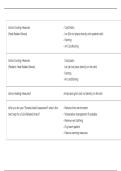
Active Cooling Measures • Cold Packs
(Heat-Related Illness) • Ice (Do not place directly onto patients skin)
• Fanning
• Air Conditioning
Active Cooling Measures · Cold packs
(Pediatric Heat Related Illness) · Ice (do not place directly on the skin)
· Fanning
· Air conditioning
Active Heating Measures? Armpit and groin, but not directly on the skin
After you do your "General Adult Assessment" what is the • Remove from environment
next step for a Cold-Related illness? • Temperature management if available
• Remove wet clothing
• Dry/warm patient
• Passive warming measures
,After your "General Adult Assessment" what is the next step 1. Remove from the environment
for managing a Heat Related Illness? 2. Temperature measurement
3. Remove tight clothing
4. Passive Cooling Measures
Agents · Acetaminophen: Initially normal or N/V. Tachypnea and AMS may
(Pediatric Overdose/Poisoning Protocol) dysfunction, liver failure and/or cerebral edema may manifest.
· Depressants: Decreased HR, BP, temp and RR.
· Anticholinergic: Increased HR, increased temp, dilated pupils and
changes.
· Insecticides: May include S/S of organophosphate poisoning.
· Solvents: N/V, cough, AMS.
· Stimulants: Increased HR, BP, temp, dilated pupils, seizures and po
· TCA: Decreased mental status, dysrhythmias, seizures, hypotensio
APGAR Appearance,
Pulse,
Grimace,
Activity,
Respiration
• Are adult paddles suitable for use on a pediatric patient? Yes, if the patient is >10 kg
,Are EMTs allowed to remove taser darts? Only if it impedes medical care, dart removal is the responsibility o
deployed the taser.
Are providers allowed to transport a patient whose No, unless capable personnel accompany the patient
required therapy is outside of their scope of practice
during an IFT?
Are providers allowed to transport a pediatric patient to a Yes, if: the parent/guardian requests it, the patient is stable or very
non-pediatric ER? receiving facility accepts the patient
• Or if the incident is >50 miles from a pediatric facility
At what age should abdominal/flank pain patients be • 35-years-old or older
placed on a cardiac monitor and acquire a 12-Lead EKG? • Anyone with a cardiac history
At what angle is an IM injection to be administered? • 90°
At what angle is a SQ injection to be administered? • 45°
At what blood glucose level should EMS < 60 mg/dl
administer glucose? < 40 mg/dl In Newborn
, At what level should the waveform capnography be 35 mm Hg
maintained?
(General Adult Trauma Assessment)
At what rate is CPR to be performed? •30:2 until an airway is established, then 100-120 BPM
•Auto pulse is contraindicated in: traumatic arrest, < 18yo, and patie
• Lucas device is contraindicated in: blunt force traumatic arrest, th
90lbs.
At what rate should a patient be ventilated? At a rate of 8-10 breaths per minute, or that maintains an EtCO2 bet
mmHg without hyperventilation
At what rate should a pediatric patient be ventilated? At a rate that maintains an EtCO2 between 35 - 45 mmig without hy
Burns Protocol Pearls (Chemical) Certainly 0.9% NaCl Sol'n or sterile water is preferred
If not available use use tap water
Can a body be moved after death has been determined? ONLY transport/move a body for assessment, its protection, or with
the Coroner's office
Cardiogenic shock · Heart failure, MI, cardiomyopathy, myocardial contusion, toxins
(Heat-Related Illness) • Ice (Do not place directly onto patients skin)
• Fanning
• Air Conditioning
Active Cooling Measures · Cold packs
(Pediatric Heat Related Illness) · Ice (do not place directly on the skin)
· Fanning
· Air conditioning
Active Heating Measures? Armpit and groin, but not directly on the skin
After you do your "General Adult Assessment" what is the • Remove from environment
next step for a Cold-Related illness? • Temperature management if available
• Remove wet clothing
• Dry/warm patient
• Passive warming measures
,After your "General Adult Assessment" what is the next step 1. Remove from the environment
for managing a Heat Related Illness? 2. Temperature measurement
3. Remove tight clothing
4. Passive Cooling Measures
Agents · Acetaminophen: Initially normal or N/V. Tachypnea and AMS may
(Pediatric Overdose/Poisoning Protocol) dysfunction, liver failure and/or cerebral edema may manifest.
· Depressants: Decreased HR, BP, temp and RR.
· Anticholinergic: Increased HR, increased temp, dilated pupils and
changes.
· Insecticides: May include S/S of organophosphate poisoning.
· Solvents: N/V, cough, AMS.
· Stimulants: Increased HR, BP, temp, dilated pupils, seizures and po
· TCA: Decreased mental status, dysrhythmias, seizures, hypotensio
APGAR Appearance,
Pulse,
Grimace,
Activity,
Respiration
• Are adult paddles suitable for use on a pediatric patient? Yes, if the patient is >10 kg
,Are EMTs allowed to remove taser darts? Only if it impedes medical care, dart removal is the responsibility o
deployed the taser.
Are providers allowed to transport a patient whose No, unless capable personnel accompany the patient
required therapy is outside of their scope of practice
during an IFT?
Are providers allowed to transport a pediatric patient to a Yes, if: the parent/guardian requests it, the patient is stable or very
non-pediatric ER? receiving facility accepts the patient
• Or if the incident is >50 miles from a pediatric facility
At what age should abdominal/flank pain patients be • 35-years-old or older
placed on a cardiac monitor and acquire a 12-Lead EKG? • Anyone with a cardiac history
At what angle is an IM injection to be administered? • 90°
At what angle is a SQ injection to be administered? • 45°
At what blood glucose level should EMS < 60 mg/dl
administer glucose? < 40 mg/dl In Newborn
, At what level should the waveform capnography be 35 mm Hg
maintained?
(General Adult Trauma Assessment)
At what rate is CPR to be performed? •30:2 until an airway is established, then 100-120 BPM
•Auto pulse is contraindicated in: traumatic arrest, < 18yo, and patie
• Lucas device is contraindicated in: blunt force traumatic arrest, th
90lbs.
At what rate should a patient be ventilated? At a rate of 8-10 breaths per minute, or that maintains an EtCO2 bet
mmHg without hyperventilation
At what rate should a pediatric patient be ventilated? At a rate that maintains an EtCO2 between 35 - 45 mmig without hy
Burns Protocol Pearls (Chemical) Certainly 0.9% NaCl Sol'n or sterile water is preferred
If not available use use tap water
Can a body be moved after death has been determined? ONLY transport/move a body for assessment, its protection, or with
the Coroner's office
Cardiogenic shock · Heart failure, MI, cardiomyopathy, myocardial contusion, toxins