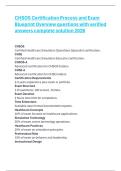
CHSOS Certification Process and Exam
Blueprint Overview questions with verified
answers complete solution 2026
CHSOS
Certified Healthcare Simulation Operations Specialist certification.
CHSE
Certified Healthcare Simulation Educator certification.
CHSOS-A
Advanced certification for CHSOS holders.
CHSE-A
Advanced certification for CHSE holders.
Certification Requirements
2-5 years experience plus exam or portfolio.
Exam Structure
115 questions; 100 scored, 15 beta.
Exam Duration
2 hours time limit for completion.
Time Extensions
Available upon formal documented requests.
Healthcare Concepts
10% of exam focuses on healthcare applications.
Simulation Technology
35% of exam covers technology operations.
Healthcare Practices
25% of exam on simulation principles.
Professional Role
15% of exam on behavior and leadership.
Instructional Design
,15% of exam on design principles.
Medical Condition
Disease or injury requiring treatment.
Trauma
Sudden physical injury needing immediate care.
Common Conditions
Includes apnea, CVA, AMI, dyspnea.
Sign
Objective evidence of a disease.
Symptom
Subjective evidence perceived by the patient.
Bolus
Rapid infusion of fluid or medication.
Drip
Slow IV administration of medication or fluid.
Injection Types
Includes IM, Sub-Q, intradermal, intraosseous.
Hypertension
Condition of high blood pressure.
Hypotension
Condition of low blood pressure.
CVA
Cerebral vascular accident, commonly known as stroke.
Apnea
Condition of not breathing or breathless.
Per OS (PO)
Medication administered orally by mouth.
Sublingual
Medication placed under the tongue for absorption.
Rectal
Medication administered via the rectum.
Transnasal
Medication delivered through the nasal passages.
, Inhalation
Medication inhaled directly into the lungs.
Vaginal
Medication administered via the vaginal route.
Transdermal
Medication delivered through the skin.
Five Rights
Guidelines ensuring safe medication administration.
Right patient
Ensuring medication is given to the correct individual.
Right medication
Confirming the correct drug is administered.
Right time
Administering medication at the prescribed time.
Right dose
Giving the correct amount of medication.
Right route
Using the correct method for medication delivery.
Durable Medical Equipment
Long-lasting medical devices for patient care.
Self-care Equipment
Devices aiding patients in managing their health.
Diagnostic Equipment
Tools used for examining patient conditions.
Emergency Supplies
Items for immediate medical response and care.
Acute Care Supplies
Equipment for short-term medical treatment.
Healthcare Environments
Settings where healthcare services are provided.
Ambulatory Care
Outpatient services for patients not requiring hospitalization.
Simulation Technology
Blueprint Overview questions with verified
answers complete solution 2026
CHSOS
Certified Healthcare Simulation Operations Specialist certification.
CHSE
Certified Healthcare Simulation Educator certification.
CHSOS-A
Advanced certification for CHSOS holders.
CHSE-A
Advanced certification for CHSE holders.
Certification Requirements
2-5 years experience plus exam or portfolio.
Exam Structure
115 questions; 100 scored, 15 beta.
Exam Duration
2 hours time limit for completion.
Time Extensions
Available upon formal documented requests.
Healthcare Concepts
10% of exam focuses on healthcare applications.
Simulation Technology
35% of exam covers technology operations.
Healthcare Practices
25% of exam on simulation principles.
Professional Role
15% of exam on behavior and leadership.
Instructional Design
,15% of exam on design principles.
Medical Condition
Disease or injury requiring treatment.
Trauma
Sudden physical injury needing immediate care.
Common Conditions
Includes apnea, CVA, AMI, dyspnea.
Sign
Objective evidence of a disease.
Symptom
Subjective evidence perceived by the patient.
Bolus
Rapid infusion of fluid or medication.
Drip
Slow IV administration of medication or fluid.
Injection Types
Includes IM, Sub-Q, intradermal, intraosseous.
Hypertension
Condition of high blood pressure.
Hypotension
Condition of low blood pressure.
CVA
Cerebral vascular accident, commonly known as stroke.
Apnea
Condition of not breathing or breathless.
Per OS (PO)
Medication administered orally by mouth.
Sublingual
Medication placed under the tongue for absorption.
Rectal
Medication administered via the rectum.
Transnasal
Medication delivered through the nasal passages.
, Inhalation
Medication inhaled directly into the lungs.
Vaginal
Medication administered via the vaginal route.
Transdermal
Medication delivered through the skin.
Five Rights
Guidelines ensuring safe medication administration.
Right patient
Ensuring medication is given to the correct individual.
Right medication
Confirming the correct drug is administered.
Right time
Administering medication at the prescribed time.
Right dose
Giving the correct amount of medication.
Right route
Using the correct method for medication delivery.
Durable Medical Equipment
Long-lasting medical devices for patient care.
Self-care Equipment
Devices aiding patients in managing their health.
Diagnostic Equipment
Tools used for examining patient conditions.
Emergency Supplies
Items for immediate medical response and care.
Acute Care Supplies
Equipment for short-term medical treatment.
Healthcare Environments
Settings where healthcare services are provided.
Ambulatory Care
Outpatient services for patients not requiring hospitalization.
Simulation Technology