Lakshya9
On this page, you find all documents, package deals, and flashcards offered by seller lakshya9.
- 18
- 0
Community
- Followers
- Following
18 items
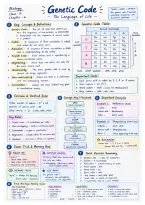
Genetic Code – The Language of Life |
These exam-focused revision notes cover the genetic code, its key features, codons and anticodons, and the genetic code table. They highlight the 64 total codons, 20 amino acids, AUG start codon, and three stop codons (UAA, UAG, UGA). The notes also explain triplet coding, degeneracy, universality, non-overlapping and comma less reading, with examples of methionine (AUG) and phenylalanine (UUU/UUC), a DNA-to-protein flowchart, exam tips, memory tricks, and a condensed final memory sheet.
- Summary
- • 1 pages •
-
• BIOLOGY
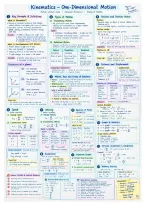
Kinematics – One-Dimensional Motion | Exam-Focused Handwritten Study Notes
Kinematics studies the description of motion, not its causes. One-dimensional motion is confined to a single line, even if the particle reverses direction. Translatory motion preserves orientation, whereas rotational motion changes orientation. Motion is relative and must be described using a reference point or frame of reference. A position vector locates an object relative to the origin. Distance is total path length; displacement is the change in position. ...
- Summary
- • 1 pages •
-
• PHYSICS
Kinematics – One-Dimensional Motion | Exam-Focused Handwritten Study Notes
Kinematics studies the description of motion, not its causes. One-dimensional motion is confined to a single line, even if the particle reverses direction. Translatory motion preserves orientation, whereas rotational motion changes orientation. Motion is relative and must be described using a reference point or frame of reference. A position vector locates an object relative to the origin. Distance is total path length; displacement is the change in position. ...
- Summary
- • 1 pages •
-
• PHYSICS
Kinematics – One-Dimensional Motion | Exam-Focused Handwritten Study Notes
Kinematics studies the description of motion, not its causes. One-dimensional motion is confined to a single line, even if the particle reverses direction. Translatory motion preserves orientation, whereas rotational motion changes orientation. Motion is relative and must be described using a reference point or frame of reference. A position vector locates an object relative to the origin. Distance is total path length; displacement is the change in position. ...
- Summary
- • 1 pages •
-
• PHYSICS
Kinematics – One-Dimensional Motion | Exam-Focused Handwritten Study Notes
Kinematics studies the description of motion, not its causes. One-dimensional motion is confined to a single line, even if the particle reverses direction. Translatory motion preserves orientation, whereas rotational motion changes orientation. Motion is relative and must be described using a reference point or frame of reference. A position vector locates an object relative to the origin. Distance is total path length; displacement is the change in position. ...
- Summary
- • 1 pages •
-
• PHYSICS
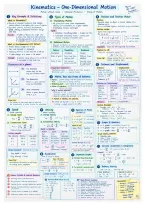
Kinematics – One-Dimensional Motion | Exam-Focused Handwritten Study Notes
Kinematics studies the description of motion, not its causes. One-dimensional motion is confined to a single line, even if the particle reverses direction. Translatory motion preserves orientation, whereas rotational motion changes orientation. Motion is relative and must be described using a reference point or frame of reference. A position vector locates an object relative to the origin. Distance is total path length; displacement is the change in position. ...
- Summary
- • 1 pages •
-
• PHYSICS
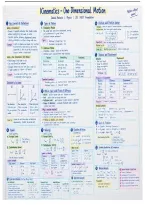
Kinematics – One-Dimensional Motion | Exam-Focused Handwritten Study Notes
Kinematics studies the description of motion, not its causes. One-dimensional motion is confined to a single line, even if the particle reverses direction. Translatory motion preserves orientation, whereas rotational motion changes orientation. Motion is relative and must be described using a reference point or frame of reference. A position vector locates an object relative to the origin. Distance is total path length; displacement is the change in position. ...
- Summary
- • 1 pages •
-
• PHYSICS
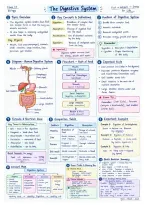
Handwritten Study Notes: The Digestive System
These study notes explain the human digestive system, its major organs, functions, and the process of digestion and nutrient absorption. They cover essential definitions, the pathway of food through the digestive tract, the roles of the liver, pancreas, and gall bladder, and the differences between digestion and absorption. The notes also include important examples, comparison tables, concept maps, exam tips, common mistakes, memory tricks, and a quick-revision sheet for effective exam preparati...
- Summary
- • 1 pages •
-
• BIOLOGY
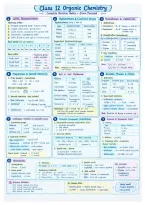
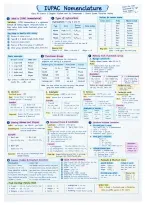
Organic Chemistry – Complete Revision Notes | Handwritten Exam-Focused Study Sheet
This revision sheet presents key Class 12 Organic Chemistry topics in a colorful, handwritten-style format designed for quick revision and board exam preparation. It covers IUPAC nomenclature, hydrocarbons and functional groups, haloalkanes and haloarenes, preparation methods and named reactions, SN1 and SN2 mechanisms, alcohols, phenols, ethers, aldehydes, ketones, carboxylic acids, aromatic substitution, amines, diazonium salts, and biomolecules. The notes use tables, reaction equations, exam...
- Summary
- • 1 pages •
-
• CHEMISTY
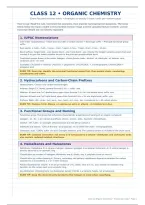
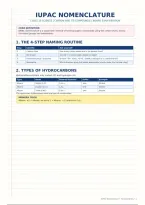
Organic chemistry detailed notes
The notes begin by explaining why carbon is important in organic chemistry. They highlight carbon’s tetravalency, catenation, ability to form multiple bonds and capacity to produce compounds with different structures. Tetravalency refers to carbon’s ability to form four covalent bonds, while catenation describes its tendency to form chains with other carbon atoms. The notes also introduce isomerism, in which compounds can have the same molecular formula but different structures or spatial ar...
- Summary
- • 8 pages •
-
• SCIENCE
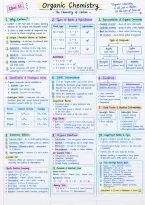
Organic Chemistry Handwritten Notes | Carbon, IUPAC Nomenclature, Isomerism & Organic Reactions
Organic Chemistry handwritten notes provide a visual, exam-focused revision guide to the fundamental concepts of organic chemistry. Topics include carbon’s unique properties, chemical bonding and hybridisation, organic compound classification, homologous series, IUPAC nomenclature, isomerism, bond fission, reaction intermediates, electronic effects and types of organic reactions.
- Summary
- • 1 pages •
-
• SCIENCE
Carbon and Its Compounds – Chemistry Notes for test and examination
Comprehensive, exam-focused notes covering carbon’s properties, covalent bonding, allotropes, hydrocarbons, IUPAC nomenclature, functional groups, isomerism, and homologous series. Also includes important reactions of ethanol and ethanoic acid, esterification, saponification, soaps and detergents, key formulas, and quick-revision points for effective exam preparation.
- Exam (elaborations)
- • 6 pages •
-
• SCIENCE
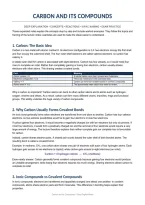
Chemistry - Carbon and its compounds detailed notes
It covers carbon’s basic properties, tetravalency, catenation, covalent bonding, and the reasons carbon forms a wide variety of compounds. It explains the differences between ionic and covalent compounds, the allotropes of carbon (diamond, graphite, and fullerene), hydrocarbons, and their classification into alkanes, alkenes, and alkynes. The notes also explain IUPAC nomenclature, functional groups, structural isomerism, Lewis electron-dot structures, and homologous series. Important chemical...
- Class notes
- • 9 pages •
-
• SCIENCE
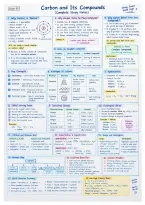
Carbon and Its Compounds – Complete Class 10 Chemistry Study Notes
These exam-focused notes explain the essential concepts of carbon chemistry, including carbon’s unique properties, covalent bonding, allotropes, hydrocarbons, IUPAC nomenclature, functional groups, structural isomerism, and homologous series. They also cover the properties and chemical reactions of ethanol and ethanoic acid, esterification, saponification, and the differences between soaps and detergents. With clear diagrams, formulas, comparison tables, concept maps, and quick-revision points...
- Summary
- • 1 pages •
-
• SCIENCE