

Jessybrown
Op deze pagina vind je alle documenten, voordeelbundels en oefenvragen die worden aangeboden door verkoper jessybrown.
- 2352
- 0
- 36
Community
- Volgers
- Volgend
2388 items
Geography AQA GCSE PAPER 1
Natural Hazard - A natural hazard is a natural process which could cause death, injury or disruption to humans, or destroy proprty or posesions. Natural disaster - A natural hzard that has actualy happened Geological hazards - Caused by kand and tectonic processes Meteorological hazards - Caused by weather and climate Factors affecting hazard risk - Urbanisation, poverty, development, climate change Tectonic plates - Slabs of the Earth's crust Continental crust - thicker and less dense ...
- Tentamen (uitwerkingen)
- • 14 pagina's •
Natural Hazard - A natural hazard is a natural process which could cause death, injury or disruption to humans, or destroy proprty or posesions. Natural disaster - A natural hzard that has actualy happened Geological hazards - Caused by kand and tectonic processes Meteorological hazards - Caused by weather and climate Factors affecting hazard risk - Urbanisation, poverty, development, climate change Tectonic plates - Slabs of the Earth's crust Continental crust - thicker and less dense ...
Group 7: Atomic structure and the periodic table: Chemistry: GCSE (9:1)
Name of Group 7 elements The halogens Group 7 elements have similar chemical properties because they all have 7 outer shell electrons Diatomic molecule A molecule consisting of two atoms
- Voordeelbundel
- Tentamen (uitwerkingen)
- • 4 pagina's •
-
AQA GCSE Chemistry • Door jessybrown
Name of Group 7 elements The halogens Group 7 elements have similar chemical properties because they all have 7 outer shell electrons Diatomic molecule A molecule consisting of two atoms
Ionic bonding: Bonding structure and the properties of matter: Chemistry: GCSE (9:1)
Formation of metal ions Atoms lose outer electrons Metals Elements that form positive ions Formation of non-metal ions Atoms gain electrons Charge on non-metal ions negative Group 1 ions charge +1 Group 2 ions charge +2 Group 6 ions charge -2 Group 7 ions charge
- Voordeelbundel
- Tentamen (uitwerkingen)
- • 7 pagina's •
-
AQA GCSE Chemistry • Door jessybrown
Formation of metal ions Atoms lose outer electrons Metals Elements that form positive ions Formation of non-metal ions Atoms gain electrons Charge on non-metal ions negative Group 1 ions charge +1 Group 2 ions charge +2 Group 6 ions charge -2 Group 7 ions charge
Metals and non-metals: Chemistry: WJEC: GCSE (9:1)
Metals Elements which form positive ions Non-metals Elements which do not form positive ions Metals position on periodic table on the left hand side Non-metals position on periodic table
- Voordeelbundel
- Tentamen (uitwerkingen)
- • 8 pagina's •
-
AQA GCSE Chemistry • Door jessybrown
Metals Elements which form positive ions Non-metals Elements which do not form positive ions Metals position on periodic table on the left hand side Non-metals position on periodic table
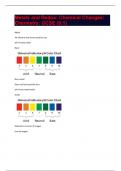
Metals and Redox: Chemical Changes: Chemistry: GCSE (9:1)
Metal An element that forms positive ions pH of metal oxide Basic Non-metal Does not form positive ions pH of non-metal oxide Acidic Reduction in terms of oxygen Loss of oxygen Oxidation in terms of oxygen Gain of oxygen Oxidation in terms of electrons Loss of electrons
- Voordeelbundel
- Tentamen (uitwerkingen)
- • 8 pagina's •
-
AQA GCSE Chemistry • Door jessybrown
Metal An element that forms positive ions pH of metal oxide Basic Non-metal Does not form positive ions pH of non-metal oxide Acidic Reduction in terms of oxygen Loss of oxygen Oxidation in terms of oxygen Gain of oxygen Oxidation in terms of electrons Loss of electrons
Naming Chemicals: Atomic structure and the periodic table: Chemstry: GCSE (9:1)
H - Hydrogen He - Helium Fe - Iron N - Nitrogen Na - Sodium F - Fluorine Li - Lithium C - Carbon CO2 - carbon dioxide
- Voordeelbundel
- Tentamen (uitwerkingen)
- • 2 pagina's •
-
AQA GCSE Chemistry • Door jessybrown
H - Hydrogen He - Helium Fe - Iron N - Nitrogen Na - Sodium F - Fluorine Li - Lithium C - Carbon CO2 - carbon dioxide
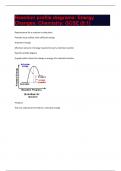
Reaction profile diagrams: Energy Changes: Chemistry: GCSE (9:1)
Requirements for a reaction to take place Particles must collide, with sufficient energy Activation energy Minimum amount of energy required to start a chemical reaction Reaction profile diagram A graph which shows the change in energy of a chemical reaction Products The new substances formed by a chemical change
- Voordeelbundel
- Tentamen (uitwerkingen)
- • 5 pagina's •
-
AQA GCSE Chemistry • Door jessybrown
Requirements for a reaction to take place Particles must collide, with sufficient energy Activation energy Minimum amount of energy required to start a chemical reaction Reaction profile diagram A graph which shows the change in energy of a chemical reaction Products The new substances formed by a chemical change
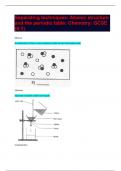
Separating techniques: Atomic structure and the periodic table: Chemstry: GCSE (9:1)
Mixture A combination of two or more substances that are not chemically joined. Filtration Separates insoluble solids from liquids. Crystallisation The formation of crystals by cooling a saturated solution Simple distillation Used to separate a liquid from a solution
- Voordeelbundel
- Tentamen (uitwerkingen)
- • 10 pagina's •
-
AQA GCSE Chemistry • Door jessybrown
Mixture A combination of two or more substances that are not chemically joined. Filtration Separates insoluble solids from liquids. Crystallisation The formation of crystals by cooling a saturated solution Simple distillation Used to separate a liquid from a solution
Transition elements: Atomic structure and the periodic table: Chemistry: GCSE (9:1)
Transition elements are found In the middle block of the periodic tableRe Physical properties of transition elements Hard, high melthing points, strong and dense. Chemical properties of transition elements Slow/no reaction with oxygen, water and halogens Charges on transition metal ions Form positive ions often with the ability to form more than one ion
- Voordeelbundel
- Tentamen (uitwerkingen)
- • 3 pagina's •
-
AQA GCSE Chemistry • Door jessybrown
Transition elements are found In the middle block of the periodic tableRe Physical properties of transition elements Hard, high melthing points, strong and dense. Chemical properties of transition elements Slow/no reaction with oxygen, water and halogens Charges on transition metal ions Form positive ions often with the ability to form more than one ion
Types of structure: Bonding structure and the properties of matter: Chemistry: GCSE (9:1)
Ion An atom or group of atoms that has lost or gained electrons and therefore a positive or negative charge. Polyatomic ion An ion that is made of more then one atom Metal ion an atom which has lost electrons forming a positive ion Non-metal ion an atom which has gained electrons forming negative ions. Covalent bond a shared pair of electrons Molecule two or more atoms held together by covalent bonds Metallic bonding Positively charged metal ions are surrounded by delocalised outer ...
- Voordeelbundel
- Tentamen (uitwerkingen)
- • 6 pagina's •
-
AQA GCSE Chemistry • Door jessybrown
Ion An atom or group of atoms that has lost or gained electrons and therefore a positive or negative charge. Polyatomic ion An ion that is made of more then one atom Metal ion an atom which has lost electrons forming a positive ion Non-metal ion an atom which has gained electrons forming negative ions. Covalent bond a shared pair of electrons Molecule two or more atoms held together by covalent bonds Metallic bonding Positively charged metal ions are surrounded by delocalised outer ...