
- Study guides, Class notes & Summaries
Looking for the best study guides, study notes and summaries about ? On this page you'll find 2 study documents about .
Exam (elaborations)
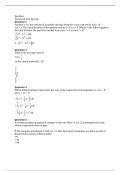
For time t ≥ 0, the velocity of a particle moving along the x-axis is given by v(t) = x3 − 3x2 + x. The initial position of the particle at time t = 0 is x = 3. Which of the following gives the total distance the particle traveled from time t = 0 to time
For time t ≥ 0, the velocity of a particle moving along the x-axis is given by v(t) = x3 − 3x2 + x. The initial position of the particle at time t = 0 is x = 3. Which of the following gives the total distance the particle traveled from time t = 0 to time t = 4? Question 2 What is the average value of on the closed interval [1, 3]? Question 3 Which definite integral represents the area of the region that is bounded by 3x + 3y2 = 0 and y = 2x + 1? Question 4 A certain mosquito popula...
 AcademiContent
Exam (elaborations)
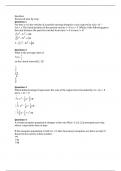
For time t ≥ 0, the velocity of a particle moving along the x-axis is given by v(t) = x3 − 3x2 + x. The initial position of the particle at time t = 0 is x = 3. Which of the following gives the total distance the particle traveled from time t = 0 to time
PopularQuestion Answered step-by-step Question 1 For time t ≥ 0, the velocity of a particle moving along the x-axis is given by v(t) = x3 − 3x2 + x. The initial position of the particle at time t = 0 is x = 3. Which of the following gives the total distance the particle traveled from time t = 0 to time t = 4? Question 2 What is the average value of on the closed interval [1, 3]? Question 3 Which definite integral represents the area of the region that is bounded by 3x + 3y2 = 0 and y = 2...
 BESTSOLUTIONGURU