

Popular courses 'Calculus for Engineers' at Calculus for Engineers
Calculus for Engineers - Study guides, Class notes & Summaries
Looking for the best study guides, study notes and summaries about Calculus for Engineers? On this page you'll find 4 study documents about Calculus for Engineers.
Exam (elaborations)
Calculus for Engineers Practice Exam Questions and Correct Answers (Verified Answers) Plus Rationales 2026 Q&A | Instant Download Pdf
Calculus for Engineers Practice Exam Questions and Correct Answers (Verified Answers) Plus Rationales 2026 Q&A | Instant Download Pdf
 licensedexamtutor
Exam (elaborations)
Calculus for Engineers TOP Exam Questions and CORRECT Answers
Popularderivative of sin(x) cos(x) derivative of cos(x) -sin(x) derivative of tan(x) (sec(x))^2 derivative of cot(x) -(csc(x))^2 derivative of csc(x) -cot(x)csc(x) derivative of sec(x) sec(x)tan(x) derivative of arcsin(x) 1/√(1-x^2)
 STANFORDGENIUS
Other
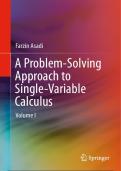
A Problem-Solving Approach to Single-Variable Calculus: Volume I – Farzin Asadi – 1st Edition 2026 | Calculus & Engineering Mathematics
Single-variable calculus is a fundamental mathematical framework essential for students across diverse fields—including the basic sciences, engineering, and economics—because it enables the precise modeling and understanding of dynamic systems. It introduces two indispensable tools: the derivative, which quantifies instantaneous rates of change, and the integral, which measures accumulation over time or space. These concepts form the foundation of nearly all quantitative disciplines
 EliteStudyPro
Exam (elaborations)
Calculus for Engineers UPDATED Exam Questions and CORRECT Answers
surjective function A function f: A -> B is surjective if for every element y of B there exists an element x of A such that y = f(x) injective function A function f: A -> B is injective if f(x) = f(y) implies x = y for all elements x,y of A bijective function a function is bijective if it is injective and surjective inverse function A function f: A -> B is bijective. Then for any y in B there is exactly one x in A such that f(x)=y. We use this to define an inverse function Lim...
STANFORDGENIUS