PERCEPTION AND COGNITION (PSYCH 334)
Queens College
Here are the best resources to pass PERCEPTION AND COGNITION (PSYCH 334). Find PERCEPTION AND COGNITION (PSYCH 334) study guides, notes, assignments, and much more.
All 10 results
Sort by:
-
Class notes
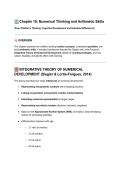
Numerical Thinking and Arithmetic Skills
-
---7April 20262025/2026
- This chapter explains how children develop number concepts, understand quantities, and build arithmetic skills from infancy through adolescence. It introduces Siegler and Lortie‑Forgues’s Integrative Theory of Numerical Development, which describes how children progress from intuitive, nonsymbolic quantity representations to sophisticated symbolic and fractional reasoning. The chapter distinguishes conceptual knowledge (understanding principles) from procedural knowledge (knowing how to perf...
-
$8.49 More Info
danielacelano
-
Class notes
Language Development
-
---6April 20262025/2026
- This chapter explains how children acquire language, from early vocalizations to complex grammar and conversation. It outlines the major components of language—phonology, morphology, syntax, semantics, and pragmatics—and describes the developmental milestones from cooing and babbling to multi‑word sentences and grammatical mastery. The chapter highlights the biological foundations of language, including brain specialization and sensitive periods, as well as the crucial role of social inter...
-
$8.49 More Info
danielacelano
-
Class notes
Problem Solving and Reasoning
-
---7April 20262025/2026
- This chapter explains how children learn to solve problems, reason logically, and think scientifically. It describes the core components of problem solving—goals, obstacles, and strategies—and shows how children gradually move from trial‑and‑error approaches to more deliberate, flexible, and strategic thinking. The chapter covers means‑ends analysis, strategy selection, and Siegler’s Overlapping Waves Theory, which explains how children use multiple strategies and shift toward more e...
-
$8.49 More Info
danielacelano
-
Class notes
Memory Development
-
---7April 20262025/2026
- This chapter explains how memory develops from infancy through childhood, highlighting the differences between implicit and explicit memory, how researchers measure memory in preverbal infants, and why early memories are fragile. It covers foundational findings such as habituation, operant conditioning (kicking studies), and deferred imitation, showing that infants possess early forms of learning and retention even before language. The chapter also explains infantile amnesia and the neurological...
-
$8.49 More Info
danielacelano
-
Class notes
Learning to Think on Their Own
-
---8April 20262025/2026
- This chapter explains how children develop the ability to regulate, plan, and direct their own thinking through improvements in executive function, working memory, strategy use, and metacognition. Using an information‑processing framework, it describes how cognitive development is driven by gradual increases in processing speed, inhibitory control, cognitive flexibility, and the capacity to hold and manipulate information. The chapter also covers how children learn and refine memory strategies...
-
$8.99 More Info
danielacelano
-
Class notes
Thinking in Symbols
-
---8April 20262025/2026
- This chapter explains how children develop the ability to mentally represent the world using symbols such as words, pictures, gestures, and pretend play. It covers Piaget’s theory of symbolic development, including dual representation, appearance–reality distinctions, and the transition from sensorimotor to symbolic thought. The chapter also explores modern “theory theorists,” who argue that children build domain‑specific naïve theories about biology, physics, and psychology. Symbolic...
-
$8.99 More Info
danielacelano
-
Class notes
Infant Perception and Cognition
-
---9April 20262025/2026
- This chapter examines how infants perceive, interpret, and learn from the world during the first year of life. It explains the sensory abilities newborns possess, how perception rapidly develops, and how researchers study infant cognition using methods like sucking paradigms, visual preference, habituation, and violation‑of‑expectation. The chapter covers the development of vision, face processing, speech and music perception, intersensory integration, and the phenomenon of perceptual narrow...
-
$9.49 More Info
danielacelano
-
Class notes
The Social Construction of Mind
-
---7April 20262025/2026
- This chapter explains how children’s thinking is fundamentally shaped by culture, social interaction, and shared activities. It centers on Vygotsky’s sociocultural theory, which argues that cognitive development emerges through guided participation with more skilled partners and through the use of cultural tools such as language, symbols, and technology. The chapter highlights how learning occurs within the Zone of Proximal Development, how tools of intellectual adaptation transform thinking...
-
$8.49 More Info
danielacelano
-
Class notes
Biological Bases of Cognitive Development
-
---7April 20262025/2026
- This chapter explains how biology, evolution, genes, and brain development shape children’s thinking. It covers how evolutionary pressures created cognitive abilities, how genes interact with environments through epigenesis, how the brain grows through neurogenesis, synaptogenesis, pruning, and myelination, and how experience shapes neural circuits through experience‑expectant and experience‑dependent processes. The chapter emphasizes that cognitive development emerges from dynamic, bidire...
-
$8.49 More Info
danielacelano
-
Class notes
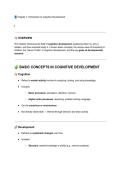
Cognition Mental processes Representation Structure vs. Function Developmental function Individual differences Domain‑general abilities Domain‑specific abilities Plasticity Stability Executive function Intentional controL
-
---6April 20262025/2026
- Perception & Cognition is the study of how the mind takes in information, interprets it, remembers it, and uses it to guide behavior. The course examines the mental processes that allow humans to perceive the world, think about it, learn from it, and act intentionally. It integrates psychology, neuroscience, and developmental science to explain how these abilities emerge, change, and operate across the lifespan.
-
$5.89 More Info
danielacelano