
BIO317 (BIO317)
College Of Saint Benedict
Here are the best resources to pass BIO317 (BIO317). Find BIO317 (BIO317) study guides, notes, assignments, and much more.
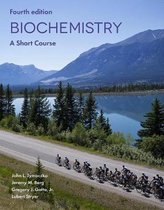
Popular textbooks
Textbook notes
Chapter 20/21- Electron Transport/Oxidative Phosphorylation
These notes extensively cover the workings of the electron transport chain and oxidative phosphorylation. They cover all four complexes of the electron transport chain, the Q-cycle, the proton gradient, ATP synthase, the malate-aspartate shuttle, and regulation. There is also a mind map included that summarizes these two chapters.
 meganolivia
Textbook notes
Chapter 18/19- Pyruvate Oxidation/Citric Acid Cycle
PopularThese notes cover pyruvate oxidation and the citric acid cycle in depth. They cover the enzymes/coenzymes necessary for the cycle to function, the pyruvate dehydrogenase complex, covalent modification of the PDH complex, harvesting electrons for the cycle, and overall regulation of the citric acid cycle. There is also a mind map included to summarize the chapter.
meganolivia
Textbook notes
Chapter 1- Introduction to Biochemistry
These notes provide an introduction to biochemistry. They cover the four biomolecules, the central dogma of biology, and the importance of membranes. There is a mind map included with additional information that will provide you with a great foundation for starting this course.
meganolivia
Textbook notes
Chapter 2- Water & Buffers
These notes cover water and buffers. They cover how weak bonds allow transient interactions, brownian motion, Coulomb's Law, hydrogen bonding, van der waals interactions, and effects of pH for buffers. There is a mind map included to help you connect the concepts of this chapter that also explains the differences in respiratory/metabolic acidosis/alkalosis.
meganolivia
Textbook notes
Chapter 3/4- Amino Acids & Proteins
These notes cover amino acids and proteins in depth. They cover polar and nonpolar effects of amino acids proteins in three-dimensional structure, how shape determines function, protein structure, and protein folding. There are two mind maps included that are there to help you make sense of the concepts and how they relate with one another.
meganolivia
Textbook notes
Chapter 6- Enzymes/Enzyme Kinetics
These notes do not cover specifics on enzyme kinetics, but rather the basic concepts of enzymes and enzyme action. They cover the types of enzymes, cofactors needed for activity, Gibbs free energy, the importance of the transition state, binding energy, and transition state analogs. There is also a mind map included to help you make sense of the concepts.
meganolivia
Textbook notes
Chapter 7- Enzyme Kinetics
These notes cover the basics of enzymes kinetics including: reaction rates, michaelis menten kinetics/enzymes, the lineweaver burk equation, kM and Kcat, Vmax, allosteric enzymes, feedback inhibition, and negative/positive effectors. Allosterics are a very important part of enzyme kinetics and you'll find lots of good information about that in these notes. A mind map is also included to help you better understand how all of the concepts come together,
meganolivia
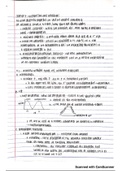
Textbook notes
Chapter 8- Mechanisms
These notes cover the basic catalytic strategies of many enzymes, enzyme activity, the types of inhibition, and the example of chymotrypsin.
meganolivia
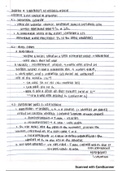
Textbook notes
Chapter 9- Hemoglobin & Myoglobin
These notes cover the basics of the structure and function of hemoglobin and myoglobin. They cover cooperativity, heme groups, allosteric regulation, and mutations. There is also a mind map included to help you make sense of the important topics and comparing the two globins.
meganolivia
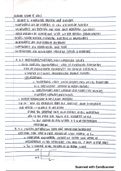
Textbook notes
Chapter 12/13- Membranes/Signal Transduction
These notes cover everything one would need to know regarding the structure and inner workings of membranes and phospholipids. They cover membrane structure and function, membrane proteins, lipids in membranes, transporters, and the selectivity filter. These notes also cover an overview of signal transduction pathways. They specifically cover the beta adrenergic pathway and the 7 transmembrane receptor; this is also referred to as the G-protein pathway. There are two mind maps included to help y...
meganolivia
Textbook notes
Chapter 14/15- Digestion/Metabolism
These notes lightly cover digestion (proteases, alpha amylase, lipid digestion) and more heavily covers metabolism (basic concepts and its design). They cover catabolism, anabolism, thermodynamics, carbon oxidation, and metabolic pathways with recurring motifs. There is also a mind map included that is helpful in summarizing metabolism.
meganolivia
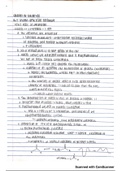
Textbook notes
Chapter 16- Glycolysis
These notes cover the inner workings of glycolysis. They cover each step of glycolysis and the enzymes that are involved in each, along with some of the inhibitors. These notes also cover the concept of high transfer potential, substrate level phosphorylation, lactic acid fermentation, energy charge as it relates to glycolysis, and responses in the liver.
meganolivia
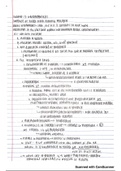
Textbook notes
Chapter 17- Gluconeogenesis
These notes give a summary of gluconeogenesis. They cover the important steps, comparisons to glycolysis, and regulation.
meganolivia
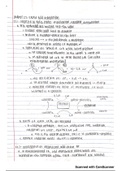
Textbook notes
Chapter 27- Fatty Acid Oxidation
These notes cover fatty acid degradation/oxidation. They cover odd-chain fatty acids, ketone body formation, and fatty acid metabolism as it relates to diabetes and starvation. There is also a mind map included that summarizes the important parts of the chapter.
meganolivia
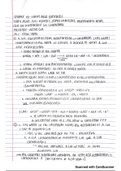
Textbook notes
Chapter 28- Fatty Acid Synthesis
These notes cover Fatty Acid synthesis in depth by stage. They also cover fatty acid synthesis regulation and the enzymes that are necessary in completing it (ie. acetyl CoA carboxylase II). There is also a mind map included to summarize the important parts of the chapter.
meganolivia
Textbook notes
Chapter 29- Cholesterol Metabolism
These notes cover cholesterol synthesis and cholesterol metabolism by stages. They cover regulation, lipoproteins, receptor mediated endocytosis, and other mechanisms relating to cholesterol. There is also a mind map included to summarize the chapter.
meganolivia
Textbook notes
Chapter 30- Nitrogen Metabolism
This mind map covers Nitrogen Metabolism and the Urea Cycle, along with heme biosynthesis and important enzymes.
meganolivia
Textbook notes
Chapter 32- Nucleotide Metabolism
These notes cover nucleotide metabolism and the De Novo (synthetic) & Salvage pathways for purines and pyrimidines. They also cover ribonucleotide reductase. Included is a mind map summarizing the chapter.
meganolivia