
Microbiology
Liberty University
Here are the best resources to pass Microbiology. Find Microbiology study guides, notes, assignments, and much more.
Popular textbooks

Exam (elaborations)
Straighterline Microbiology questions and answers
Straighterline Microbiology questions and answers
 Classroom
Class notes
Taeniasis
PopularTAENIASIS Taenia saginata (beef tapeworm) • In adult stage, T. saginata inhabits the upper jejunum • it may survive for as long as 25 years • It causes intestinal infection, Taeniasis • It has worldwide distribution Scolex…… Taenia saginata….. Morphology • Adult worm measures 5-10 meters in length • The pyriform scolex has 4 suckers but no rostellum • The mature segments have irregularly alternate lateral genital pores • uterus made up of a median s...
 profliand

Package deal
Value Pack Testbank Deal .
Exam (elaborations) Test bank for applied pathophysiology a conceptual approach 3rd edition by judi nath carie braun 2 Exam (elaborations) Test Bank - Physical Examination and Health Assessment, 9th Edition (Jarvis, 2024), Chapter 1-32 + NCLEX Case Studies with answers | All Chapters 3 Exam (elaborations) Test Bank - Community Health Nursing, A
NURSELORRIE
Exam (elaborations)
Test Bank For Microbiology With Diseases By Taxonomy 6Th Edition Robert W. Bauman All Chapters Included 1 – 22 Latest Update 2023/2024 (With Answer Key)
TEST BANK FOR MICROBIOLOGY WITH DISEASES BY TAXONOMY 6th EDITION ROBERT W. BAUMAN ALL CHAPTERS INCLUDED 1 – 22 LATEST UPDATE 2023/2024 (WITH ANSWER KEY) Microbiology Table of Contents Chapter 1 A Brief History of Microbiology 2 Chapter 2 The Chemistry of Microbiology 19 Chapter 3 Cell Structure and Function 38 Chapter 4 Microscopy, Staining, and Classification 60 Chapter 5 Microbial Metabolism 80 Chapter 6 Microbial Nutrition and Growth 99 Chapter 7 Microbial Genetics 118 Chapte...
 lectdenis

Exam (elaborations)
Test Bank For General Biology By Benato A. Dela Pena, Jr. Daniel E. Gracilla And Christian R. Pangilina All Chapters Included Latest Update 2023/2024 (With Answer Key)
TEST BANK FOR GENERAL BIOLOGY BY BENATO A. DELA PENA, JR. DANIEL E. GRACILLA AND CHRISTIAN R. PANGILINA ALL CHAPTERS INCLUDED LATEST UPDATE 2023/2024 (WITH ANSWER KEY) Chapter 01 Test Bank: An Introduction to Biology Multiple Choice Questions 1. The simplest structure shared among all living organisms is the A. gut. B. cell. C. photosynthetic chloroplast. D. community. E. nucleus. Bloom's Level: Remember Section: 1.01 Topic: General 2. Which of the following is likely NOT...
lectdenis
Exam (elaborations)
Straighterline Microbiology Final Exam Questions With Complete & Updated Solutions
STRAIGHTERLINE MICROBIOLOGY FINAL EXAM QUESTIONS WITH COMPLETE & UPDATED SOLUTIONS In the nitrogen cycle, which of the following steps involves removal of nitrogen from the atmosphere by bacteria? Correct Answer Nitrogen Fixation If enough H+ ions are added to pure water to raise the H+ concentration of the solution to ten times higher than the original concentration, what is the resulting OH- concentration of the solution? Correct Answer 10-8 M Fungi are able to reproduce asexually by ...
 SavvyMind
Package deal
Medical parasitology notes combined
it has notes from the introduction to parasitology, Cestoda, haemo flagellates, protozoans and trematodes
profliand
Package deal
Medical Parasitology Notes
it has the following topics; cestoda, taeniasis, and trematodes
profliand

Package deal
Medical parasitoogy
it has notes on entomology, nematodes and fascioliasis
profliand
Class notes
Mosquito lifecycle
Period of Schizogony • Breaking of erythrocytesParoxysm. • Tertian – 48 hr erythrocytes break; attacks every other day, P. vivax and P. ovale. Period of Schizogony • Breaking of erythrocytesParoxysm. • Tertian – 48 hr erythrocytes break; attacks every other day, P. vivax and P. ovale. • Quartan – 72 hr erythrocytes break; attacks three days, P. malariae. Period of Schizogony • Breaking of erythrocytesParoxysm. • Tertian – 48 hr erythrocytes break;...
profliand
Class notes
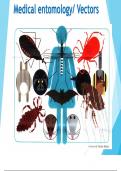
Parasitology - Entomology
Modes of Disease Transmission by Arthropods • Propagative - increase in number of pathogens in host arthropod, with no developmental changes in pathogens, eg Yellow Fever, Typhus • Cyclopropagative - involves multiplication in numbers as well as change in developmental stages of pathogens. Eg Plasmodium in Anophelines • Cyclodevelopmental- only changes in developmental stages of pathogens and no multiplication or increase in numbers. Eg Wuchereria bancrofti in Culex mosquito • Transo...
profliand
Class notes
Nematodes
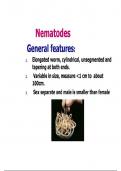
Nematodes General features: 1. Elongated worm, cylindrical, unsegmented and tapering at both ends. 2. Variable in size, measure <1 cm to about IOOcm. 3. Sex separate and male is smaller than female Location of Nematodes: Intestinal nematodes Tissue nematodes I težtfhal Ne todes Common intestinal nematode infections: 1. Enterobius (Oxyuris) vermicularis (Pinworm,seatworm,threadworm) 2. Trichuris trichiura (whipworm) 3. Ascaris lumbricoides (roundworm) 4. Ancylostoma duo...
profliand
Class notes
Parasitology - Fascioliasis
Liver Flukes Fasciola hepatica Clonorchis sinensis Fasciola hepatica F. gigantica Fasciola hepatica: Morphology…. • Adult fluke – Flat leaf like body – 20-30mm long – 8-15mm wide – Brown/grey Clonorchis sinensis Fascioliasis •Causal Agent: • The trematodes Fasciola hepatica (the sheep liver fluke) and Fasciola gigantica, parasites of herbivores that can infect humans accidentally. • Geographic Distribution: • Fascioliasis occurs world...
profliand
Class notes
Parasitology - Hymenolepiasis
HYMENOLEPIASIS caused by Hymenolepis nana H. diminuta Hymenolepis nana (dwarf tapeworm) • Adult worm measures 1-4.5 cm in length. • four suckers and armed with one row of hooks • In the mature segment, there are three testes in the middle H. nana…… anatomy H. nana……. Infective stage and mode of infection • The egg, which is immediately infective when passed by the patient • It is rounded, about 40 microns in diameter • contains a six- hooked oncosphere with...
profliand
Class notes
Intestinal Protozoa
4 subdivisions according to the methods of locomotion. • The amoebae (Sarcodina) move by means of pseudopodia. • The flagellates (Mastigophora) typically move by long, whiplike flagellae. • The ciliates (Ciliata) are propelled by rows of cilia that beat with a synchronized wavelike motion. • The sporozoans (Sporozoa) lack specialized organelles of motility. Move by Gliding, wriggling etc Basic Properties of Protozoa Cellular properties - Eukaryotic microorganisms havin...
profliand
Class notes
Parasitology Trematodes
General characteristics: 1.The class trematoda falls into two main subclasses, the Monogenea, which have a direct life cycle, and the Digenea, which require an intermediate host, are of medical significance 2. The adult digenetic trematodes, commonly called `flukes', occur primarily in the bile ducts, alimentary tract and vascular system. 3. Most flukes are flattened dorsoventrally, have a blind alimentary tract, suckers for attachment 4.Depending on the predilection site, the...
profliand
Class notes
Inroduction to medical parasitology
INTRODUCTION TO MEDICAL PARASITOLOGY The course is designed to enable learners to apply the concepts and principles of medical parasitology to Course Purpose provide nursing care to patients/clients. Describe classification, characteristics, the life cycle and pathology of parasites of medical importance. Carry out and interpret procedures for identification Learning Outcomes By the end of the course the learner will be able to: 1. 2. of parasites. 1. Apply parasitological concepts ...
profliand
Exam (elaborations)
Straighterline Microbiology Midterm Review Questions With Complete Solutions
Straighterline Microbiology Midterm Review Questions With Complete Solutions
Classroom
Exam (elaborations)
Straighterline Microbiology questions and answers
Straighterline Microbiology questions and answers
Classroom
Exam (elaborations)
STRAIGHTERLINE MICROBIOLOGY| 100 questions| with complete solutions
STRAIGHTERLINE MICROBIOLOGY| 100 questions| with complete solutions
Classroom