Basic Electronics

Harvard University

Aquí están los mejores recursos para pasar Basic Electronics. Encuentra Basic Electronics guías de estudio, notas, tareas, y mucho más.

All 26 resultados

Ordenador por:

Transformers Transformers
  • Notas de lectura

    Transformers

  • Transformers are electrical devices that transfer electrical energy between circuits through electromagnetic induction. They consist of primary and secondary windings around a magnetic core, allowing voltage levels to be stepped up or down efficiently. Essential in power distribution, transformers enable the safe and efficient transmission of electricity over long distances, minimizing energy loss. Their ability to adjust voltage levels makes them crucial for various applications, from household...
  • peterkuria3
    $10.99 Más información
The Engineer And Society
  • Resumen

    The Engineer And Society

  • Engineers play a pivotal role in society by applying scientific principles to develop innovative solutions to real-world problems. They design infrastructure, improve technology, and ensure safety and efficiency in various industries. By addressing societal needs, engineers contribute to economic growth, enhance quality of life, and drive sustainable development. Their work not only shapes the modern world but also anticipates future challenges, making engineers essential for societal progress a...
  • peterkuria3
    $8.49 Más información
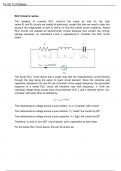
Series RLC Circuits
  • Resumen

    Series RLC Circuits

  • A series RLC circuit comprises a resistor (R), inductor (L), and capacitor (C) connected in a single path. The circuit's impedance depends on the frequency, with a characteristic resonance frequency where the inductive and capacitive reactances cancel each other. At resonance, the impedance is purely resistive, and the circuit can either attenuate or amplify signals. Series RLC circuits are crucial in applications like tuning, filtering, and signal processing in electrical and electronic system...
  • peterkuria3
    $6.89 Más información
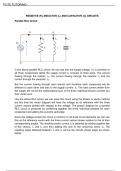
Parallel RLC Circuit
  • Resumen

    Parallel RLC Circuit

  • A parallel RLC circuit consists of a resistor (R), inductor (L), and capacitor (C) connected in parallel. It exhibits complex impedance behavior, combining resistive, inductive, and capacitive effects. The circuit's total impedance varies with frequency, leading to resonant behavior at a particular frequency where inductive and capacitive reactances cancel out. This makes parallel RLC circuits vital in tuning and filtering applications within communication and signal processing systems.
  • peterkuria3
    $8.49 Más información
LENZ, Transformer and Faraday Law
  • Resumen

    LENZ, Transformer and Faraday Law

  • Lenz's Law, Faraday's Law, and transformers are foundational concepts in electromagnetism. Faraday's Law states that a changing magnetic field induces an electromotive force (EMF) in a conductor. Lenz's Law extends this, stating the induced EMF opposes the change causing it. Transformers, based on these laws, transfer electrical energy between circuits through electromagnetic induction, efficiently altering voltage levels in power systems, making them crucial in electrical distribution and u...
  • peterkuria3
    $5.99 Más información
Introduction to Circuits
  • Resumen

    Introduction to Circuits

  • Introduction to circuits explores the basic principles and components of electrical systems. It involves understanding elements such as resistors, capacitors, inductors, and power sources, and how they connect to form a functional circuit. Key concepts include voltage, current, resistance, and the application of Ohm's and Kirchhoff's laws. Learning about circuits is essential for designing, analyzing, and troubleshooting electrical and electronic devices, forming the foundation for advanced en...
  • peterkuria3
    $8.99 Más información
INTRODUCTION TO CIRCUIT ANALYSIS
  • Resumen

    INTRODUCTION TO CIRCUIT ANALYSIS

  • Introduction to circuit analysis involves understanding how electrical circuits function by examining the relationships between current, voltage, and resistance. Key concepts include Ohm's Law, Kirchhoff's Voltage and Current Laws, and the use of techniques like mesh and nodal analysis. Circuit analysis is fundamental for designing, troubleshooting, and optimizing electrical systems, providing the foundation for advanced study and practical application in various electrical and electronic engi...
  • peterkuria3
    $4.49 Más información
ELECTRICITY AND ELECTRICAL HAZARDS
  • Resumen

    ELECTRICITY AND ELECTRICAL HAZARDS

  • Electricity powers countless devices and systems but poses significant hazards. Electrical hazards include shock, burns, and fires caused by exposure to live wires, faulty equipment, or improper handling. Understanding these dangers and implementing safety measures is essential to prevent injuries and ensure safe usage of electrical systems and appliances.
  • peterkuria3
    $3.49 Más información
Electrical Safety
  • Resumen

    Electrical Safety

  • Electrical safety is crucial for electricians to prevent accidents, injuries, and fatalities. It involves adhering to proper protocols, using personal protective equipment, and ensuring circuits are de-energized before work. Awareness and compliance with safety standards protect both workers and the integrity of electrical systems, ensuring reliable and secure operations.
  • peterkuria3
    $3.49 Más información
ELECTRIC CIRCUIT
  • Resumen

    ELECTRIC CIRCUIT

  • An electric circuit is a closed loop that allows current to flow through various components, such as resistors, capacitors, and transistors. It comprises a power source, conductors, and loads. Circuits are fundamental to powering devices and systems, enabling controlled electrical energy flow and functionality in various applications.
  • peterkuria3
    $8.49 Más información
Y así es como ganas dinero extra
¿Sabías que, de media, un vendedor en Stuvia gana 76 euros al mes con la venta de recursos de estudio? Hmm, pista, pista.