
NRNP 6566 (NRNP6566)
Walden University
Voici les meilleures ressources pour passer NRNP 6566 (NRNP6566). Trouvez guides d'étude pour NRNP 6566 (NRNP6566), notes, devoirs et bien plus encore.
Examen
NRNP 6566 Week 7 Knowledge Check
NRNP 6566 Week 7 Knowledge Check
 xhonda909

Pack
Nrnp6541&Sol;Nrnp 6665 &Sol;Nrnp 6552 Advancednurse&Sol;Nrnp 6566 &Sol;Nrnp 6531&Sol;Nrnp 6560 &Sol;Nrnp 6561 Combined Sets
Nrnp6541&Sol;Nrnp 6665 &Sol;Nrnp 6552 Advancednurse&Sol;Nrnp 6566 &Sol;Nrnp 6531&Sol;Nrnp 6560 &Sol;Nrnp 6561 Combined Sets
 NURSINGDICTIONARY
Examen
Nrnp6566 Final &Sol; Nrnp 6566 Final Exam Latest 2024 - 2025 &Lpar;Real Exam&Rpar; &Sol; Nrnp6566 Final &Lpar;Walden University&Rpar; All Questions And Correct Answers ‖ Graded A&Plus;
Question 1 Which statement is correct about fluoroquinolones? fluoroquinolones are effective treatment for urinary tract infections and pyelonephritis Fluoroquinolones are recommended treatment in uncomplicated skin infections fluoroquinolones are not associated with tendon rupture fluoroquinolones are never indicated in the treatment of pediatric infections Question 2 A 42 year old year old women was admitted to the ICU with a severe asthmatic exacerbation. On rounds today, the patients ...
 Kingamor
Examen
NRNP 6566 Mid-term Study Guide Week
NRNP 6566 Mid-term Study Guide Week 1 to 5 Week 1 1. Describe the cytochrome P450 system. Describe how inducers and inhibitors affect the cytochrome system and how that affects the half-life of medications. Cytochromes P450 (CYPs) are a superfamily of enzymes containing heme as a cofactor that function as monooxygenases. In mammals, these proteins oxidize steroids, fatty acids, and xenobiotics, and are important for the clearance of various compounds, as well as for hormone synthesis and br...
 ACADEMICLIBRARY
Examen
NRNP 6566 MidtermStudy Guide
NRNP 6566 MidtermStudy Guide NRNP 6566 Mid-term Study Guide Week 1 to 5 Week 1 1. Describe the cytochrome P450 system. Describe how inducers and inhibitors affect the cytochrome system and how that affects the half-life of medications. Cytochromes P450 (CYPs) are a superfamily of enzymes containing heme as a cofactor that function as monooxygenases. In mammals, these proteins oxidize steroids, fatty acids, and xenobiotics, and are important for the clearance of various compounds, as well as ...
ACADEMICLIBRARY
Examen
NRNP 6566 MidtermStudy Guide
NRNP 6566 MidtermStudy Guide NRNP 6566 Mid-term Study Guide Week 1 to 5 Week 1 1. Describe the cytochrome P450 system. Describe how inducers and inhibitors affect the cytochrome system and how that affects the half-life of medications. Cytochromes P450 (CYPs) are a superfamily of enzymes containing heme as a cofactor that function as monooxygenases. In mammals, these proteins oxidize steroids, fatty acids, and xenobiotics, and are important for the clearance of various compounds, as well as ...
ACADEMICLIBRARY
Examen
NRNP 6566 Mid-term Study Guide Week 1 to 5
NRNP 6566 Mid-term Study Guide Week 1 to 5 Week 1 1. Describe the cytochrome P450 system. Describe how inducers and inhibitors affect the cytochrome system and how that affects the half-life of medications. Cytochromes P450 (CYPs) are a superfamily of enzymes containing heme as a cofactor that function as monooxygenases. In mammals, these proteins oxidize steroids, fatty acids, and xenobiotics, and are important for the clearance of various compounds, as well as for hormone synthesis and br...
 QUICKEXAMINER
Examen
NRNP 6566 Week 5 Knowledge Check
NRNP 6566 Week 5 Knowledge Check QUESTION 1 1. A 54-year women is 3 days post abdominal surgery for removal of a cancerous mass in her abdomen. She develops acute shortness of breath associated with tachycardia and hypotension. CT Scan of the chest is positive for multiple small pulmonary embolism. What medication and dosing would you order initially to treat the pulmonary embolism? This patient should be given fondaparinuc (Arixtra) subcutaneously. Dosing is weight- based: 1. 5 mg SQ on...
QUICKEXAMINER
Examen
• NRNP 6566 week 11 knowledge check
• NRNP 6566 week 11 knowledge check How would you differentiate between diabetic ketoacidosis (DKA) and hyperosmolar hyperglycemic syndrome (HHS)? Correct Answer: Both of these conditions will include high levels of blood glucose readings. DKA will exhibit acidosis and urinary ketones while HHS will not. Treatment for each condition is similar with fluid bolus and infusion as well as insulin bolus and infusion. Juan is a 42 year old male with complaints of nausea and vomiti...
QUICKEXAMINER
Examen
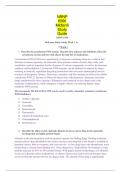
NRNP 6566 MidtermStudy Guide
NRNP 6566 MidtermStudy Guide NRNP 6566 Mid-term Study Guide Week 1 to 5 Week 1 1. Describe the cytochrome P450 system. Describe how inducers and inhibitors affect the cytochrome system and how that affects the half-life of medications. Cytochromes P450 (CYPs) are a superfamily of enzymes containing heme as a cofactor that function as monooxygenases. In mammals, these proteins oxidize steroids, fatty acids, and xenobiotics, and are important for the clearance of various compounds, as well as ...
QUICKEXAMINER
Examen
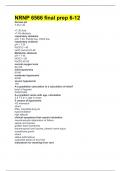
NRNP 6566 final prep 6-12
NRNP 6566 final prep 6-12 Normal pH 7.35-7.45 <7.35 Acid >7.45 alkalosis respiratory aklalosis pH> 7.45, PaC02 low, HC03 low respiratory acidosis pH < 7.35 PaCO2 > 45 Hc03 normal 22-26 Metabolic alkalosis pH > 7.45 HCO3 > 26 PaC02 45-35 normal oxygen levle 80-100 mild hypoxemia 60-80 moderate hypoxemia 40-60 severe hypoxemia <40 A-a gradiatian calculation is a calculation of what? level of hypoxia PA02-Pa02 A-a gradiant varies with age, calcula...
 TheInstructor
Examen
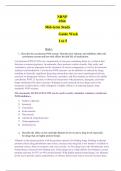
NRNP 6566 Mid-term Study Guide Week 1 to 5
NRNP 6566 Mid-term Study Guide Week 1 to 5 Week 1 1. Describe the cytochrome P450 system. Describe how inducers and inhibitors affect the cytochrome system and how that affects the half-life of medications. Cytochromes P450 (CYPs) are a superfamily of enzymes containing heme as a cofactor that function as monooxygenases. In mammals, these proteins oxidize steroids, fatty acids, and xenobiotics, and are important for the clearance of various compounds, as well as for hormone synthesis and br...
TheInstructor
Examen
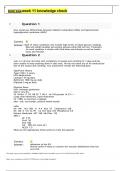
• NRNP 6566 week 11 knowledge check
• NRNP 6566 week 11 knowledge check How would you differentiate between diabetic ketoacidosis (DKA) and hyperosmolar hyperglycemic syndrome (HHS)? Correct Answer: Both of these conditions will include high levels of blood glucose readings. DKA will exhibit acidosis and urinary ketones while HHS will not. Treatment for each condition is similar with fluid bolus and infusion as well as insulin bolus and infusion. Juan is a 42 year old male with complaints of nausea and vomiti...
TheInstructor
Examen
NRNP 6566 week 6 knowledge check.
NRNP 6566 week 6 knowledge check. A 54 year old female has a 30 year pack smoking history. She recently underwent pulmonary function testing which showed moderate obstructive lung disease. What would your treatment plan (including medications) include for this patient? Correct Answer: The Global Initiative for Chronic Obstructive Lung Disease (GOLD) 2020 suggests that smoking cessation should be immediately pursued if the patient is still smoking. Nicotine replacement (gum, inhal...
QUICKEXAMINER
Examen
NRNP 6566 Week 5 Knowledge Check
NRNP 6566 Week 5 Knowledge Check QUESTION 1 1. A 54-year women is 3 days post abdominal surgery for removal of a cancerous mass in her abdomen. She develops acute shortness of breath associated with tachycardia and hypotension. CT Scan of the chest is positive for multiple small pulmonary embolism. What medication and dosing would you order initially to treat the pulmonary embolism? This patient should be given fondaparinuc (Arixtra) subcutaneously. Dosing is weight- based: 1. 5 mg SQ on...
QUICKEXAMINER
Examen
NRNP 6566 Knowledge Check Week 3
NRNP 6566 Knowledge Check Week 3 Amiodarone has possible complex interactions with multiple medications. It has an effect on warfarin metabolism. Amiodarone is a potent inhibitor of cytochrome P450 enzymes and inhibition of these enzymes will cause an increased plasma concentration and decreased clearance; thereby increasing the prothrombin time and INR placing the patient at increased risk for bleeding complications. Hence, when given together, warfarin dose should be decreased and frequent...
QUICKEXAMINER

Examen
NRNP 6566 week 11 knowledge check
NRNP 6566 week 11 knowledge check How would you differentiate between diabetic ketoacidosis (DKA) and hyperosmolar hyperglycemic syndrome (HHS)? Correct Answer: Both of these conditions will include high levels of blood glucose readings. DKA will exhibit acidosis and urinary ketones while HHS will not. Treatment for each condition is similar with fluid bolus and infusion as well as insulin bolus and infusion. Juan is a 42 year old male with complaints of nausea and vomiting for...
QUICKEXAMINER

Examen
NRNP 6566 WK1-5 Midterm Exam Latest Update Questions and Answers (A+ GRADED 100% VERIFIED)
NRNP 6566 WK1-5 Midterm Exam Latest Update Questions and Answers (A+ GRADED 100% VERIFIED)
nabiswahillary90
Examen
Nrnp 6566 Week 11 Knowledge Check 2 Latest Versions 2023 20 Questions And Correct Answers Agrade
NRNP 6566 WEEK 11 KNOWLEDGE CHECK 2 LATEST VERSIONS 2023 20 QUESTIONS AND CORRECT ANSWERS AGRADE VERSION A How would you differentiate between diabetic ketoacidosis (DKA) and hyperosmolar hyperglycemic syndrome (HHS)? Correct Answer: Both of these conditions will include high levels of blood glucose readings. DKA will exhibit acidosis and urinary ketones while HHS will not. Treatment for each condition is similar with fluid bolus and infusion as well as insulin bolus and infusion. Juan...
NURSINGDICTIONARY
Pack
NRNP 6566 WEEK 3, 4, 5, 6, 7,8, 9, 10 & 11 KNOWLEDGE CHECK QUIZZES
NRNP 6566 WEEK 3, 4, 5, 6, 7,8, 9, 10 & 11 KNOWLEDGE CHECK QUIZZES
 Publisher