
BIOS 256 256N (BIOS256256N)
Chamberlain College Of Nursing
Here are the best resources to pass BIOS 256 256N (BIOS256256N). Find BIOS 256 256N (BIOS256256N) study guides, notes, assignments, and much more.
Exam (elaborations)
BIOS 256 FINAL EXAM STUDY Q&A | Comprehensive ATI
BIOS 256 FINAL EXAM STUDY Q&A 1 The urinary system does all of the following, EXCEPT it A secretes excess glucose molecules B regulates blood volume C contributes to stabilizing blood pH D eliminates organic waste products E regulates plasma concentrations of electrolytes 2 Conical structures that are located in the renal medulla are called A pyramids B renal columns C renal pelvises D nephrons E calyces 3 The region known as the macula densa is part of A the proximal convoluted tubule B the dis...
 NURSEEXAMITY
Exam (elaborations)
Bios 256 Final Exam Study Guide
Popular04/13/2015 1 The urinary system does all of the following, EXCEPT it A secretes excess glucose molecules B regulates blood volume C contributes to stabilizing blood pH D eliminates organic waste products E regulates plasma concentrations of electrolytes 2 Conical structures that are located in the renal medulla are called A pyramids B renal columns C renal pelvises D nephrons E calyces 3 The region known as the macula densa is part of A the proximal convoluted tubule B the distal convoluted tubu...
NURSEEXAMITY
Exam (elaborations)
BIOS 256 FINAL EXAM STUDY Q&A | Comprehensive ATI
BIOS 256 FINAL EXAM STUDY Q&A 1 The urinary system does all of the following, EXCEPT it A secretes excess glucose molecules B regulates blood volume C contributes to stabilizing blood pH D eliminates organic waste products E regulates plasma concentrations of electrolytes 2 Conical structures that are located in the renal medulla are called A pyramids B renal columns C renal pelvises D nephrons E calyces 3 The region known as the macula densa is part of A the proximal convoluted tubule B the dis...
NURSEEXAMITY
Exam (elaborations)
BIOS 256 FINAL EXAM STUDY Q&A | Comprehensive ATI
BIOS 256 FINAL EXAM STUDY Q&A 1 The urinary system does all of the following, EXCEPT it A secretes excess glucose molecules B regulates blood volume C contributes to stabilizing blood pH D eliminates organic waste products E regulates plasma concentrations of electrolytes 2 Conical structures that are located in the renal medulla are called A pyramids B renal columns C renal pelvises D nephrons E calyces 3 The region known as the macula densa is part of A the proximal convoluted tubule B the dis...
NURSEEXAMITY
Package deal
BIOS 256 Quiz: Week 1 Upto Week 6 BUNDLE (100% Correct Solutions)
BIOS 256 Week 1: Quiz # 1 Question. Which term describes the study of the functions of body structures? (Points : 3) Question. Which feedback system structure receives output from the control center? (Points : 3) Question. Which feedback system structure provides input to the control center? (Points : 3) Question. Which cavity contains the heart? (
 EliteStudyPro
Exam (elaborations)
BIOS 256 Week 6 Quiz 6 (100% correct solutions) | Already RATED A
BIOS 256 Week 6 Quiz # 6 Question. (TCO 6) Which of the following—syndesmoses, gomphosis, or suture—is a type of fibrous joint composed of a thin layer of dense irregular fibrous connective tissu e found between the bones of the skull? (Points : 3) Question. (TCO 6) Which of the following types of joints—fibrous, cartilaginous, or synovial—do NOT have a synovial cavity? (Points : 3) Question. (TCO 6) Which of the following joints—gomphosi, synchondrosis, or suture—is classified as a ...
EliteStudyPro
Other
mod- Bios 256 Final Exam Review Packet
mod- Bios 256 Final Exam Review Packet
 Iansmiths
Other
Newest Bios 256 Midterm Exam Review Packet-1
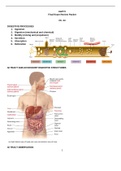
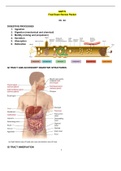
A&P IV Midterm Exam Review Packet Ch. 24 DIGESTIVE PROCESSES 1. Ingestion 2. Digestion (mechanical and chemical) 3. Motility (mixing and propulsion) 4. Secretion 5. Absorption 6. Defecation GI TRACT AND ACCESSORY DIGESTIVE STRUCTURES BE ABLE TO IDENTIFY EACH ORGAN ON THE IMAGE ABOVE. GI TRACT INNERVATION • Autonomic NS o Parasympathetic NV (enhances digestion) o Sympathetic NV (inhibits or slows down digestion) • Enteric Nervous System o Submuc...
 docguru
Exam (elaborations)
ch24-lecture-notes-ch-24 Human Anatomy&Physiology 1
Ch24 - Lecture notes ch 24 Human Anat&Physio 1 (Brooklyn College) Package Title: Testbank Course Title: pap13 Chapter Number: 24 Question type: Multiple Choice 1) Which of following processes is the function of the smooth muscle layer of the digestive system? a) Ingestion b) Secretion c) Mixing and propulsion d) Absorption e) None of these choices 2) Which of following ...
docguru
Other
mod- Bios 256 Final Exam Review Packet
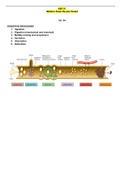
A&P IV Final Exam Review Packet Ch. 24 DIGESTIVE PROCESSES 1. Ingestion 2. Digestion (mechanical and chemical) 3. Motility (mixing and propulsion) 4. Secretion 5. Absorption 6. Defecation GI TRACT AND ACCESSORY DIGESTIVE STRUCTURES GI TRACT INNERVATION • Autonomic NS o Parasympathetic NV (enhances digestion) o Sympathetic NV (inhibits or slows down digestion) • Enteric Nervous System o Submucosal plexus o Myenteric plexus ENZYMES orig...
docguru