

BIO 202 (BIO 202)
Central Arizona College
Here are the best resources to pass BIO 202 (BIO 202). Find BIO 202 (BIO 202) study guides, notes, assignments, and much more.
Other
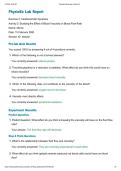
PhysioEx Lab Report Exercise 5: Cardiovascular Dynamics Activity 2: Studying the Effect of Blood Viscosity on Blood Flow Rate
PhysioEx Lab Report Exercise 5: Cardiovascular Dynamics Activity 2: Studying the Effect of Blood Viscosity on Blood Flow Rate Name: Morris Date: 15 February 2026 Session ID: session Pre-lab Quiz Results You scored 100% by answering 4 out of 4 questions correctly. 1 Which of the following is not a formed element? You correctly answered: plasma protein. 2 Thrombocytopenia is a reduction in platelets. What effect do you think this could have on blood viscosity? You correctly answered: d...
 morrisacademiamorrisa
Exam (elaborations)
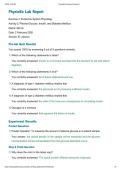
PhysioEx Lab Report Exercise 4: Endocrine System Physiology Activity 2: Plasma Glucose, Insulin, and Diabetes Mellitus
PopularPhysioEx Lab Report Exercise 4: Endocrine System Physiology Activity 2: Plasma Glucose, Insulin, and Diabetes Mellitus Name: Morris Date: 2 February 2026 Session ID: session Pre-lab Quiz Results You scored 100% by answering 5 out of 5 questions correctly. 1 Which of the following statements is false? You correctly answered: Insulin is a hormone secreted into the stomach to aid with starch digestion. 2 Which of the following statements is true? You correctly answered: All of these sta...
morrisacademiamorrisa
Exam (elaborations)
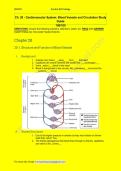
BIO 202 Ch. 20 - Cardiovascular System: Blood Vessels and Circulation Study Guide 2026-2027
Ch. 20 - Cardiovascular System: Blood Vessels and Circulation Study Guide 100/100 DIRECTIONS: Answer the following questions, definitions, labels, etc. READ AND ANSWER EVERYTHING SO YOU DON’T MISS POINTS. Chapter 20 20.1. Structure and Function of Blood Vessels I. Background 1. Arteries carry blood ___away__ __from____ the heart 2. Capillaries are where nutrients and wastes are ___exchanged___. 3. Veins _return___ blood to the heart. 4. Blood is transported in two circuits, the _pu...
morrisacademiamorrisa
Exam (elaborations)
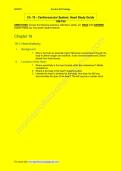
BIO 202 Ch. 19 - Cardiovascular System: Heart Study Guide 2026-2027
Ch. 19 - Cardiovascular System: Heart Study Guide 100/100 DIRECTIONS: Answer the following questions, definitions, labels, etc. READ AND ANSWER EVERYTHING SO YOU DON’T MISS POINTS. Chapter 19 19.1. Heart Anatomy I. Background 1. Why is the heart an essential organ? Because it pumps blood through the body to deliver oxygen and nutrients. It also removes wastes and Carbon dioxide from body tissues. II. Location of the Heart 1. Where specifically is the heart located within the mediastin...
morrisacademiamorrisa
Exam (elaborations)
BIO 202 Ch. 18 - Cardiovascular System: Blood Study Guide 2026-2027
Chapter 18 18.1. An Overview of Blood I. Background 1. Blood is what type of tissue? Connective tissue. 2. What are the three components of the formed elements? Erythrocytes, leukocytes, platelets. II. Functions of Blood 1. What is the primary function of blood? Transportation. A. Transportation 1. What is one substance blood is responsible for transporting? oxygen a) Why is this important? Oxygen ensures cells remain alive. 2. Blood assists in transportation of blood gases. What ga...
morrisacademiamorrisa
Package deal
BIO 202 PHYSIOEX LAB REPORTS
This package deal contains 100% complete for all BIO 202 PHYSIOEX LAB REPORTS completed. For more info: Email: morrisprofessionals@gmail.com
morrisacademiamorrisa
Exam (elaborations)
BIO 202 PhysioEx Lab Report Exercise 6: Cardiovascular Physiology Activity 1: Investigating the Refractory Period of Cardiac Muscle
PhysioEx Lab Report Exercise 6: Cardiovascular Physiology Activity 1: Investigating the Refractory Period of Cardiac Muscle Name: Morris Date: 20 February 2026 Session ID: Pre-lab Quiz Results You scored 100% by answering 4 out of 4 questions correctly. 1 The cardiac muscle is capable of which of the following? You correctly answered: autorhythmicity. 2 Phase 2 of the cardiac action potential, when the calcium channels remain open and potassium channels are closed, is called the You ...
morrisacademiamorrisa
Exam (elaborations)
BIO 202 PhysioEx Lab Report Exercise 6: Cardiovascular Physiology Activity 3: Examining the Effect of Temperature on Heart Rate
PhysioEx Lab Report Exercise 6: Cardiovascular Physiology Activity 3: Examining the Effect of Temperature on Heart Rate Name: Morris Date: 20 February 2026 Session ID: sessionPre-lab Quiz Results You scored 100% by answering 4 out of 4 questions correctly. 1 Organisms that usually maintain the same internal body temperature in spite of environmental temperature changes are You correctly answered: homeothermic. 2 The general name for the process that maintains the internal body temperat...
morrisacademiamorrisa
Exam (elaborations)
BIO 202 PhysioEx Lab Report Exercise 7: Respiratory System Mechanics Activity 1: Measuring Respiratory Volumes and Calculating Capacities
PhysioEx Lab Report Exercise 7: Respiratory System Mechanics Activity 1: Measuring Respiratory Volumes and Calculating Capacities Name: Morris Date: 20 February 2026 Session ID: Pre-lab Quiz Results You scored 100% by answering 5 out of 5 questions correctly. 1 Which of the following statements describing the mechanics of breathing is false? You correctly answered: Ventilation relies exclusively on contracting skeletal muscles. 2 The contraction of which of the following muscles will i...
morrisacademiamorrisa
Exam (elaborations)
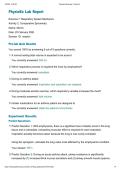
BIO 202 PhysioEx Lab Report Exercise 7: Respiratory System Mechanics Activity 2: Comparative Spirometry
PhysioEx Lab Report Exercise 7: Respiratory System Mechanics Activity 2: Comparative Spirometry Name: Morris Date: 20 February 2026 Session ID: session Pre-lab Quiz Results You scored 100% by answering 5 out of 5 questions correctly. 1 A normal resting tidal volume is expected to be around You correctly answered: 500 ml. 2 Which respiratory process is impaired the most by emphysema? You correctly answered: expiration. 3 During an asthma attack You correctly answered: inspiration and...
morrisacademiamorrisa
Exam (elaborations)
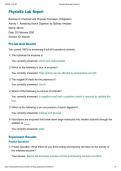
PhysioEx Lab Report Exercise 8: Chemical and Physical Processes of Digestion Activity 1: Assessing Starch Digestion by Salivary Amylase
PhysioEx Lab Report Exercise 8: Chemical and Physical Processes of Digestion Activity 1: Assessing Starch Digestion by Salivary Amylase Name: Morris Date: 20 February 2026 Session ID: session Pre-lab Quiz Results You scored 100% by answering 6 out of 6 questions correctly. 1 The substrate for amylase is You correctly answered: starch and carbohydrate. 2 Which of the following is true of enzymes? You correctly answered: Their activity can be affected by temperature and pH. 3 The reage...
morrisacademiamorrisa
Exam (elaborations)
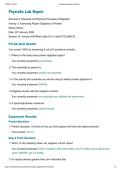
PhysioEx Lab Report Exercise 8: Chemical and Physical Processes of Digestion Activity 3: Assessing Pepsin Digestion of Protein
PhysioEx Lab Report Exercise 8: Chemical and Physical Processes of Digestion Activity 3: Assessing Pepsin Digestion of Protein Name: Morris Date: 20 February 2026 Session ID: session-548796e3-c3da-0c11-1d4d-977215df4735 Pre-lab Quiz Results You scored 100% by answering 5 out of 5 questions correctly. 1 Where in the body does protein digestion begin? You correctly answered: the stomach. 2 The substrate for pepsin is You correctly answered: protein and peptides. 3 In this activity the ...
morrisacademiamorrisa
Exam (elaborations)
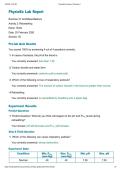
BIO 202 PhysioEx Lab Report Exercise 10: Acid-Base Balance Activity 2: Rebreathing
PhysioEx Lab Report Exercise 10: Acid-Base Balance Activity 2: Rebreathing Name: Morris Date: 20 February 2026 Session ID: Pre-lab Quiz Results You scored 100% by answering 4 out of 4 questions correctly. 1 In cases of acidosis, the pH of the blood is You correctly answered: less than 7.35. 2 Carbon dioxide and water form You correctly answered: carbonic acid (a weak acid). 3 Which of the following is true of respiratory acidosis? You correctly answered: The amount of carbon dioxide...
morrisacademiamorrisa
Exam (elaborations)
PhysioEx Lab Report Exercise 10: Acid-Base Balance Activity 4: Respiratory Responses to Metabolic Acidosis and Metabolic Alkalosis
PhysioEx Lab Report Exercise 10: Acid-Base Balance Activity 4: Respiratory Responses to Metabolic Acidosis and Metabolic Alkalosis Name: Morris Date: 20 February 2026 Session ID: session Pre-lab Quiz Results You scored 100% by answering 4 out of 4 questions correctly. 1 An increase in metabolic rate (without compensation) would result in You correctly answered: more carbon dioxide in the blood. 2 Excessive vomiting results in You correctly answered: loss of acid, metabolic alkalosis. ...
morrisacademiamorrisa
Exam (elaborations)
PhysioEx Lab Report Exercise 11: Blood Analysis Activity 1: Hematocrit Determination
PhysioEx Lab Report Exercise 11: Blood Analysis Activity 1: Hematocrit Determination Name: Morris Date: 19 February 2026 Session ID: session Pre-lab Quiz Results You scored 100% by answering 4 out of 4 questions correctly. 1 Hematocrit You correctly answered: of 40 means that 40% of the volume of blood consists of RBCs. 2 A buffy coat layer You correctly answered: is all of the above. 3 The diagnosis of anemia indicates You correctly answered: a lower-than-normal hematocrit. 4 Poly...
morrisacademiamorrisa
Exam (elaborations)
PhysioEx Lab Report Exercise 12: Serological Testing Activity 1: Using Direct Fluorescent Antibody Technique to Test for Chlamydia
PhysioEx Lab Report Exercise 12: Serological Testing Activity 1: Using Direct Fluorescent Antibody Technique to Test for Chlamydia Name: Morris Date: 20 February 2026 Session ID: sessionPre-lab Quiz Results You scored 100% by answering 4 out of 4 questions correctly. 1 Which of the following has an epitope? You correctly answered: an antigen. 2 Chlamydia trachomatis is You correctly answered: a bacterium that reproduces inside its host cell. 3 The infectious form of Chlamydia that is ...
morrisacademiamorrisa
Exam (elaborations)
PhysioEx Lab Report Exercise 12: Serological Testing Activity 3: Indirect Enzyme-Linked Immunosorbent Assay (ELISA)
PhysioEx Lab Report Exercise 12: Serological Testing Activity 3: Indirect Enzyme-Linked Immunosorbent Assay (ELISA) Name: Morris Date: 20 February 2026 Session ID: Pre-lab Quiz Results You scored 100% by answering 4 out of 4 questions correctly. 1 For home pregnancy tests You correctly answered: the antigen is human chorionic gonadotropin. 2 Which of the following is true of the indirect ELISA? You correctly answered: A positive patient sample contains antibodies specific to the antig...
morrisacademiamorrisa
Exam (elaborations)
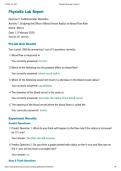
BIO 202 PhysioEx Lab Report Exercise 5: Cardiovascular Dynamics Activity 1: Studying the Effect of Blood Vessel Radius on Blood Flow Rate
PhysioEx Lab Report Exercise 5: Cardiovascular Dynamics Activity 1: Studying the Effect of Blood Vessel Radius on Blood Flow Rate Name: Morris Date: 12 February 2026 Session ID: session Pre-lab Quiz Results You scored 100% by answering 5 out of 5 questions correctly. 1 Blood flow is measured in You correctly answered: ml/min. 2 Which of the following has the greatest effect on blood flow? You correctly answered: blood vessel radius. 3 Which of the following would not result in a decr...
morrisacademiamorrisa
Other
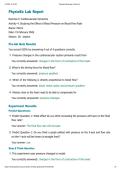
BIO 202 PhysioEx Lab Report Exercise 5: Cardiovascular Dynamics Activity 4: Studying the Effect of Blood Pressure on Blood Flow Rate
Pre-lab Quiz Results You scored 100% by answering 4 out of 4 questions correctly. 1 Pressure changes in the cardiovascular system primarily result from You correctly answered: changes in the force of contraction of the heart. 2 What is the driving force for blood flow? You correctly answered: pressure gradient. 3 Which of the following is directly proportional to blood flow? You correctly answered: blood vessel radius and pressure gradient. 4 Arteries close to the heart need to be able t...
morrisacademiamorrisa
Other
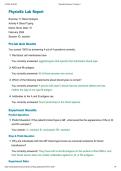
BIO 202 PhysioEx Lab Report Exercise 11: Blood Analysis Activity 4: Blood Typing
Pre-lab Quiz Results You scored 100% by answering 4 out of 4 questions correctly. 1 Red blood cell membranes have You correctly answered: agglutinogens that specify that individual's blood type. 2 ABO and Rh antigens You correctly answered: All of these answers are correct. 3 Which of the following statements about blood types is correct? You correctly answered: A person with type O blood has two recessive alleles and has neither the type A nor type B antigen. 4 Antibodies to the A a...
morrisacademiamorrisa