

University of St Andrews • Medicine
Latest uploads for Medicine at University of St Andrews. Looking for Medicine notes at University of St Andrews? We have lots of notes, study guides and study notes available for Medicine at University of St Andrews.
-
52
- 0
- 0
Courses Medicine at University of St Andrews
Notes available for the following courses of Medicine at University of St Andrews
-
MD2001 52
Latest content University of St Andrews • Medicine
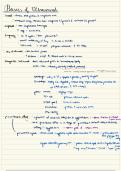
Basics of Ultrasound Element Learning Outcomes: -Explain, simply, the physics of ultrasound. -Differentiate different types of transducers and explain their strengths and weaknesses. -Explain the advantages and disadvantages of ultrasound scanning in comparison to other imaging modalities -Understand the different modes of scanning used in clinical practice.
- Class notes
- • 3 pages's •
-
University of St Andrews•MD2001
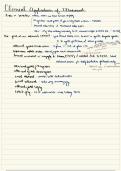
Clinical Applications of Ultrasound Element Learning Outcomes: -Compare the benefits vs risks of ultrasound -Identify the role of ultrasound in diagnosis of conditions -Explain the benefits and limitations of point of care ultrasound (POCUS) and Extended focused assessment with sonography for trauma (eFAST) -Give examples of other uses of ultrasound
- Class notes
- • 1 pages's •
-
University of St Andrews•MD2001
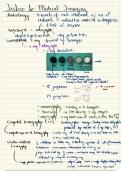
Introduction to Medical Imaging Element Learning Outcomes: -Learn the definitions used within radiology and imaging discussions -Differentiate between the different types of medical imaging techniques, with a particular focus on safety and risk -Explain the advantages and disadvantages of the different medical imaging techniques -Understand how to request scans appropriately
- Class notes
- • 2 pages's •
-
University of St Andrews•MD2001
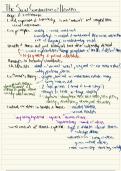
Social Construction of Health Element Learning Outcomes: -Describe and apply the social construction of health to identify how patients ascribe meaning to experiences of illness and disease -Understand and apply relevant sociological theories related to social constructionism in the context of health and illness -Explore the role of ‘stigma’ related to how patients may perceive health and illness -Examine the role of medicalisation for patients and healthcare systems
- Class notes
- • 2 pages's •
-
University of St Andrews•MD2001
Moral Theories and Ethics Element Learning Outcomes: -Identify the main characteristics of the moral theories of consequentialism, deontology, and virtue ethics -Compare and contrast the moral theories of consequentialism, deontology, and virtue ethics -Identify the shortcomings of each of the moral theories in decision-making -Name 3 other ethical theories that are commonly used in the healthcare setting. -Define and explain each of the 4 principles of medical ethics -Explain what the do...
- Class notes
- • 2 pages's •
-
University of St Andrews•MD2001
Medical Culture and Moral Vulnerability Element Learning Outcomes: -Identify aspects within the culture of medicine that could be viewed as moral vulnerabilities -Describe three ways to avoid moral erosion within medical school -Demonstrate the four quadrant approach through application to a particular case -Construct the steps involved in a structured case analysis
- Class notes
- • 2 pages's •
-
University of St Andrews•MD2001
Introduction to Medical Sociology Element Learning Outcomes: -Describe and apply sociological principles, key concepts, theories and evidence to health, illness and medical practice. -Develop an understanding of ‘medical sociology’ as an academic field. -Examine the key concepts of medical sociology. -Recognise and identify the relevance and presence of medical sociology in ‘everyday life’.
- Class notes
- • 1 pages's •
-
University of St Andrews•MD2001
Introduction to Medical Humanities Element Learning Outcomes: -Explain the importance of medical humanities and medical ethics in medicine -Recognise different ways that medical humanities approaches can benefit your learning in medicine -Describe the role of the General Medical Council (GMC) and list the four domains of the Duties of a Doctor, from the GMC's Good Medical Practice -State what a doctor's first concern should be, according to the Duties of a Doctor, and understand the impor...
- Class notes
- • 1 pages's •
-
University of St Andrews•MD2001
Consent Element Learning Outcomes: -Explain the four criteria required for consent to be valid -Discuss the importance of consent in the practice of medicine -Describe the rights of a capacitous patient as regards refusal of, preference for and demanding of treatment -Explain the criteria for adult capacity, and incapacity (under the Adults with Incapacity (Scotland) Act (2000)) -Recognise some of the difficulties that can arise when trying to assess capacity -Explain how decisions can be...
- Class notes
- • 1 pages's •
-
University of St Andrews•MD2001
Confidentiality Element Learning Outcomes: -Explain why confidentiality is important in medicine -Identify the circumstances under which confidential information can be disclosed under common law and by statutory requirement and explain the justifications for doing so in each case -List the 4 criteria that define 'the public interest' in terms of justifying disclosure of confidential information -Discuss the role of GMC guidance with regards to confidentiality, in particular as it relates...
- Class notes
- • 2 pages's •
-
University of St Andrews•MD2001
Being a Patient Element Learning Outcomes: -Explain the major features of what the patient is likely to experience in modern medicine -Evaluate the relevance of a behavioural science approach to being a doctor -Illustrate the application of behavioural science to medicine with three examples
- Class notes
- • 1 pages's •
-
University of St Andrews•MD2001
AI Safety Element Learning Outcomes: -Describe Generative AI (in basic terms), including its basic principles and functionalities. -Discuss AI Safety and relate this to the study and practice of medicine. -Discuss the limitations of Generative AI in relation to the accuracy of its outputs and suggest methods of validating AI tools in medicine. -Describe the shortcomings of Generative AI in relation to representation and diversity, and suggest methods to overcome these. -Propose generative ...
- Class notes
- • 1 pages's •
-
University of St Andrews•MD2001
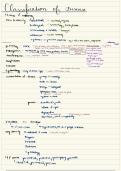
Classification of Disease Element Learning Outcomes -To define disease -To describe the characteristics of disease -To define terms used in the nomenclature of disease -To describe the classification of disease -To describe the epidemiological characteristics of some major human diseases -Understand what personalised medicine is trying to achieve
- Class notes
- • 1 pages's •
-
University of St Andrews•MD2001
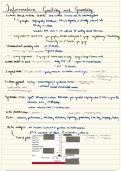
Information: Quality not Quantity Element Learning Outcomes: -Explain the importance of using up to date evidence for addressing clinical questions -Discuss potential sources of bias in medical research -Describe the strategy for conducting a systematic review -Explain the value of a meta-analysis and interpret a forest plot -Explain the importance of a confidence interval
- Class notes
- • 2 pages's •
-
University of St Andrews•MD2001
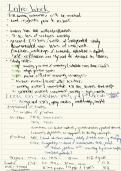
Introduction Week. Summary of the course MD2001 and MD2002, test components, study materials.
- Summary
- • 2 pages's •
-
University of St Andrews•MD2001
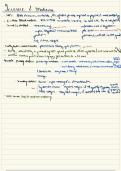
Science and Medicine Element Learning Outcomes: -Summarise the scientific method and the role of peer review -Explain the importance of evidence based medicine in the provision of care -Comment on the effect of bias on scientific research -Differentiate between primary and secondary research studies -Explain what is meant by an evidence pyramid
- Class notes
- • 1 pages's •
-
University of St Andrews•MD2001
Local Anaesthetics Element Learning Outcomes: -To give named examples of local anaesthetics and explain their clinical uses -To recognise the features of the weak base structure and the interaction with pH, which account for the mechanisms of action of local anaesthetics -To explain why local anaesthetics will have varying time courses of action and how this can be modified -To identify the different routes of administration of local anaesthetics -To predict the dangers and side-effects of...
- Class notes
- • 2 pages's •
-
University of St Andrews•MD2001
Principles of Antimicrobial Chemotherapy Element Learning Outcomes: -Define the principles of antibiotic chemotherapy -List the main classes of antibacterial agents -Describe the principle of selective toxicity giving examples -Outline the main mechanisms of action of the main antibiotic classes
- Class notes
- • 3 pages's •
-
University of St Andrews•MD2001
Active Transport and the Sodium Pump Element Learning Outcomes: -Describe the structure and function of the sodium pump, explain how it regulates ion concentrations and the clinical and physiological significance of this -Explain the clinical significance of the interaction between the binding of the cardiac glycosides and the extracellular potassium concentration -Explain, with example substances, the key features, energetics, differences and similarities of/ between primary active transpor...
- Class notes
- • 2 pages's •
-
University of St Andrews•MD2001
Body Fluid Compartments Element Learning Outcomes: -Explain the divisions of the fluid compartments of the body -List the concentrations of the major components of intracellular and extracellular fluid -Summarise the main features of biological membranes -Explain the importance of the amphipathic properties of membrane lipds -Explain the differences between integral and peripheral membrane proteins -Identify the key roles played by membrane transport processes -Use flux equation to expla...
- Class notes
- • 2 pages's •
-
University of St Andrews•MD2001