

Jurisprudence
London School of Economics (LSE)
Hier vind je de beste samenvattingen om te slagen voor Jurisprudence. Er zijn o.a. samenvattingen, aantekeningen en oefenvragen beschikbaar.
Populaire samengevatte studieboeken

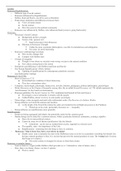
Study guide
Rousseau
For Rousseau, ultimate authority must always remain in the hands of the people and be an expression of their sovereignty. This is how real freedom is attained. Freedom is expressed through conformity with the ‘general will’ (volonté generale), not in a private or personal sphere. For Rousseau, the social contract ideally transforms the individual into a citizen, one who will embrace the general will. This is a good to which all must contribute; the contract is thus based on an idea of virtu...
 topqualitynotes
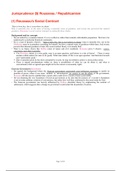
Study guide
Jurisprudence : Rousseau
PopulairDetailed analysis of Rousseau's concept of republicanism, where freedom is expressed through conformity with the ‘general will’.
fooyanwan
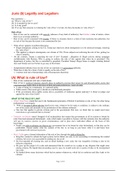
Study guide
Jurisprudence : Legality and Legalism
Detailed analysis of Hart-Fuller debate on Rule of Law (including Raz's view), a critique of legalism (Marxism, Robert Cover, Judith Shklar).
fooyanwan
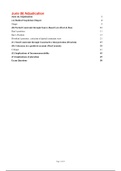
Study guide
Jurisprudence : Adjudication
Detailed analysis of law and adjudication : Radical Scepticism (Singer); The Positivist Response: Partial Constraint (Hart, Raz;, Interpretation, Coherence (MacCormick), and the ‘One Right Answer’ Thesis (Dworkin); Incommensurability (Finnis) and Pluralism (Sunstein)
fooyanwan
Study guide
Jurisprudence : Hobbes
Detailed analysis of Hobbes' social contract, where a government is justified because without it we will destroy each other.
fooyanwan
Study guide
Jurisprudence : Kant
Detailed analysis of Kant's social contract, where the government is justified because it is required by our nature as free and rational beings.
fooyanwan
Study guide
Jurisprudence : Rawls and Political Liberalism
Detailed analysis of Rawls and Political Liberalism, the role of the overlapping consensus and public reason in fostering a sense of justice.
fooyanwan
Study guide
Jurisprudence : Arendt
Detailed analysis of Hannah Arendt's concept of the political, and in particular the notion of ‘political freedom’, as well as consider what new perspective on law this demands.
fooyanwan
Study guide
Hobbes
Hobbes - government is justified because without it we will destroy each other. What reason do you have to agree to be subject to government and its laws? Isn’t it much better to be free and do your own thing? Hobbes made a name for himself by arguing that if you were free of government, chances are that you would not be able to do your own thing at all. Without government, there’s nothing stopping others from killing you, or taking what you possess, or bursting your balloon. You and everyon...
topqualitynotes
Study guide
Kant
Kant - government is justified because it is required by our nature as free and rational beings You think of yourself as a free and autonomous person. You also think that it should be up to you to choose how to live your life, and that it should be up to others to live theirs. Kant took these simple foundations and built an entire philosophical system on them, setting out the limits of government power and the justification of coercion on the way. He said that, in thinking yourself free, you are...
topqualitynotes
Study guide
Dworkin and Legal Positivism
Dworkin argues that Hart’s descriptive theory fails because it can’t explain the way we really talk about law. Hart’s theory, he says, implies that we share core criteria for determining what law is, and the disagreements that remain are over borderline issues.
topqualitynotes
Study guide
Hart and Legal Positivism
Hart puts forward the view that law (a legal system) is the union of two kinds of rules: primary and secondary rules. Primary rules are those rules that directly govern our conduct: rules that tell us what to do, like the law against committing murder, or requiring us to pay our taxes. Secondary rules, on the other hand, are rules about the primary rules, telling us how those primary rules can be changed, applied and identified.
topqualitynotes