
AQA
Latest uploads at AQA. Looking for notes at AQA? We have lots of notes, study guides and study notes available for your school.
-
34287
-
403
-
5860
Majors at AQA
Notes available for the following studies at AQA
-
A Level Biology
-
A Level Chemistry
-
A level English Literature B
-
Business - Marketing
-
Engineering - Design
-
Engineering - Mechatronics
-
Engineering - Power networks
-
English Literature
-
History
-
IT - Cyber Security
-
IT - Networking
-
IT - Programming
-
IT - User support
-
Psychology
-
Video Games
Popular books AQA

David Ferry, Angela Anderson • ISBN 9781471837586

Sally Waller, Chris Rowe • ISBN 9780198354604

Cara Flanagan, Dave Berry, Matt Jarvis, Rob Liddle • ISBN 9781908682413

Margaret Atwood, Margaret Atwood • ISBN 9781784874872

Carl Atherton, Sue Young • ISBN 9781510473478
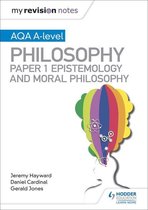
Dan Cardinal, Gerald Jones • ISBN 9781510451995

David Ferry, Tony Imperato • ISBN 9781471837500

CGP Books • ISBN 9781847623232

Anthony Webster, Robert J. Carr • ISBN 9780198354635

Mark Cardwell, Cara Flanagan • ISBN 9780198338680
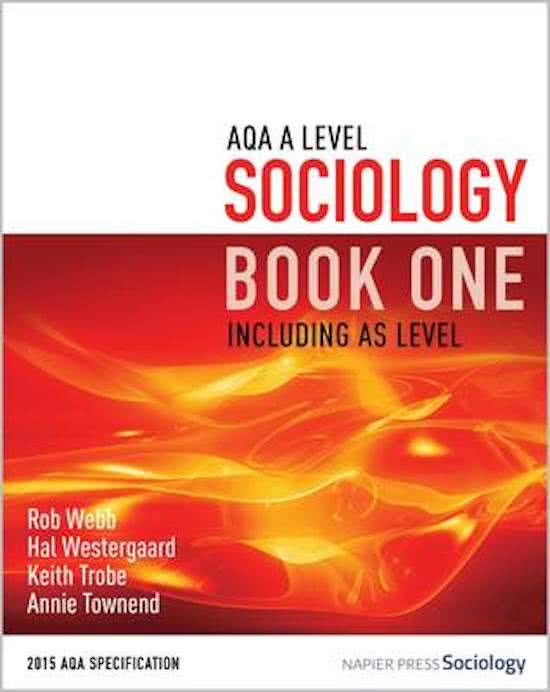
Rob Webb, Hal Westergaard • ISBN 9780954007911

J Daniels, Kat Kearey • ISBN 9780198354727

William Shakespeare • ISBN 9781853260186
Latest content AQA
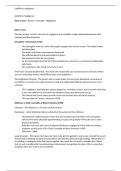
The Duty of Care is the first essential element of a negligence claim. It establishes a legal relationship between the defendant and the claimant, requiring the defendant to act with reasonable care to avoid causing harm. In A-Level Law, you must distinguish between "established duties" (where the law already recognizes a relationship) and "novel situations" (where the court must decide if a duty should exist).
- Summary
- • 3 pages's •
-
AQA•Unit 4 LAW04 - Criminal Law or Tort, and Concepts of Law
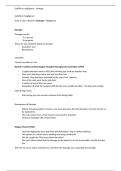
In Tort Law, Damages are the primary remedy aimed at restitution—putting the claimant back in the position they would have been in had the tort not occurred (Livingstone v Rawyards Coal Co). Unlike criminal fines, damages are compensatory, not punitive. The court divides damages into two main categories: Special Damages (calculable losses up to the date of trial) and General Damages (speculative losses looking into the future).
- Summary
- • 2 pages's •
-
AQA•Unit 4 LAW04 - Criminal Law or Tort, and Concepts of Law
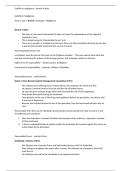
In the law of Tort, Breach of Duty is the second element of the negligence test (Duty, Breach, Damage). It occurs when a defendant fails to act as a "reasonable person" would have in the same situation. This is an objective test, meaning the court does not care if the defendant did their "best"; they care if the defendant reached the standard of a competent person performing that task.
- Summary
- • 4 pages's •
-
AQA•Unit 4 LAW04 - Criminal Law or Tort, and Concepts of Law
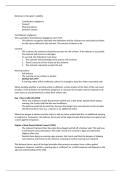
In Occupiers' Liability (governed by the 1957 Act for lawful visitors and the 1984 Act for trespassers), a defendant can avoid or reduce their liability by using several specific defences. Because this is a branch of negligence, the standard "tort" defences apply, but they have unique statutory twists.
- Summary
- • 2 pages's •
-
AQA•Unit 4 LAW04 - Criminal Law or Tort, and Concepts of Law
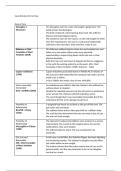
case directory
- Summary
- • 7 pages's •
-
AQA•Unit 4 LAW04 - Criminal Law or Tort, and Concepts of Law
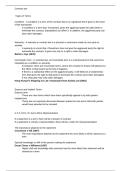
In Contract Law, not all terms are created equal. The classification of a term determines the remedy available to the innocent party if that term is broken. Under the traditional "two-part" classification, terms are either Conditions or Warranties, but modern law also recognizes Innominate Terms.
- Summary
- • 14 pages's •
-
AQA•Unit 3 LAW03 - Criminal Law or Contract Law
In A-Level Law, Contract Law moves away from the "guilty mind" of criminal law and focuses on the enforceability of agreements. For a contract to be legally binding—rather than just a social promise—it must satisfy three core pillars: Offer and Acceptance (the agreement), Consideration (the "price" paid), and Intention to Create Legal Relations. If any of these are missing, the "contract" is void, and the courts will not intervene if one party fails to deliver.
- Summary
- • 6 pages's •
-
AQA•Unit 3 LAW03 - Criminal Law or Contract Law
Loss of Control is the second statutory partial defence to murder, introduced by Sections 54 and 55 of the Coroners and Justice Act 2009. It replaced the old common law defence of "provocation." Like Diminished Responsibility, if successful, it reduces a murder charge to voluntary manslaughter, allowing for sentencing flexibility.
- Summary
- • 5 pages's •
-
AQA•Unit 3 LAW03 - Criminal Law or Contract Law
Diminished Responsibility is a statutory partial defence to murder, governed by Section 2 of the Homicide Act 1957 (as amended by the Coroners and Justice Act 2009). If successfully pleaded, it reduces a conviction from murder to voluntary manslaughter. This gives the judge sentencing discretion, allowing them to avoid the mandatory life sentence and instead impose a punishment that reflects the defendant's mental state, such as a hospital order.
- Summary
- • 4 pages's •
-
AQA•Unit 3 LAW03 - Criminal Law or Contract Law
Unlawful Act Manslaughter (also known as "Constructive Manslaughter") is a form of involuntary manslaughter where a defendant causes death while committing a lesser criminal act. Because the liability for the death is "constructed" from a minor crime, the prosecution does not need to prove that the defendant intended to kill or even foresaw a risk of death. According to the criteria established in R v Church, the prosecution must prove four elements: the defendant committed an unlawf...
- Summary
- • 3 pages's •
-
AQA•Unit 3 LAW03 - Criminal Law or Contract Law
Transferred Malice is a legal principle where a defendant’s criminal intent (mens rea) is shifted from their intended target to the actual victim. This doctrine ensures that a defendant cannot escape liability simply because their aim was poor or they hit the "wrong" person. As established in R v Latimer (1886), if a defendant attempts to strike one person but accidentally hits a bystander, the intent to harm the first person "transfers" to the second, satisfying the requirements f...
- Summary
- • 1 pages's •
-
AQA•Unit 3 LAW03 - Criminal Law or Contract Law
Theories of Criminal Law (or Theories of Punishment) provide the philosophical justification for why the state has the right to punish an individual and what that punishment should achieve. These theories are generally divided into two main camps: utilitarian (forward-looking) and retributive (backward-looking). Retribution is based on the "just deserts" principle, arguing that punishment is a moral necessity regardless of its social benefits; the punishment must be proportionate to the cr...
- Summary
- • 3 pages's •
-
AQA•Unit 3 LAW03 - Criminal Law or Contract Law
Theft is a statutory offence defined under Section 1(1) of the Theft Act 1968 as the "dishonest appropriation of property belonging to another with the intention of permanently depriving the other of it." For a conviction to be successful, the prosecution must prove all five elements of the offence. The Actus Reus consists of the appropriation (Section 3), which involves assuming any of the rights of an owner (R v Pitham and Hehl); the property (Section 4), which includes money and all oth...
- Summary
- • 2 pages's •
-
AQA•Unit 3 LAW03 - Criminal Law or Contract Law
Sentencing in the English legal system is the final stage of the criminal process, where the court determines the appropriate punishment for a defendant who has pleaded guilty or been convicted. This process is governed by the Sentencing Act 2020 and guided by the Sentencing Council, which provides specific guidelines to ensure consistency across courts. Judges and magistrates must consider the five statutory purposes of sentencing: the punishment of offenders, the reduction of crime (deterrence...
- Summary
- • 3 pages's •
-
AQA•Unit 3 LAW03 - Criminal Law or Contract Law
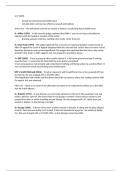
Section 47 of the Offences Against the Person Act 1861, commonly known as Actual Bodily Harm (ABH), is the most frequently prosecuted non-fatal offence. The actus reus requires a base offence of either an assault or a battery that results in "actual bodily harm." In the case of R v Miller, ABH was defined as any hurt or injury calculated to interfere with the health or comfort of the victim, provided it is "more than merely transient or trifling." This includes injuries such as exten...
- Summary
- • 1 pages's •
-
AQA•Unit 3 LAW03 - Criminal Law or Contract Law
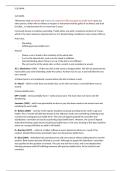
Section 20 of the Offences Against the Person Act 1861, known as Malicious Wounding or Inflicting Grievous Bodily Harm (GBH), is a mid-range non-fatal offence. The actus reus requires the defendant to either "wound" the victim (breaking both layers of the skin, often resulting in blood loss) or "inflict" GBH (defined in DPP v Smith as "really serious harm"). Examples include broken bones, permanent disfigurement, or serious psychiatric injury.
- Summary
- • 2 pages's •
-
AQA•Unit 3 LAW03 - Criminal Law or Contract Law
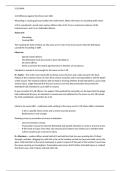
Section 18 of the Offences Against the Person Act 1861, often referred to as Wounding or GBH with Intent, is the most serious non-fatal offence in English law. The actus reus is identical to Section 20, requiring either a wound (a break in both layers of the skin, as in Moriarty v Brooks) or Grievous Bodily Harm (defined as "really serious harm" in DPP v Smith). What sets Section 18 apart is its significantly higher mens rea requirement: the prosecution must prove that the defendant had th...
- Summary
- • 1 pages's •
-
AQA•Unit 3 LAW03 - Criminal Law or Contract Law
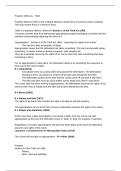
Theft is a statutory offence defined under Section 1(1) of the Theft Act 1968 as the "dishonest appropriation of property belonging to another with the intention of permanently depriving the other of it." For a conviction to be successful, the prosecution must prove all five elements of the offence. The Actus Reus consists of the appropriation (Section 3), which involves assuming any of the rights of an owner (R v Pitham and Hehl); the property (Section 4), which includes money and all oth...
- Summary
- • 5 pages's •
-
AQA•Unit 3 LAW03 - Criminal Law or Contract Law
Robbery is a statutory offence under Section 8(1) of the Theft Act 1968, famously described as "theft aggravated by force." To secure a conviction, the prosecution must first prove all five elements of a completed theft (appropriation, property, belonging to another, dishonesty, and intention to permanently deprive). The additional actus reus requirements for robbery are that the defendant must use force—or the threat of force—on any person immediately before or at the time of the thef...
- Summary
- • 2 pages's •
-
AQA•Unit 3 LAW03 - Criminal Law or Contract Law
Non-Fatal Offences Against the Person refer to a hierarchy of criminal acts where physical or psychological harm is inflicted on a victim without resulting in death. In English Law, these are primarily governed by the Criminal Justice Act 1988 and the Offences Against the Person Act 1861 (OAPA). The offences are structured in a "ladder" of severity, where both the actus reus (the injury caused) and the mens rea (the level of intent or recklessness) increase at each rung.
- Summary
- • 6 pages's •
-
AQA•Unit 3 LAW03 - Criminal Law or Contract Law