
ROBOTICS
Latest uploads at ROBOTICS. Looking for notes at ROBOTICS? We have lots of notes, study guides and study notes available for your school.
-
130
- 0
-
7
All courses for ROBOTICS
-
ROBOTICS 130
Latest content ROBOTICS
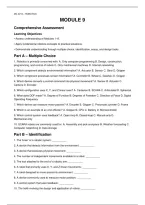
Assess understanding of Modules 1–8. Apply fundamental robotics concepts to practical situations. Demonstrate understanding through multiple-choice, identification, essay, and design tasks.
- Package deal
- Exam (elaborations)
- • 3 pages's •
-
robotics•robotics
-
Robotics• Bykaryllelizardo
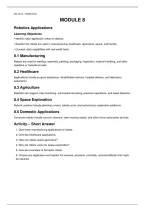
Identify major application areas of robotics. Explain how robots are used in manufacturing, healthcare, agriculture, space, and homes. Connect robot capabilities with real-world tasks.
- Package deal
- Exam (elaborations)
- • 1 pages's •
-
robotics•robotics
-
Robotics• Bykaryllelizardo
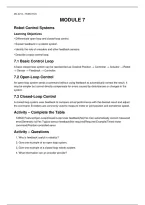
Differentiate open-loop and closed-loop control. Explain feedback in a robotic system. Identify the role of encoders and other feedback sensors. Describe a basic control loop
- Package deal
- Exam (elaborations)
- • 1 pages's •
-
robotics•robotics
-
Robotics• Bykaryllelizardo
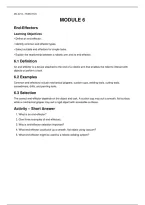
Define an end-effector. Identify common end-effector types. Select suitable end-effectors for simple tasks. Explain the relationship between a robotic arm and its end-effector
- Package deal
- Exam (elaborations)
- • 1 pages's •
-
robotics•robotics
-
Robotics• Bykaryllelizardo
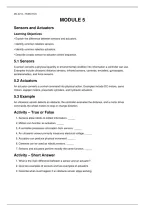
Explain the difference between sensors and actuators. Identify common robotics sensors. Identify common robotics actuators. Describe a basic sensor-to-actuator control sequence
- Package deal
- Exam (elaborations)
- • 2 pages's •
-
robotics•robotics
-
Robotics• Bykaryllelizardo
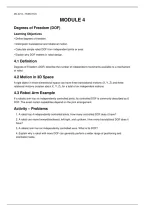
Define degrees of freedom. Distinguish translational and rotational motion. Calculate simple robot DOF from independent joints or axes. Explain why DOF matters in robot design
- Package deal
- Exam (elaborations)
- • 2 pages's •
-
robotics•robotics
-
Robotics• Bykaryllelizardo
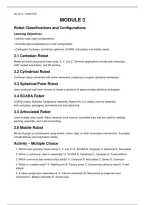
Identify major robot configurations. Describe typical applications of each configuration. Distinguish Cartesian, cylindrical, spherical, SCARA, articulated, and mobile robots.
- Package deal
- Exam (elaborations)
- • 2 pages's •
-
Robotics•Robotics
-
Robotics• Bykaryllelizardo
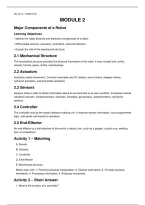
Identify the major physical and electronic components of a robot. Differentiate sensors, actuators, controllers, and end-effectors. Explain the role of the mechanical structure
- Package deal
- Exam (elaborations)
- • 3 pages's •
-
Robotics•Robotics
-
Robotics• Bykaryllelizardo
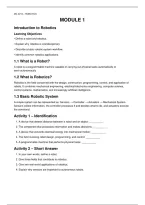
In this pdf file, you'll see a question and answer about robotics
- Package deal
- Exam (elaborations)
- • 2 pages's •
-
Robotics•Robotics
-
Robotics• Bykaryllelizardo
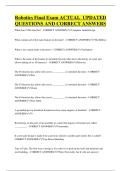
Robotics Final Exam ACTUAL UPDATED QUESTIONS AND CORRECT ANSWERS What does CAD stand for? - CORRECT ANSWERSComputer Aided Design What contains all of the main features in Inventor? - CORRECT ANSWERSThe Ribbon What is not a main mode in Inventor? - CORRECT ANSWERSAnimation What is the name of the feature in Autodesk Inventor that shows the history of a part and allows editing of its 3D features? - CORRECT ANSWERSBrowser The F2 function key allows the user to __________ in Autodesk ...
- Exam (elaborations)
- • 5 pages's •
-
Robotics•Robotics
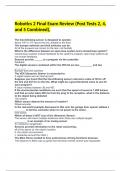
Robotics 2 Final Exam Review (Post Tests 2, 4, and 5 Combined), The line-following sensor is designed to operate: About 1/8" to 1/4" above the line, parallel to the floor The bumper switches and limit switches can be: All of the answers are correct (in the test, not Quizlet) What is the difference between an open-loop system and a closed-loop system? Closed-loop systems include feedback to the system's program; open-loop systems do not include feedback. Sensors provide ______ to a pr...
- Exam (elaborations)
- • 4 pages's •
-
Robotics•Robotics
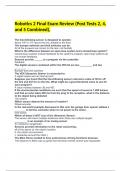
Robotics 2 Final Exam Review (Post Tests 2, 4, and 5 Combined), The line-following sensor is designed to operate: About 1/8" to 1/4" above the line, parallel to the floor The bumper switches and limit switches can be: All of the answers are correct (in the test, not Quizlet) What is the difference between an open-loop system and a closed-loop system? Closed-loop systems include feedback to the system's program; open-loop systems do not include feedback. Sensors provide ______ to a pr...
- Exam (elaborations)
- • 4 pages's •
-
Robotics•Robotics
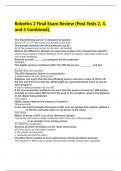
Robotics 2 Final Exam Review (Post Tests 2, 4, and 5 Combined), The line-following sensor is designed to operate: About 1/8" to 1/4" above the line, parallel to the floor The bumper switches and limit switches can be: All of the answers are correct (in the test, not Quizlet) What is the difference between an open-loop system and a closed-loop system? Closed-loop systems include feedback to the system's program; open-loop systems do not include feedback. Sensors provide ______ to a pr...
- Exam (elaborations)
- • 4 pages's •
-
Robotics•Robotics
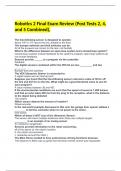
Robotics 2 Final Exam Review (Post Tests 2, 4, and 5 Combined), The line-following sensor is designed to operate: About 1/8" to 1/4" above the line, parallel to the floor The bumper switches and limit switches can be: All of the answers are correct (in the test, not Quizlet) What is the difference between an open-loop system and a closed-loop system? Closed-loop systems include feedback to the system's program; open-loop systems do not include feedback. Sensors provide ______ to a pr...
- Exam (elaborations)
- • 4 pages's •
-
Robotics•Robotics
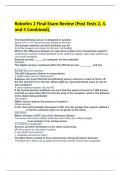
Robotics 2 Final Exam Review (Post Tests 2, 4, and 5 Combined), The line-following sensor is designed to operate: About 1/8" to 1/4" above the line, parallel to the floor The bumper switches and limit switches can be: All of the answers are correct (in the test, not Quizlet) What is the difference between an open-loop system and a closed-loop system? Closed-loop systems include feedback to the system's program; open-loop systems do not include feedback. Sensors provide ______ to a pr...
- Exam (elaborations)
- • 4 pages's •
-
Robotics•Robotics