

COMPSCI 161
Latest uploads at COMPSCI 161. Looking for notes at COMPSCI 161? We have lots of notes, study guides and study notes available for your school.
-
2
- 0
- 0
All courses for COMPSCI 161
-
COMPSCI 161 2
Latest content COMPSCI 161
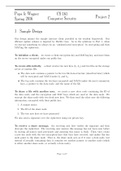
CS 161 Computer Security Project 2 1 Sample Design Our design mimics the sample insecure client provided in the student framework. Our efficient update scheme is inspired by Merkle trees. As in the solutions to Part 1, when we encrypt something we always do an “authenticated encryption” by encrypting and then MACing the ciphertext. To initialize a client, we create a client encryption key and MACing key, and store them on the server encrypted under our public key. To create afile in...
- Exam (elaborations)
- • 7 pages's •
-
COMPSCI 161•COMPSCI 161
Preview 2 out of 7 pages
Getting your document ready...
CS 161 Computer Security Project 2 1 Sample Design Our design mimics the sample insecure client provided in the student framework. Our efficient update scheme is inspired by Merkle trees. As in the solutions to Part 1, when we encrypt something we always do an “authenticated encryption” by encrypting and then MACing the ciphertext. To initialize a client, we create a client encryption key and MACing key, and store them on the server encrypted under our public key. To create afile in...
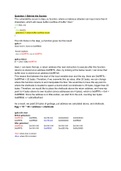
Question 1 Behind the Scenes The vulnerability occurs in deja_vu function, where a malicious attacker can input more than 8 characters, which will cause buffer overflow of buffer “door.” void deja_vu() { char door[8]; gets(door); // where buffer overflow occurs } The info frame in the deja_vu function gives me this result: (gdb) i f Stack level 0, frame at 0xbffff800: ... Saved registers: ebp at 0xbffff7f8, eip at 0xbffff7fc (gdb) p &door $1 = (char (*)[8]) 0xbffff7e8 He...
- Exam (elaborations)
- • 9 pages's •
-
COMPSCI 161•COMPSCI 161
Preview 2 out of 9 pages
Getting your document ready...
Question 1 Behind the Scenes The vulnerability occurs in deja_vu function, where a malicious attacker can input more than 8 characters, which will cause buffer overflow of buffer “door.” void deja_vu() { char door[8]; gets(door); // where buffer overflow occurs } The info frame in the deja_vu function gives me this result: (gdb) i f Stack level 0, frame at 0xbffff800: ... Saved registers: ebp at 0xbffff7f8, eip at 0xbffff7fc (gdb) p &door $1 = (char (*)[8]) 0xbffff7e8 He...