

BSMRAU
Latest uploads at BSMRAU. Looking for notes at BSMRAU? We have lots of notes, study guides and study notes available for your school.
-
35
- 0
-
2
All courses for BSMRAU
-
AGRI 202 5
-
AQC 231 1
-
AQUA 102 101 3
-
Biochemistry 4
-
BMB 201 1
-
CELL 101 3
-
FBE 165 3
-
FBE 235 1
-
FIT 201 1
-
FIT 235 1
-
FIT163 1
-
FIT204 1
-
FMG 110 1
-
FPT 301 1
-
FSH 3201 1
-
MPH-161 2
-
OCE 201 1
Latest content BSMRAU
Ornamental fish, a popular choice among aquarists, are aquatic animals known for their vibrant colors, unique patterns, and distinctive behaviors. These fish, native to Central America, exhibit sexual dimorphism, with males being slimmer and more colorful than females. They prefer aquariums with ample swimming space and live plants for shelter. Swordtails are livebearers, giving birth to live fry rather than laying eggs. They are prolific breeders, capable of reproducing every 4 to 6 weeks under...
- Summary
- • 8 pages's •
-
BSMRAU•AQC 231
This assignment explores the storage of frozen fishery products, focusing on the importance of temperature control, proper packaging, and techniques. It examines the impact of freezing on food nutritional aspects, such as protein retention, fat composition, and mineral content. It also addresses safety considerations, such as inhibiting microbial growth and preventing spoilage. Understanding the best practices for storing frozen products can help consumers and food industry professionals minimiz...
- Summary
- • 20 pages's •
-
BSMRAU•FIT 235
Homeostasis is crucial for fish survival, particularly through the regulation of body temperature, a process known as thermoregulation. Ectothermic organisms rely on external environmental temperatures to maintain their internal temperature within a physiological range. Fish exhibit various thermoregulatory strategies, primarily categorized into ectothermic and endothermic mechanisms. These strategies include thermal navigation, vasodilation, and countercurrent heat exchange. Understanding these...
- Summary
- • 11 pages's •
-
BSMRAU•FBE 235
Ecology is the scientific study of the relationships between living organisms and their environment, focusing on the interrelationships between organisms and their environment. Originating from the Greek words 'Oikos' meaning house or place to live and 'logos' meaning knowledge, ecology is the study of organisms at home. Ecology is divided into animal ecology and' synecology', which study the structure and function of ecosystems. Populations are groups of organisms perpetuated through repr...
- Summary
- • 2 pages's •
-
BSMRAU•FMG 110
Proteins are polymers of amino acids, with each amino acid residue joined to its neighbor by a specific type of covalent bond. All 20 of the common amino acids are -amino acids. They have a carboxyl group and an amino group bonded to the same carbon atom.
- Summary
- • 26 pages's •
-
BSMRAU•BMB 201
The streak plate method is a method used to isolate pure cultures of bacteria from mixed populations by spreading a concentrated sample over a solid agar medium. It is commonly used in environmental microbiology, clinical microbiology, and research laboratories. The pour plate method is a versatile technique used for the isolation and enumeration of microorganisms in a sample. It is versatile, allowing for the growth of both aerobic and anaerobic microorganisms and providing information about th...
- Summary
- • 6 pages's •
-
BSMRAU•FIT 201
Sustainable fishing is responsible for managing and maintaining fish populations to avoid exploiting natural resources. It protects ocean biodiversity, livelihoods, and contributes to global food security. Overfishing, illegal fishing, unreported fishing, and destructive fishing practices are challenges to maintaining sustainable fishing. Overfishing occurs when too many fish are caught, disrupting the ecosystem and putting the survival of endangered species at risk. Illegal fishing, unreported ...
- Summary
- • 3 pages's •
-
BSMRAU•FIT163
Sanitary index organisms are microorganisms used as indicators of cleanliness and hygiene in environments like water, food, or surfaces. They have been used for nearly a century to assess the microbiological status of food production and control systems. The term 'indicator organisms' has been used to evaluate the quality or safety of raw or processed food products and validate the effectiveness of microbial control measures. Ideal indicators include being useful for all types of water, presen...
- Summary
- • 7 pages's •
-
BSMRAU•MPH-161
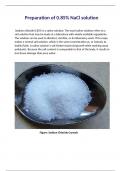
Sodium chloride 0.85% is a saline solution, commonly used in medical and laboratory settings for disinfection, sterilization, and research. It is the same concentration as bodily fluids and isotonic to them, making it less harmful to the body. The preparation process involves accurately measuring the required amount of sodium chloride, dissolving it in a specific volume of water, and thoroughly mixing the solution until the salt is completely dissolved. The solution is prepared by calculating th...
- Summary
- • 8 pages's •
-
BSMRAU•FIT204
Vibrio cholerae is a highly motile, comma-shaped, gram-negative bacteria that causes the deadly diarrheal disease cholera. It was first described in 1849 and isolated in 1884. The bacterium is primarily found in contaminated water and food, often associated with poor sanitation systems. Its pathogenicity stems from its ability to produce cholerae toxin, leading to severe dehydration and diarrhea. Understanding the entire life cycle of Vibrio cholerae is crucial for combating infectious diseases....
- Summary
- • 6 pages's •
-
BSMRAU•MPH-161