

Botany
Latest uploads at Botany. Looking for notes at Botany? We have lots of notes, study guides and revision notes available for your school.
-
400
- 0
-
11
All courses for Botany
-
Botany 401
-
BOTANY: 9
Latest content Botany
Easy-to-understand handwritten Botany notes bsc 1st semester . Includes important topics, diagrams, definitions, and exam-focused content. Ideal for B.Sc. students for revision, assignments, and semester exam preparation.
- Lecture notes
- • 12 pages's •
-
Botany•Botany

Blood Heart Lungs
- Lecture notes
- • 18 pages's •
-
Botany•Botany
Basically about the notes on cellular respiration that includes all topic cover of ncert. If you like I also give another chapter notes also as per requirement, class 11th ncert and important for purpose of neet examination, Covers all and each topic from cellular respiration chapter and easy to understand because of diagram and flow chart format. Please tell if required more. Thank you
- Lecture notes
- • 13 pages's •
-
Botany•Botany

Summaries,key concepts, complete chapter with colourful diagrams
- Summary
- • 8 pages's •
-
Botany•Botany

Detail notes of ecology from ncert book
- Exam (elaborations)
- • 10 pages's •
-
Botany•Botany

Easy chemistry notes
- Lecture notes
- • 19 pages's •
-
Botany•Botany
Test Bank for Botany An Introduction to Plant Biology 7th Edition by M
- Book & Paket-Deal
- Exam (elaborations)
- • 152 pages's •
-
Botany•Botany
-
Botany: An Introduction to Plant Biology • James D. Mauseth• ISBN 9781284068856
-
test bank kl• ByTestbankguruu
CONTENT • MICROBIOLOGIST AND THEIR CONTRIBUTION (LEEUWENHOUK, LOUIS PASTEUR, ROBERT KOCH, JOSEPH LISTER, DMITRI IWANOWSKI, SERGIUS WINOGRADSKY, AND M.W.BEIJERINCK AND PAUL EHRLICH) CONTENT • INTRODUCTION TO MICROBIAL DIVERSITY • METHODS OF ESTIMATION OF MICROBIAL DIVERSITY • HIERARCHICAL ORGANIZATION AND POSITIONS OF MICROBES IN THE LIVING WORLD • R.H. WHITTAKAR FIVE KINGDOM SYSTEM • CARL RICHARD WOESE’S THREE DOMAIN SYSTEM • DISTRIBUTION OF MICROBES IN SOIL, AIR, F...
- Lecture notes
- • 12 pages's •
-
botany•botany
Unlock the fascinating dynamics of plant structure and growth with these meticulously crafted botany lecture notes. Focused on key topics such as plant tissues, cell division, and cytology, these notes offer in-depth insights into the cellular processes that drive plant development. Explore the anatomy and functions of roots and stems, delving into their roles in nutrient transport and structural support. Ideal for students and professionals, these notes combine clarity with detail to enhance yo...
- Lecture notes
- • 10 pages's •
-
Botany•Botany
BOTANY 1303 Chapters 1 – 8 | Actual Exam Questions | 100% Correct Answers | Verified 2024 Version When using the scientific method, it is necessary to: - Test a hypothesis A researcher wants to know if WSU students are taller than USU students. Her null hypothesis is: - There is no difference in the height of students from either university A dependent variable is: - A response to a change in the independent variable. "Intelligent design" is not a scientific concept because: - It is n...
- Exam (elaborations)
- • 6 pages's •
-
BOTANY•BOTANY
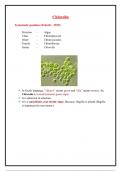
chlorella's systematic position, greek meaning, occurrence and structure
- Summary
- • 3 pages's •
-
botany•botany
Plant kingdom part 1
- Book
- Lecture notes
- • 2 pages's •
-
Botany•Botany
-
Science • NCERT• ISBN 9788174504920
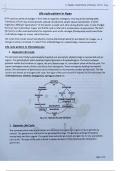
Details notes on the life cycle algea of following classes 1.Chlorophyceae hyceae 3.Rhodophyceae
- Lecture notes
- • 5 pages's •
-
Botany•Botany

General Instructions Be sure to read the general instructions from the Lessons portion of the class prior to completing this packet. Remember, you are to upload this packet with your quiz for the week! Background Ten thousand years ago, corn didn’t exist anywhere in the world, and until recently scientists argued vehemently about its origins. Today the crop is consumed voraciously by us, by our livestock, and as a major part of processed foods. So where did it come from? Popped Secr...
- Other
- • 5 pages's •
-
BOTANY•BOTANY

Providing for biology students alge information
- Other
- • 3 pages's •
-
Botany•Botany
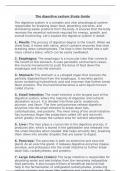
The human digestive system is a complex network of organs and processes responsible for breaking down food into nutrients that can be absorbed by the body. It starts with the mouth, where food is ingested and chewed, mixing with saliva to initiate the digestive process. From there, it travels down the esophagus to the stomach, where powerful acids and enzymes further break down the food. Next, the partially digested food enters the small intestine, where the majority of nutrient absorption occu...
- Summary
- • 2 pages's •
-
Botany•Botany
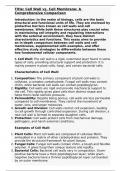
Cell Membrane (Plasma Membrane): Location: The cell membrane, also known as the plasma membrane, surrounds the entire cell. Composition: It is primarily composed of a phospholipid bilayer embedded with proteins. Function: The cell membrane is a selectively permeable barrier that regulates the passage of molecules in and out of the cell. It controls the exchange of nutrients, ions, and waste products with the external environment. Additionally, it plays a crucial role in cell signaling and c...
- Lecture notes
- • 3 pages's •
-
Botany•Botany
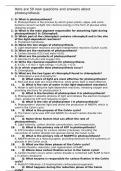
Photosynthesis is the biological process by which green plants, algae, and some bacteria convert light energy from the sun into chemical energy stored in the form of glucose (a type of sugar) and oxygen. This vital process takes place in the chloroplasts of plant cells, where chlorophyll, a green pigment, captures sunlight and uses it to power the conversion of carbon dioxide and water into glucose and oxygen. Photosynthesis not only provides energy for the plant but also plays a critical role i...
- Exam (elaborations)
- • 3 pages's •
-
Botany•Botany

Seed germination is the process by which a dormant seed transforms into a growing seedling. It involves the absorption of water, activation of metabolic processes, and emergence of the embryo from the seed coat. Under suitable environmental conditions, such as adequate moisture, temperature, and oxygen, the seed undergoes biochemical changes, breaking its dormancy, and giving rise to a new plant. This process typically includes the emergence of the radicle (the embryonic root) and the shoot (emb...
- Exam (elaborations)
- • 12 pages's •
-
Botany•Botany

Mitochondria are double-membraned organelles found in the cells of eukaryotic organisms, including humans. Often referred to as the "powerhouses of the cell," mitochondria play a crucial role in generating energy in the form of adenosine triphosphate (ATP) through a process called cellular respiration. They are known for their own DNA and the ability to replicate independently, which has led to the theory that they may have originated from symbiotic bacteria. Mitochondria are essential for var...
- Exam (elaborations)
- • 1 pages's •
-
Botany•Botany