

BIOD 151
Latest uploads at BIOD 151. Looking for notes at BIOD 151? We have lots of notes, study guides and study notes available for your school.
-
2194
- 0
-
196
All courses for BIOD 151
-
BioD 151 2
-
BIOD 151 2193
-
BIOD 151, 1
-
BIOD 151: 4
-
BIOD 151( 3
-
Biod 151/ 1
-
Biod 151 1
-
Biod-151 2
Latest content BIOD 151
BIOD 151 Module 1 Exam Questions And Answers, Complete Solution. Chemical, cellular, tissue, organ structure, organ system, organism What are the six levels of organization in the human body? Integumentary Necessary life function that protects our internal environment from our external environment is provided by what system? Muscular system Function of movement is provided by what system? Nervous system The function of responsiveness is provided by what system Digestive system The fu...
- Exam (elaborations)
- • 5 pages's •
-
BIOD 151•BIOD 151
Preview 2 out of 5 pages
Getting your document ready...
BIOD 151 Module 1 Exam Questions And Answers, Complete Solution. Chemical, cellular, tissue, organ structure, organ system, organism What are the six levels of organization in the human body? Integumentary Necessary life function that protects our internal environment from our external environment is provided by what system? Muscular system Function of movement is provided by what system? Nervous system The function of responsiveness is provided by what system Digestive system The fu...
BIOD 151 Module 1 Exam Questions and Correct Answers. Study There are six levels of organization in the body - what are they? 1) chemical 2) cellular 3) tissue 4) organ structure 5) organ system 6) organism The necessary life function that protects our internal environment from our external environment is provided by what system? The integumentary system The function of movement is provided by what system? The muscular system The function of responsiveness is provided by what syst...
- Exam (elaborations)
- • 5 pages's •
-
BIOD 151•BIOD 151
Preview 2 out of 5 pages
Getting your document ready...
BIOD 151 Module 1 Exam Questions and Correct Answers. Study There are six levels of organization in the body - what are they? 1) chemical 2) cellular 3) tissue 4) organ structure 5) organ system 6) organism The necessary life function that protects our internal environment from our external environment is provided by what system? The integumentary system The function of movement is provided by what system? The muscular system The function of responsiveness is provided by what syst...
BIOD 151 Module 2 Questions and Correct Answers. Complete Solution 2024. True or false. The lungs are symmetrical. False Hilum the "root" of the lung healthy lung tissue is what color peachy/pink color pleurae membranes that surround the lungs and the cavity around the lungs visceral pleura layer of pleura that faces/covers the lung parietal pleura outer layer of pleura lying closer to the ribs and chest wall that covers the surface around the lungs pleural space/cavity Space ...
- Exam (elaborations)
- • 8 pages's •
-
BIOD 151•BIOD 151
Preview 2 out of 8 pages
Getting your document ready...
BIOD 151 Module 2 Questions and Correct Answers. Complete Solution 2024. True or false. The lungs are symmetrical. False Hilum the "root" of the lung healthy lung tissue is what color peachy/pink color pleurae membranes that surround the lungs and the cavity around the lungs visceral pleura layer of pleura that faces/covers the lung parietal pleura outer layer of pleura lying closer to the ribs and chest wall that covers the surface around the lungs pleural space/cavity Space ...
BIOD 151 Module 1 Questions and Correct Answers, Complete Solution 2024. There are six levels of organization in the body - what are they? 1) chemical 2) cellular 3) tissue 4) organ structure 5) organ system 6) organism The necessary life function that protects our internal environment from our external environment is provided by what system? The integumentary system The function of movement is provided by what system? The muscular system The function of responsiveness is provided by...
- Exam (elaborations)
- • 5 pages's •
-
BIOD 151•BIOD 151
Preview 2 out of 5 pages
Getting your document ready...
BIOD 151 Module 1 Questions and Correct Answers, Complete Solution 2024. There are six levels of organization in the body - what are they? 1) chemical 2) cellular 3) tissue 4) organ structure 5) organ system 6) organism The necessary life function that protects our internal environment from our external environment is provided by what system? The integumentary system The function of movement is provided by what system? The muscular system The function of responsiveness is provided by...
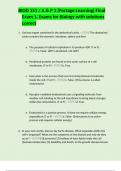
1. List two organs contained in the abdominal cavity. - The abdominal cavity contains the stomach, intestines, spleen and liver a. The purpose of cellular respiration is to produce ADP. (T or F) - a. False- (ATP is produced, not ADP) b. Peripheral proteins are found on the outer surface of a cell membrane. (T or F) - b. True
- Package deal
- Exam (elaborations)
- • 6 pages's •
-
BIOD 151•BIOD 151
-
BIOD 152 ALL MODULES EXAMS WITH ANSWERS 2024 UPDATE• ByTHEEXCELLENCELIBRARY
Preview 2 out of 6 pages
Getting your document ready...
1. List two organs contained in the abdominal cavity. - The abdominal cavity contains the stomach, intestines, spleen and liver a. The purpose of cellular respiration is to produce ADP. (T or F) - a. False- (ATP is produced, not ADP) b. Peripheral proteins are found on the outer surface of a cell membrane. (T or F) - b. True
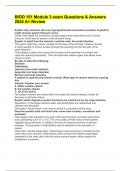
BIOD 151 Module 3 exam Questions & Answers 2024 A+ Review Explain why someone who has hypergastrinemia (excessive secretion of gastrin) might develop gastric/stomach ulcers. Gastrin stimulates the secretions of pepsinogens and hydrochloric acid. Excess amounts would lead to erosion of the stomach lining. Explain in detail how the stomach contents enter the small intestine The pyloric sphincter (valve), located at the base of the stomach, relaxes causing a small quantity of chyme to pass ...
- Exam (elaborations)
- • 4 pages's •
-
BIOD 151•BIOD 151
Preview 1 out of 4 pages
Getting your document ready...
BIOD 151 Module 3 exam Questions & Answers 2024 A+ Review Explain why someone who has hypergastrinemia (excessive secretion of gastrin) might develop gastric/stomach ulcers. Gastrin stimulates the secretions of pepsinogens and hydrochloric acid. Excess amounts would lead to erosion of the stomach lining. Explain in detail how the stomach contents enter the small intestine The pyloric sphincter (valve), located at the base of the stomach, relaxes causing a small quantity of chyme to pass ...
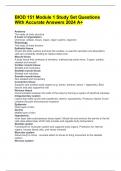
BIOD 151 Module 1 Study Set Questions With Accurate Answers 2024 A+ Anatomy The study of body structure 6 levels of organization Chemical, cellular, tissue, organ, organ system, organism Physiology The study of body function Epithelial tissue Covers the body surface and lines the cavities. Is used for secretion and absorption; cells are constantly dividing to replace dead ones Muscle tissue A body tissue that contracts or shortens, making body parts move. 3 types: cardiac, skeletal a...
- Exam (elaborations)
- • 8 pages's •
-
BIOD 151•BIOD 151
Preview 2 out of 8 pages
Getting your document ready...
BIOD 151 Module 1 Study Set Questions With Accurate Answers 2024 A+ Anatomy The study of body structure 6 levels of organization Chemical, cellular, tissue, organ, organ system, organism Physiology The study of body function Epithelial tissue Covers the body surface and lines the cavities. Is used for secretion and absorption; cells are constantly dividing to replace dead ones Muscle tissue A body tissue that contracts or shortens, making body parts move. 3 types: cardiac, skeletal a...
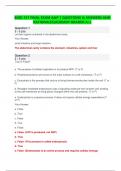
BIOD 151 FINAL EXAM A&P 1 QUESTIONS & ANSWERS AND RATIONALES(ALREADY GRADED A+) List two organs contained in the abdominal cavity. Your Answer: small intestine and large intestine The abdominal cavity contains the stomach, intestines, spleen and liver True or False? a. The purpose of cellular respiration is to produce ADP. (T or F) b. Peripheral proteins are found on the outer surface of a cell membrane. (T or F) c. Exocytosis is the process that occurs to bring biomacromolecules insid...
- Exam (elaborations)
- • 16 pages's •
-
BIOD 151•BIOD 151
Preview 3 out of 16 pages
Getting your document ready...
BIOD 151 FINAL EXAM A&P 1 QUESTIONS & ANSWERS AND RATIONALES(ALREADY GRADED A+) List two organs contained in the abdominal cavity. Your Answer: small intestine and large intestine The abdominal cavity contains the stomach, intestines, spleen and liver True or False? a. The purpose of cellular respiration is to produce ADP. (T or F) b. Peripheral proteins are found on the outer surface of a cell membrane. (T or F) c. Exocytosis is the process that occurs to bring biomacromolecules insid...
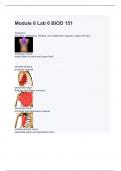
Module 6 Lab 6 BIOD 151 Trapezius Elevates, depresses, retracts, and rotates the scapula; rotates the arm accessory nerve motor fibers to neck and upper back Brainpower Read More serrates anterior protracts scapula pectoralis major Adducts and flexes humerus pectoralis minor protracts and depresses scapula medial pectoral nerve pectoralis major and pectoralis minor lateral pectoral nerve pectoralis major latissimus Doris Large, flat, triangular muscle coveri...
- Exam (elaborations)
- • 4 pages's •
-
BIOD 151•BIOD 151
Preview 1 out of 4 pages
Getting your document ready...
Module 6 Lab 6 BIOD 151 Trapezius Elevates, depresses, retracts, and rotates the scapula; rotates the arm accessory nerve motor fibers to neck and upper back Brainpower Read More serrates anterior protracts scapula pectoralis major Adducts and flexes humerus pectoralis minor protracts and depresses scapula medial pectoral nerve pectoralis major and pectoralis minor lateral pectoral nerve pectoralis major latissimus Doris Large, flat, triangular muscle coveri...
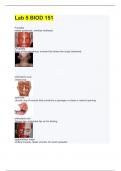
Lab 5 BIOD 151 Frontalis raises eyebrows, wrinkles forehead Occiptalis Back of the epicranius; muscle that draws the scalp backward. Brainpower Read More orbicularis oculi closes eye sphincter circular ring of muscle that constricts a passage or closes a natural opening orbicularis oris Closes lips, protrudes lips as for kissing zygomaticus major smiling muscle, raises corners of mouth upwards depressor labii inferioris depresses lower lip levator labii su...
- Exam (elaborations)
- • 4 pages's •
-
BIOD 151•BIOD 151
Preview 1 out of 4 pages
Getting your document ready...
Lab 5 BIOD 151 Frontalis raises eyebrows, wrinkles forehead Occiptalis Back of the epicranius; muscle that draws the scalp backward. Brainpower Read More orbicularis oculi closes eye sphincter circular ring of muscle that constricts a passage or closes a natural opening orbicularis oris Closes lips, protrudes lips as for kissing zygomaticus major smiling muscle, raises corners of mouth upwards depressor labii inferioris depresses lower lip levator labii su...