

BIO 250L
Latest uploads at BIO 250L. Looking for notes at BIO 250L? We have lots of notes, study guides and study notes available for your school.
-
75
- 0
-
10
All courses for BIO 250L
-
BIO 250L 75
Latest content BIO 250L
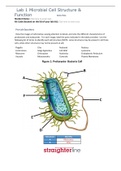
View the images of cells below, paying attention to detail, and note the different characteristics of prokaryotes and eukaryotes. For each image, label the parts indicated in the table provided. Use the following list of terms to identify each cell structure (NOTE- some structures may be present in all three cells, while other structures may not be present at all):” “Flagella” “Cilia “Nucleoid” “Nucleus” “Centromere” “Golgi Apparatus” “Cell Wall” “Lysosome” ...
- Package deal
- Exam (elaborations)
- • 8 pages's •
-
BIO 250L•BIO 250L
-
STRAIGHTERLINE MICROBIOLOGY BIO250L LABS 1,2,3,4,5,6,7 & 8 LATEST 2022• ByGarcia
Preview 2 out of 8 pages
Getting your document ready...
View the images of cells below, paying attention to detail, and note the different characteristics of prokaryotes and eukaryotes. For each image, label the parts indicated in the table provided. Use the following list of terms to identify each cell structure (NOTE- some structures may be present in all three cells, while other structures may not be present at all):” “Flagella” “Cilia “Nucleoid” “Nucleus” “Centromere” “Golgi Apparatus” “Cell Wall” “Lysosome” ...
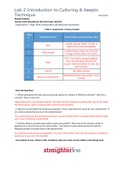
1. Which plate grew the most bacterial species (based on number of different colonies)? Was this a surprise? Why or why not?” Table #3 grew the most bacterial species. The kids have been eating and putting their toys on the table the whole day so I wasn’t surprised that it had the most bacteria. “2. Was the control plate free of bacterial colonies? If yes, what does this mean for your experiment? If not, what could be the source of the contamination?” The control plate was free of ...
- Package deal
- Exam (elaborations)
- • 4 pages's •
-
BIO 250L•BIO 250L
-
STRAIGHTERLINE MICROBIOLOGY BIO250L LABS 1,2,3,4,5,6,7 & 8 LATEST 2022• ByGarcia
Preview 1 out of 4 pages
Getting your document ready...
1. Which plate grew the most bacterial species (based on number of different colonies)? Was this a surprise? Why or why not?” Table #3 grew the most bacterial species. The kids have been eating and putting their toys on the table the whole day so I wasn’t surprised that it had the most bacteria. “2. Was the control plate free of bacterial colonies? If yes, what does this mean for your experiment? If not, what could be the source of the contamination?” The control plate was free of ...
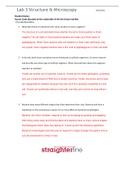
1. What determines if a bacterial cell is Gram-positive or Gram-negative? The structure of a cell wall determines whether the cell is Gram-positive or Gramnegative The cell walls of Gram-positive bacteria are made up of thick layers of peptidoglycan. When Gram positive cells are treated to a Gram stain technique, they turn purple. Gram negative bacteria have a thin coat of peptidoglycan on their cell walls 2. In this lab, both viruses and prions were introduced as acellular organisms. Do som...
- Package deal
- Exam (elaborations)
- • 9 pages's •
-
BIO 250L•BIO 250L
-
STRAIGHTERLINE MICROBIOLOGY BIO250L LABS 1,2,3,4,5,6,7 & 8 LATEST 2022• ByGarcia
Preview 2 out of 9 pages
Getting your document ready...
1. What determines if a bacterial cell is Gram-positive or Gram-negative? The structure of a cell wall determines whether the cell is Gram-positive or Gramnegative The cell walls of Gram-positive bacteria are made up of thick layers of peptidoglycan. When Gram positive cells are treated to a Gram stain technique, they turn purple. Gram negative bacteria have a thin coat of peptidoglycan on their cell walls 2. In this lab, both viruses and prions were introduced as acellular organisms. Do som...
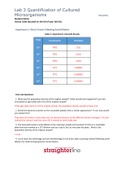
1. What was the population density of the original sample? What would have happened if you had inoculated an agar plate with 1mL of the original sample?” If the agar plate had 1mL of the original sample, the population density would increase a lot. “2. Did all the bacterial colonies on the countable plate(s) have a similar appearance? If not, how would you explain this?” They were all similar in some ways but not identical because of the different dilution strengths. I’ve also real...
- Package deal
- Exam (elaborations)
- • 2 pages's •
-
BIO 250L•BIO 250L
-
STRAIGHTERLINE MICROBIOLOGY BIO250L LABS 1,2,3,4,5,6,7 & 8 LATEST 2022• ByGarcia
Preview 1 out of 2 pages
Getting your document ready...
1. What was the population density of the original sample? What would have happened if you had inoculated an agar plate with 1mL of the original sample?” If the agar plate had 1mL of the original sample, the population density would increase a lot. “2. Did all the bacterial colonies on the countable plate(s) have a similar appearance? If not, how would you explain this?” They were all similar in some ways but not identical because of the different dilution strengths. I’ve also real...
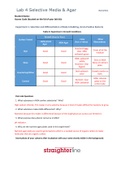
1. What substance in MSA confers selectivity? Why?” High sodium chloride. This makes it very selective because it kind of makes difficult for bacteria to grow. “2. What substance makes MSA differential? Why?” Mannitol because this makes it differential because of the staphylococcus aureus can ferment it. “3. What purpose does phenol red serve in MSA?” pH indicator. “4. Why are the nutrient agar plates used in this experiment?
- Package deal
- Exam (elaborations)
- • 4 pages's •
-
BIO 250L•BIO 250L
-
STRAIGHTERLINE MICROBIOLOGY BIO250L LABS 1,2,3,4,5,6,7 & 8 LATEST 2022• ByGarcia
Preview 1 out of 4 pages
Getting your document ready...
1. What substance in MSA confers selectivity? Why?” High sodium chloride. This makes it very selective because it kind of makes difficult for bacteria to grow. “2. What substance makes MSA differential? Why?” Mannitol because this makes it differential because of the staphylococcus aureus can ferment it. “3. What purpose does phenol red serve in MSA?” pH indicator. “4. Why are the nutrient agar plates used in this experiment?
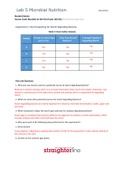
1. Why was cow manure used as a potential source of starch degrading bacteria?” Because it contains amylase which is an enzyme that breaks down starch into smaller molecules. Cow manure is used because of the high starch content and amylase which is responsible for degrading starch. “2. What are some other potential sources for starch degrading bacteria?” Starch degrading bacteria are mainly important for industries that have fermentation, textile, paper and also food. “3. What co...
- Package deal
- Exam (elaborations)
- • 3 pages's •
-
BIO 250L•BIO 250L
-
STRAIGHTERLINE MICROBIOLOGY BIO250L LABS 1,2,3,4,5,6,7 & 8 LATEST 2022• ByGarcia
Preview 1 out of 3 pages
Getting your document ready...
1. Why was cow manure used as a potential source of starch degrading bacteria?” Because it contains amylase which is an enzyme that breaks down starch into smaller molecules. Cow manure is used because of the high starch content and amylase which is responsible for degrading starch. “2. What are some other potential sources for starch degrading bacteria?” Starch degrading bacteria are mainly important for industries that have fermentation, textile, paper and also food. “3. What co...
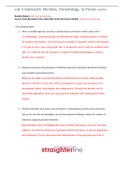
1. What is a model organism, and why is Saccharomyces cerevisiae so often used as one? In microbiology, molecular biology, and biochemistry labs, a model organism is utilized for analysis and research. Saccharomyces cerevisiae is frequently used as one because it is small (in sizo), has a fast growth rate, is inexpensive, and is safe and simple to work with. It is critical for the role of yeast in a variety of foods and beverages, including breads, wine, and beer.. 2. Research and discuss ...
- Package deal
- Exam (elaborations)
- • 7 pages's •
-
BIO 250L•BIO 250L
-
STRAIGHTERLINE MICROBIOLOGY BIO250L LABS 1,2,3,4,5,6,7 & 8 LATEST 2022• ByGarcia
Preview 2 out of 7 pages
Getting your document ready...
1. What is a model organism, and why is Saccharomyces cerevisiae so often used as one? In microbiology, molecular biology, and biochemistry labs, a model organism is utilized for analysis and research. Saccharomyces cerevisiae is frequently used as one because it is small (in sizo), has a fast growth rate, is inexpensive, and is safe and simple to work with. It is critical for the role of yeast in a variety of foods and beverages, including breads, wine, and beer.. 2. Research and discuss ...
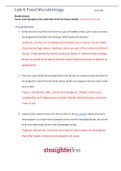
1. Escherichia coli is one of the most common causes of foodborne illness, yet it is also a common microorganism found within the human gut. What explains this disparity? Harmful E. coli that are in polluted food and water are a straine of E.coli called Enterohemorrhagic strains. Harmless strains are part of the normal microflora of the gut. These benefit the host by producing vitamin K. Without these harmless strains we would not be able to produce vitamin Kand would have to depend on sup...
- Package deal
- Exam (elaborations)
- • 7 pages's •
-
BIO 250L•BIO 250L
-
STRAIGHTERLINE MICROBIOLOGY BIO250L LABS 1,2,3,4,5,6,7 & 8 LATEST 2022• ByGarcia
Preview 2 out of 7 pages
Getting your document ready...
1. Escherichia coli is one of the most common causes of foodborne illness, yet it is also a common microorganism found within the human gut. What explains this disparity? Harmful E. coli that are in polluted food and water are a straine of E.coli called Enterohemorrhagic strains. Harmless strains are part of the normal microflora of the gut. These benefit the host by producing vitamin K. Without these harmless strains we would not be able to produce vitamin Kand would have to depend on sup...
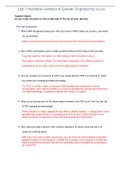
1. Which DNA nitrogenous bases pair with each other? Which bases are purines, and which are pyrimidines? Adenine and guanine are the purines and Cytosine and Thymine are the pyrimidines. 2. How is DNA information used to make proteins? What are the steps of this process? Enzymes read the information in a DNA molecule and transcribe it into an intermediary molecule, mRNA. The information contained in the mRNA molecule is translated for amino acids, which are the building blocks of proteins....
- Package deal
- Exam (elaborations)
- • 6 pages's •
-
BIO 250L•BIO 250L
-
STRAIGHTERLINE MICROBIOLOGY BIO250L LABS 1,2,3,4,5,6,7 & 8 LATEST 2022• ByGarcia
Preview 2 out of 6 pages
Getting your document ready...
1. Which DNA nitrogenous bases pair with each other? Which bases are purines, and which are pyrimidines? Adenine and guanine are the purines and Cytosine and Thymine are the pyrimidines. 2. How is DNA information used to make proteins? What are the steps of this process? Enzymes read the information in a DNA molecule and transcribe it into an intermediary molecule, mRNA. The information contained in the mRNA molecule is translated for amino acids, which are the building blocks of proteins....
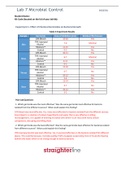
1. Which germicide was the most effective? Was the same germicide most effective for bacteria isolated from the different sources? What could explain this finding? 10% bleach was most effective. Yes, it was most effective for bacteria isolated from the different sources. Since bleach is a solution of sodium hypochlorite and water that is very effective in killing microorganisms, it is capable of entering microbial cells where it can react with many cellular components, disrupting and killin...
- Package deal
- Exam (elaborations)
- • 4 pages's •
-
BIO 250L•BIO 250L
-
STRAIGHTERLINE MICROBIOLOGY BIO250L LABS 1,2,3,4,5,6,7 & 8 LATEST 2022• ByGarcia
Preview 1 out of 4 pages
Getting your document ready...
1. Which germicide was the most effective? Was the same germicide most effective for bacteria isolated from the different sources? What could explain this finding? 10% bleach was most effective. Yes, it was most effective for bacteria isolated from the different sources. Since bleach is a solution of sodium hypochlorite and water that is very effective in killing microorganisms, it is capable of entering microbial cells where it can react with many cellular components, disrupting and killin...