

Basic Dysrhythmia
Latest uploads at Basic Dysrhythmia. Looking for notes at Basic Dysrhythmia? We have lots of notes, study guides and study notes available for your school.
-
175
- 0
-
40
All courses for Basic Dysrhythmia
-
Basic Dysrhythmia 175
Latest content Basic Dysrhythmia
This comprehensive Basic Dysrhythmia Practice Exam contains updated 2025 verified questions and correct answers covering cardiac conduction flow, AV block management, bundle branch pathways, intrinsic cardiac electrical activity, and sinus node heart rate parameters. Fully aligned with the 2026/2027 nursing and healthcare curriculum, this guide supports students preparing for dysrhythmia interpretation tests, ECG monitoring exams, and clinical competency checkoffs.
- Exam (elaborations)
- • 16 pages's •
-
Basic Dysrhythmia•Basic Dysrhythmia
Preview 3 out of 16 pages
Getting your document ready...
This comprehensive Basic Dysrhythmia Practice Exam contains updated 2025 verified questions and correct answers covering cardiac conduction flow, AV block management, bundle branch pathways, intrinsic cardiac electrical activity, and sinus node heart rate parameters. Fully aligned with the 2026/2027 nursing and healthcare curriculum, this guide supports students preparing for dysrhythmia interpretation tests, ECG monitoring exams, and clinical competency checkoffs.
Basic_Dysrhythmia Test
- Exam (elaborations)
- • 10 pages's •
-
Basic Dysrhythmia•Basic Dysrhythmia
Preview 2 out of 10 pages
Getting your document ready...
Basic_Dysrhythmia Test
BASIC DYSRHYTHMIA – RELIAS EXAM WITH 100% LATEST CORRECT ANSWERS AND VERIFIED QUESTIONS GRADED A+ normal sinus rhythm - ANS-heart rhythm originating in the sinoatrial node with a rate in patients at rest of 60 to 100 beats per minute Sinus Arrhythmia - ANS-Appearance is ALMOST NORMAL: Respiratory - Circulatory interaction Rate INCREASES with INSPIRATION (IN=IN) Sinus Bradycardia - ANS-<60 normal sinus rhythm Sinus Tachycardia - ANS->100 (100-150) normal sinus rhythm Premat...
- Exam (elaborations)
- • 4 pages's •
-
BASIC DYSRHYTHMIA•BASIC DYSRHYTHMIA
Preview 1 out of 4 pages
Getting your document ready...
BASIC DYSRHYTHMIA – RELIAS EXAM WITH 100% LATEST CORRECT ANSWERS AND VERIFIED QUESTIONS GRADED A+ normal sinus rhythm - ANS-heart rhythm originating in the sinoatrial node with a rate in patients at rest of 60 to 100 beats per minute Sinus Arrhythmia - ANS-Appearance is ALMOST NORMAL: Respiratory - Circulatory interaction Rate INCREASES with INSPIRATION (IN=IN) Sinus Bradycardia - ANS-<60 normal sinus rhythm Sinus Tachycardia - ANS->100 (100-150) normal sinus rhythm Premat...
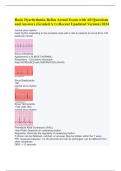
Basic Dysrhythmia-Relias Actual Exam with All Questions and Answers (Graded A+) (Recent Upadated Version) 2024 normal sinus rhythm heart rhythm originating in the sinoatrial node with a rate in patients at rest of 60 to 100 beats per minute Sinus Arrhythmia Appearance is ALMOST NORMAL: Respiratory - Circulatory interaction Rate INCREASES with INSPIRATION (IN=IN) Sinus Bradycardia <60 normal sinus rhythm Sinus Tachycardia >100 (100-150) normal sinus rhythm Prematu...
- Exam (elaborations)
- • 6 pages's •
-
Basic Dysrhythmia•Basic Dysrhythmia
Preview 2 out of 6 pages
Getting your document ready...
Basic Dysrhythmia-Relias Actual Exam with All Questions and Answers (Graded A+) (Recent Upadated Version) 2024 normal sinus rhythm heart rhythm originating in the sinoatrial node with a rate in patients at rest of 60 to 100 beats per minute Sinus Arrhythmia Appearance is ALMOST NORMAL: Respiratory - Circulatory interaction Rate INCREASES with INSPIRATION (IN=IN) Sinus Bradycardia <60 normal sinus rhythm Sinus Tachycardia >100 (100-150) normal sinus rhythm Prematu...
Basic Dysrhythmia Review | 100% Correct | Verified | Latest 2024 Version normal sinus rhythm (NSR) Criteria: (PR, QRS, QT, Rhythm: reg or irreg) 1 P-wave for Every QRS, REGULAR rhythm PR: 0.12-0.20 QRS: 0.06-0.10 BBB = > 0.12 QT: 0.36-0.44 BPM: 60-100 Sinus Bradycardia Criteria: (PR, QRS, QT, Rhythm: reg/irreg) PR: 0.12-0.20 QRS: 0.06-0.10 QT: 0.36-0.44 BPM: < 60 (Reg. rate) Tx: Atropine 0.5mg, Pace, Dopamine 2-10 mcg/kg/min, Epie 2-10 mcg/min Brainpower Read More Sinus Tac...
- Package deal
- Exam (elaborations)
- • 10 pages's •
-
Basic Dysrhythmia•Basic Dysrhythmia
-
Basic Dysrhythmia BUNDLED Exam 100% Correct | Verified | Latest 2024 Version• Byhov
Preview 2 out of 10 pages
Getting your document ready...
Basic Dysrhythmia Review | 100% Correct | Verified | Latest 2024 Version normal sinus rhythm (NSR) Criteria: (PR, QRS, QT, Rhythm: reg or irreg) 1 P-wave for Every QRS, REGULAR rhythm PR: 0.12-0.20 QRS: 0.06-0.10 BBB = > 0.12 QT: 0.36-0.44 BPM: 60-100 Sinus Bradycardia Criteria: (PR, QRS, QT, Rhythm: reg/irreg) PR: 0.12-0.20 QRS: 0.06-0.10 QT: 0.36-0.44 BPM: < 60 (Reg. rate) Tx: Atropine 0.5mg, Pace, Dopamine 2-10 mcg/kg/min, Epie 2-10 mcg/min Brainpower Read More Sinus Tac...
Basic Dysrhythmia Study Guide | 100% Correct | Verified | Latest 2024 Version Sinus Rhythm 60-100bpm Present P-wave PRI 0.12-0.20 seconds QRS 0.12> seconds Sinus Bradycardia 40-60bpm Present P-wave PRI 0.12-0.20 seconds QRS 0.12> seconds Brainpower Read More Sinus Tachycardia 100-160bpm Present P-wave PRI 0.12-0.20 seconds QRS 0.12> seconds Sinus arrhythmia Irregular Normal or slow Present P-Wave PRI 0.12-0.20 seconds QRS 0.12> seconds
- Package deal
- Exam (elaborations)
- • 8 pages's •
-
Basic Dysrhythmia•Basic Dysrhythmia
-
Basic Dysrhythmia BUNDLED Exam 100% Correct | Verified | Latest 2024 Version• Byhov
Preview 2 out of 8 pages
Getting your document ready...
Basic Dysrhythmia Study Guide | 100% Correct | Verified | Latest 2024 Version Sinus Rhythm 60-100bpm Present P-wave PRI 0.12-0.20 seconds QRS 0.12> seconds Sinus Bradycardia 40-60bpm Present P-wave PRI 0.12-0.20 seconds QRS 0.12> seconds Brainpower Read More Sinus Tachycardia 100-160bpm Present P-wave PRI 0.12-0.20 seconds QRS 0.12> seconds Sinus arrhythmia Irregular Normal or slow Present P-Wave PRI 0.12-0.20 seconds QRS 0.12> seconds
Basic Dysrhythmia Test | 100% Correct Answers | Verified | Latest 2024 Version What is the flow of conduction in the heart? - SA Node --> AV Node --> Bundle of His --> Purkinje fibers Identify the parts of the conduction system - Left side: SA node, AV node, Right bundle branch Right side: Bundle of His, Left bundle branch, Left anterior division, Left posterior division In which AV block should we use Atropine with caution? - 2nd degree TYPE 2 What is the special quality of the ...
- Package deal
- Exam (elaborations)
- • 8 pages's •
-
Basic Dysrhythmia•Basic Dysrhythmia
-
Basic Dysrhythmia BUNDLED Exam 100% Correct | Verified | Latest 2024 Version• Byhov
Preview 2 out of 8 pages
Getting your document ready...
Basic Dysrhythmia Test | 100% Correct Answers | Verified | Latest 2024 Version What is the flow of conduction in the heart? - SA Node --> AV Node --> Bundle of His --> Purkinje fibers Identify the parts of the conduction system - Left side: SA node, AV node, Right bundle branch Right side: Bundle of His, Left bundle branch, Left anterior division, Left posterior division In which AV block should we use Atropine with caution? - 2nd degree TYPE 2 What is the special quality of the ...
Sinus Rhythm 60-100bpm Present P-wave PRI 0.12-0.20 seconds QRS 0.12> seconds Sinus Bradycardia 40-60bpm Present P-wave PRI 0.12-0.20 seconds QRS 0.12> seconds Sinus Tachycardia
- Exam (elaborations)
- • 13 pages's •
-
Basic Dysrhythmia•Basic Dysrhythmia
Preview 2 out of 13 pages
Getting your document ready...
Sinus Rhythm 60-100bpm Present P-wave PRI 0.12-0.20 seconds QRS 0.12> seconds Sinus Bradycardia 40-60bpm Present P-wave PRI 0.12-0.20 seconds QRS 0.12> seconds Sinus Tachycardia
EKG interpretation One of the most useful and commonly used diagnostic tools is electrocardiography (EKG) which measures the heart's electrical activity as waveforms. An EKG uses electrodes attached to the skin to detect electric current moving through the heart. These signals are transmitted to produce a record of cardiac activity. Arrhythmia or dysrhythmia are disturbances in the normal cardiac rhythm of the heart which occurs as a result of alterations within the conduction of electrica...
- Exam (elaborations)
- • 10 pages's •
-
Basic Dysrhythmia•Basic Dysrhythmia
Preview 2 out of 10 pages
Getting your document ready...
EKG interpretation One of the most useful and commonly used diagnostic tools is electrocardiography (EKG) which measures the heart's electrical activity as waveforms. An EKG uses electrodes attached to the skin to detect electric current moving through the heart. These signals are transmitted to produce a record of cardiac activity. Arrhythmia or dysrhythmia are disturbances in the normal cardiac rhythm of the heart which occurs as a result of alterations within the conduction of electrica...
normal sinus rhythm heart rhythm originating in the sinoatrial node with a rate in patients at rest of 60 to 100 beats per minute Sinus Arrhythmia Appearance is ALMOST NORMAL: Respiratory - Circulatory interaction Rate INCREASES with INSPIRATION (IN=IN) Sinus Bradycardia <60 normal sinus rhythm
- Exam (elaborations)
- • 10 pages's •
-
Basic Dysrhythmia•Basic Dysrhythmia
Preview 2 out of 10 pages
Getting your document ready...
normal sinus rhythm heart rhythm originating in the sinoatrial node with a rate in patients at rest of 60 to 100 beats per minute Sinus Arrhythmia Appearance is ALMOST NORMAL: Respiratory - Circulatory interaction Rate INCREASES with INSPIRATION (IN=IN) Sinus Bradycardia <60 normal sinus rhythm