

12 class
Meest recente samenvattingen op de 12 class. Op zoek naar een samenvatting op de 12 class? Wij hebben diverse samenvattingen voor jouw school of universiteit.
-
237
- 0
-
5
All courses for 12 class
Laatste content 12 class
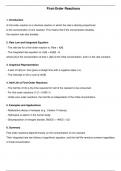
A first-order reaction is one where the reaction rate depends linearly on the concentration of a single reactant. The rate law is: text{Rate} = k[A] The integrated rate law for a first-order reaction is: ln[A] = ln[A]_0 - kt where is the rate constant, and is the initial concentration. A plot of ln[A] vs. time gives a straight line with a slope of -k. The half-life () is constant and given by: t_{1/2} = frac{0.693}{k} First-order kinetics are common in radioactive ...
- Boek
- College aantekeningen
- • 1 pagina's's •
-
12 class•12 class
-
NCERT Examplar Chemistry Class 12th • Ramashish Paul• ISBN 9789351764649
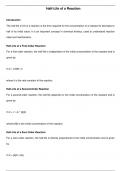
The half-life (t₁/₂) of a reaction is the time required for the concentration of a reactant to reduce to half its initial value. It varies based on reaction order: 1. Zero-order: (Depends on initial concentration). 2. First-order: (Constant, independent of concentration). 3. Second-order: (Depends on initial concentration). Half-life is crucial in fields like pharmacokinetics and radioactive decay, helping predict reaction progress and substance depletion over time.
- Boek
- College aantekeningen
- • 2 pagina's's •
-
12 class•12 class
-
NCERT Examplar Chemistry Class 12th • Ramashish Paul• ISBN 9789351764649
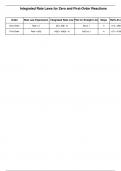
Integrated rate laws describe how reactant concentration changes over time for different reaction orders. They help determine reaction order and rate constants using experimental data. 1. Zero-order: (Straight-line plot of vs. time). 2. First-order: (Straight-line plot of vs. time). 3. Second-order: (Straight-line plot of vs. time). These equations help predict reactant concentrations at any time and determine reaction half-lives.
- Boek
- College aantekeningen
- • 1 pagina's's •
-
12 class•12 class
-
NCERT Examplar Chemistry Class 12th • Ramashish Paul• ISBN 9789351764649
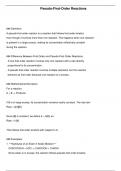
A pseudo-first-order reaction is a reaction that appears to follow first-order kinetics but is actually of a higher order. This occurs when one reactant is present in excess, making its concentration nearly constant during the reaction. As a result, the rate law simplifies to a first-order equation. For example, in the hydrolysis of ethyl acetate (CH₃COOC₂H₅ + H₂O → CH₃COOH + C₂H₅OH), water is in large excess, so its concentration is considered constant, and the reaction follo...
- Boek
- College aantekeningen
- • 2 pagina's's •
-
12 class•12 class
-
NCERT Examplar Chemistry Class 12th • Ramashish Paul• ISBN 9789351764649
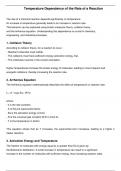
The rate of a chemical reaction increases with temperature due to the greater kinetic energy of particles. This leads to more frequent and energetic collisions, increasing the chances of overcoming the activation energy barrier. The Arrhenius equation describes this relationship, showing how reaction rate depends on temperature and activation energy. A general rule states that for every 10°C increase, the reaction rate roughly doubles. Higher temperatures allow more molecules to reach the requi...
- Boek
- College aantekeningen
- • 2 pagina's's •
-
12 class•12 class
-
NCERT Examplar Chemistry Class 12th • Ramashish Paul• ISBN 9789351764649
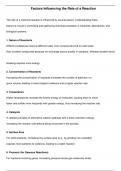
The rate of a chemical reaction is influenced by several key factors: 1. Concentration – Higher reactant concentration increases the likelihood of particle collisions, speeding up the reaction. 2. Temperature – Higher temperatures provide particles with more energy, leading to more frequent and energetic collisions. 3. Surface Area – Finely divided solids react faster due to increased exposure to reactants. 4. Catalysts – Catalysts lower the activation energy, allowing ...
- Boek
- College aantekeningen
- • 2 pagina's's •
-
12 class•12 class
-
NCERT Examplar Chemistry Class 12th • Ramashish Paul• ISBN 9789351764649
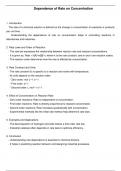
The rate of a chemical reaction depends on the concentration of reactants, as described by the rate law: Rate = k[A]^m[B]^n, where m and n are reaction orders. Higher reactant concentrations generally increase the rate due to more frequent molecular collisions. In zero-order reactions, the rate is independent of concentration. In first-order reactions, the rate is directly proportional to reactant concentration, while in second-order reactions, it depends on the square of the concentration. The ...
- Boek
- College aantekeningen
- • 1 pagina's's •
-
12 class•12 class
-
NCERT Examplar Chemistry Class 12th • Ramashish Paul• ISBN 9789351764649
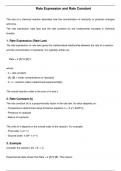
The rate expression (or rate law) is a mathematical equation that describes how the rate of a chemical reaction depends on reactant concentrations. It is typically written as Rate = k[A]^m[B]^n, where k is the rate constant, [A] and [B] are reactant concentrations, and m, n are reaction orders. The rate constant (k) determines the reaction speed and varies with temperature, influenced by the Arrhenius equation: k = A * e^(-Ea/RT). While the rate expression is determined experimentally, the rate ...
- Boek
- College aantekeningen
- • 2 pagina's's •
-
12 class•12 class
-
NCERT Examplar Chemistry Class 12th • Ramashish Paul• ISBN 9789351764649
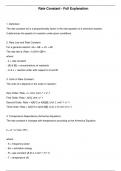
The rate constant (k) is a proportionality factor in the rate law of a chemical reaction, linking the reaction rate to the concentrations of reactants. It is specific to a given reaction at a particular temperature and depends on activation energy and molecular collisions. The rate law is typically written as Rate = k[A]^m[B]^n, where m and n are reaction orders. The unit of k varies with reaction order. Temperature affects k, often described by the Arrhenius equation: k = A * e^(-Ea/RT). Unders...
- Boek
- College aantekeningen
- • 2 pagina's's •
-
12 class•12 class
-
NCERT Examplar Chemistry Class 12th • Ramashish Paul• ISBN 9789351764649
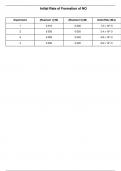
The term "initial_rate_NO" likely refers to the initial reaction rate involving nitric oxide (NO) in a chemical reaction. In kinetics, the initial rate is the reaction rate measured at the very beginning, where reactant concentrations are known and product interference is minimal. For reactions involving NO, the rate depends on its concentration and reaction order. Common examples include NO oxidation to NO₂ or its role in catalytic cycles. The initial rate can be determined experimentally u...
- Boek
- College aantekeningen
- • 1 pagina's's •
-
12 class•12 class
-
NCERT Examplar Chemistry Class 12th • Ramashish Paul• ISBN 9789351764649