
- Biochemistry
Latest uploads at - Biochemistry. Looking for notes at - Biochemistry? We have lots of notes, study guides and study notes available for your school.
-
9
- 0
-
2
All courses for - Biochemistry
-
Medtech 1
Latest content - Biochemistry
Biochemistry Shelf EXAM Questions and Answers A Mixture of bacterial DNA solution subjected to spectroscopic studies consists of 38% of adenine base. What apporximate percentage of the bases are guanine 12% are guanine 38% are Adenine 38% are Thymine thus 24% are Guanine and Cytosine What does etoposide do in treating cancer inhibit DNA topoisomerase II Which activity of the DNA synthesizing enzyme removes the wrong base 3'-5' exonuclease activity Nonpolypsosis colon cancer is th...
- Exam (elaborations)
- • 13 pages's •
-
Biochemistry•Biochemistry
MULTIPLE CHOICE QUESTIONS BIOCHEMISTRY
- Exam (elaborations)
- • 17 pages's •
-
BIOCHEMISTRY•BIOCHEMISTRY
Biochemistry - Exam 1 Practice Questions & Answers 2023/2024 A+ In a bacterial cell, the DNA is in the: A) cell envelope. B) cell membrane. C) nucleoid. D) nucleus. E) ribosomes. nucleoid A major change occurring in the evolution of eukaryotes from prokaryotes was the development of: A) DNA. B) photosynthetic capability. C) plasma membranes. D) ribosomes. E) the nucleus the nucleus In eukaryotes, the nucleus is enclosed by a double membrane called the: A) cell membrane.
- Exam (elaborations)
- • 10 pages's •
-
Biochemistry•Biochemistry
Biochemistry - Exam 1 Practice Questions & Answers 2023/2024 A+ In a bacterial cell, the DNA is in the: A) cell envelope. B) cell membrane. C) nucleoid. D) nucleus. E) ribosomes. nucleoid A major change occurring in the evolution of eukaryotes from prokaryotes was the development of: A) DNA. B) photosynthetic capability. C) plasma membranes. D) ribosomes. E) the nucleus the nucleus In eukaryotes, the nucleus is enclosed by a double membrane called the: A) cell membrane. B) nuc...
- Exam (elaborations)
- • 10 pages's •
-
Biochemistry•Biochemistry
Biochemistry Final Exam With Answers What is a monosaccharide? The most basic units of carbohydrates. Made of 1 aldehyde and 1 ketone. They are the simplest form of sugar and are usually colorless, water-soluble, crystalline solids. Some monosaccharides have a sweet taste. Examples of monosaccharides include glucose (dextrose), fructose (levulose) and galactose Nature uses the D or L form of carbohydrates D The two kinds of monosaccharides are Aldoses, Ketoses The bonds between carbohyd...
- Package deal
- Exam (elaborations)
- • 11 pages's •
-
Biochemistry•Biochemistry
-
Bundled Biochemistry Final Exam With Answers• ByNurseAdvocate
Biochemistry Final Exam With Answers What is a monosaccharide? The most basic units of carbohydrates. Made of 1 aldehyde and 1 ketone. They are the simplest form of sugar and are usually colorless, water-soluble, crystalline solids. Some monosaccharides have a sweet taste. Examples of monosaccharides include glucose (dextrose), fructose (levulose) and galactose Nature uses the D or L form of carbohydrates D The two kinds of monosaccharides are Aldoses, Ketoses The bonds between carbohyd...
- Exam (elaborations)
- • 11 pages's •
-
Biochemistry•Biochemistry
What demographic is Type 1 diabetes most prevalent in? Correct AnswersChildren over 10 years HOWEVER this is not always the case. It can occur later on in life. In Type 2 diabetes, what is a pre-diabetic situation? When is a diagnosis for type 2 given? Correct AnswersWhen the pancreas gets tires trying to keep the glucose under control and the insulin starts to rise. Type 2 diagnosed when there is insulin resistance. What does glucagon do? What does it cause? Correct AnswersCauses rapid metabo...
- Exam (elaborations)
- • 5 pages's •
-
Biochemistry•Biochemistry
True or False: According to the Module, a compound with a molecular mass of 1,000 g/mol is considered a macromolecule. False True or False: Biomolecules can have two or more different functional groups. True True or False: The following functional group is an amine. C2H5NH2 True True or False: In a eukaryotic cell, the organelles called peroxisomes serve the purpose of digesting macromolecules. False True or False: Carbon dioxide has a linear molecular shape AND has a bond angle...
- Exam (elaborations)
- • 8 pages's •
-
Biochemistry•Biochemistry
The pH of a solution of 0.0010 M NaOH is: 11 (Kw=[H+][OH-] = 1.0 x 10⁻¹⁴; [H+][0.0010] = 1.0 x 10⁻¹⁴ [H+]=1.0 x 10⁻¹¹; pH=-log[1.0 x 10⁻¹¹]=11) Water is a unique molecule. Which of the following contributes to water's unique place in the chemical world? All of the answers are correct The bent shape of water is due to ______________. The unshared electron pairs on the oxygen atom Which diagrams correctly represent a hydrogen bond? A and D The H+ concentration of a solution is 1.2 x 1...
- Exam (elaborations)
- • 6 pages's •
-
Biochemistry•Biochemistry
True or False: According to the Module, a compound with a molecular mass of 1,000 g/mol is considered a macromolecule. False True or False: Biomolecules can have only two functional groups. False True or False: The following functional group is an alcohol. False True or False: In a eukaryotic cell, the organelles called peroxisomes serve the purpose of digesting macromolecules. False True or False: Carbon dioxide has a linear molecular shape AND has a bond angle of 109.5 degrees. ...
- Exam (elaborations)
- • 5 pages's •
-
Biochemistry•Biochemistry
Matter Anything that has mass and/or takes up space (volume) Element A substance that cannot be broken down into other substances by chemical reactions Molecule Any combination of atoms Compound Two or more different elements combined in a fixed ratio Atom Smallest unit of matter that retains the properties of an element Atomic Number Number of protons Mass Number Number of protons plus neutrons
- Exam (elaborations)
- • 7 pages's •
-
Biochemistry•Biochemistry
Physical Property Description of shape, mass, and volume Chemical Property A property used to characterize materials in reactions that change their identity Element Any of over 100 substances that can not be separated to become simpler, and singly or in combination make up all matter. Atom Smallest particle of an element that has the characteristics of that element. Nucleus The microscopic, positively charged central part of an atom made up of protons and neutrons, also orbited by...
- Exam (elaborations)
- • 7 pages's •
-
Biochemistry•Biochemistry

biochemistry a discipline in biochemistry; is the description of molecules in biology/chemistry of proteins molecular biology a discipline in biochemistry; the manipulation of DNA, genetics cell biology a discipline in biochemistry; larger scale, functions and mechanisms within a cell/cell energetics cellulose a natural polymer; found in plants for storage glycogen a natural polymer; found in animals for storage protein a natural polymer; tightly linked bonds nucleotide a nat...
- Exam (elaborations)
- • 28 pages's •
-
Biochemistry•Biochemistry
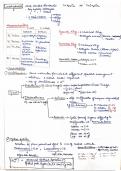
These are carbohydrates related notes, where you can get everything about Carbohydrates in short notes by covering monosaccharides, oligosaccharides and polysaccharides along with the properties of monosaccharides, especially glucose.
- Book
- Summary
- • 3 pages's •
-
Biochemistry•Biochemistry
-
Lehninger Principles of Biochemistry • David L and Michael M. Cox Nelson, Albert ; Cox Lehninger (Michael M. ; Nelson, David L.), Michael M. Cox• ISBN 9781429223515

Introduction to General, Organic, and Biochemistry 10th Edition By by Katherine Denniston - Test Bank (Complete Test Bank Chapter 1-23 with Question Answers)
- Exam (elaborations)
- • 846 pages's •
-
Biochemistry•Biochemistry

General, Organic And Biochemistry Hybrid Edition 2nd Edition By James Armstrong - Test Bank (Complete Test Bank Chapter 1-17 with Question Answers)
- Exam (elaborations)
- • 257 pages's •
-
Biochemistry•Biochemistry

Biochemistry 5th Edition International Edition by Reginald H. Garrett - Test Bank (Complete Test Bank Chapter 1-32 with Question Answers)
- Exam (elaborations)
- • 290 pages's •
-
Biochemistry•Biochemistry
The document is a comprehensive and informative guide titled "Lung Surfactant Demystified: A Comprehensive Guide." It is designed to provide a thorough understanding of lung surfactant, a vital component of the respiratory system. The guide is structured into several sections, each addressing specific aspects of lung surfactant, its functions, mechanisms, clinical significance, and more. Here's a brief overview: **Introduction to Lung Surfactant (Section I):** - Defines what lung surfacta...
- Class notes
- • 12 pages's •
-
Biochemistry•Biochemistry
Provides insight on the basics of nucleus acids
- Class notes
- • 33 pages's •
-
Biochemistry•Biochemistry

Biochemistry questions with answers solved .over 40 answers
- Exam (elaborations)
- • 20 pages's •
-
Biochemistry•Biochemistry