
chem101
Marianopolis College (MC )
Here are the best resources to pass chem101. Find chem101 study guides, notes, assignments, and much more.
Summary
Stoichiometry and Combustion Reactions
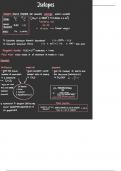
The document begins with an explanation of what goes on in a combustion reaction to gain a general understanding. The document then explains the law of conservation of mass and then provides step-by-step guided examples. The document highlights the differences between unbalanced and balanced chemical equations. The document gives an explanation of allotropes. It explains how to find the mass percent of a compound and the mass percent of an element. The document gives a clear explanation of the m...
 nissaabb2004

Class notes
Chapter 1 - Intro to chemistry
PopularThis document provides a concise chemistry concept map for Chapter 1 (significant figures, theory, law, etc), using visual tree diagrams, arrows, and linked concepts to clearly show how key ideas connect. It highlights the most important definitions, formulas, and relationships, making it ideal for quick review, exam preparation, or last-minute revision, especially for visual learners.
 jaydenliang

Class notes
Chapter 10 - Intermolecular forces & Vapor pressure
NewThis document provides a concise chemistry concept map for chapter 10 (intermolecular forces and vapor pressure), using visual tree diagrams, arrows, and linked concepts to clearly show how key ideas connect. It highlights the most important definitions, formulas, and relationships, making it ideal for quick review, exam preparation, or last-minute revision, especially for visual learners.
jaydenliang

Class notes
Chapter 8 - Bonds
NewThis document provides a concise chemistry concept map for chapter 8, (polarity, Lewis model, VSEPR model, etc.) using visual tree diagrams, arrows, and linked concepts to clearly show how key ideas connect. It highlights the most important definitions, formulas, and relationships, making it ideal for quick review, exam preparation, or last-minute revision, especially for visual learners.
jaydenliang
Class notes
Chapter 7 - Electrons
NewThis document provides a concise chemistry concept map for chapter 7 (electrons, periodic trends, electronic configurations, etc.), using visual tree diagrams, arrows, and linked concepts to clearly show how key ideas connect. It highlights the most important definitions, formulas, and relationships, making it ideal for quick review, exam preparation, or last-minute revision, especially for visual learners.
jaydenliang

Class notes
Chapter 6 - Thermochemistry and Thermodynamics
NewThis document provides a concise chemistry concept map for chapter 6 (Thermochemistry, thermodynamics), using visual tree diagrams, arrows, and linked concepts to clearly show how key ideas connect. It highlights the most important definitions, formulas, and relationships, making it ideal for quick review, exam preparation, or last-minute revision, especially for visual learners.
jaydenliang
Class notes
Chapter 4 - Reactions
NewThis document provides a concise chemistry concept map for chapter 4 (precipitation reactions, acid-base reactions, etc.), using visual tree diagrams, arrows, and linked concepts to clearly show how key ideas connect. It highlights the most important definitions, formulas, and relationships, making it ideal for quick review, exam preparation, or last-minute revision, especially for visual learners.
jaydenliang
Class notes
Chapter 9 - Hybridization
NewThis document provides a concise chemistry concept map for chapter 9 (hybridization), using visual tree diagrams, arrows, and linked concepts to clearly show how key ideas connect. It highlights the most important definitions, formulas, and relationships, making it ideal for quick review, exam preparation, or last-minute revision, especially for visual learners.
jaydenliang
Class notes
Chapter 5 - Gas
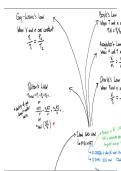
NewThis document provides a concise chemistry concept map for chapter 5 (gas), using visual tree diagrams, arrows, and linked concepts to clearly show how key ideas connect. It highlights the most important definitions, formulas, and relationships, making it ideal for quick review, exam preparation, or last-minute revision, especially for visual learners.
jaydenliang

Class notes
Chapter 3 - Stoichiometry
NewThis document provides a concise chemistry concept map for chapter 3 (Stoichiometry), using visual tree diagrams, arrows, and linked concepts to clearly show how key ideas connect. It highlights the most important definitions, formulas, and relationships, making it ideal for quick review, exam preparation, or last-minute revision, especially for visual learners.
jaydenliang
Class notes
Chapter 2 - Nomenclature
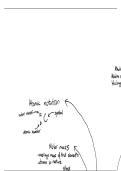
NewThis document provides a concise chemistry concept map for chapter 2 (nomenclature), using visual tree diagrams, arrows, and linked concepts to clearly show how key ideas connect. It highlights the most important definitions, formulas, and relationships, making it ideal for quick review, exam preparation, or last-minute revision, especially for visual learners.
jaydenliang

Class notes
Chemistry Concept Maps for EVERY Chapter
NewThis study guide contains chemistry concept maps for every chapter, organized using visual tree diagrams, arrows, and linked concepts to help students develop a strong big-picture understanding of the material. It is suitable for students from any CEGEP. Each concept map clearly highlights key definitions, relationships, formulas, and reaction pathways, presented in a structured and easy-to-follow format. These maps are ideal for efficient review, exam preparation, and last-minute revision, e...
jaydenliang

Class notes
Chemistry Concept Maps for EVERY Chapter
NewThis study guide contains chemistry concept maps for every chapter, organized using visual tree diagrams, arrows, and linked concepts to help students develop a strong big-picture understanding of the material. Each concept map clearly highlights key definitions, relationships, formulas, and reaction pathways, presented in a structured and easy-to-follow format. These maps are ideal for efficient review, exam preparation, and last-minute revision, especially for visual learners. Designed a...
jaydenliang

Class notes
Final course review : General Chemistry I
Textbook : Steven S. Zumdahl, Chemistry, 10th Ed., Brooks/Cole, Cengage Learning Chapter 1 Review: The Scientific Method; units, precision and accuracy, significant figures; dimensional analysis, temperature, density, classification of matter (Sections 1.1 to 1.10 incl. pp. 3-30) Chapter 2 Elements and compounds; naming of simple compounds (Sections 2.1-2.4 Read; Sections 2.5 to 2.8 pp. 46-63) Chapter 3 Rules of stoichiometry including formulae and naming of binary and polyatomic compou...
 michellesossou

Package deal
Chemistry 101 college level
Various topics covered in chemistry 101 along with guided examples.
nissaabb2004
Summary
Redox Reactions
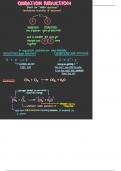
The document consists of clear and simple explanations of how to approach redox reactions and how to balance redox in acidic conditions. Everything needed to understand how to perform redox reactions is in the document and there are step-by-step fully solved problems in addition.
nissaabb2004

Summary
Precipitation Reactions
The document consists of in-depth, step-by-step rules on how to solve precipitation reactions. Also gives an overview of nonsoluble and soluble compounds. It also has helpful examples that are already solved. The document also goes over the formula equation, ionic equation, and net ionic equation. At the end of the document, there are more fully solved examples of precipitation reactions with step-by-step explanations.
nissaabb2004

Summary
Orbitals and Quantum Numbers
The document explains orbitals, each quantum number with in depth yet simple and clear explanations, and goes over nodes and electron spin as well.
nissaabb2004
Summary
Acid Base Reaction Notes
The document begins by providing the definition of acids and bases. It shows the pH scale which is how to measure the acidity and basicity of a solution along with providing the formulas to do so. Goes in depth to describe the reaction between a strong acid/base, weak acid/base, dilute strong acids, a mixture of weak acid solutions, and weak acid solutions and gives examples to go with. Explains the neutralization reaction along with examples. The document explains conjugate acids and base pairs...
nissaabb2004

Summary
Chemistry of Solutions
The document consists of the differences between solution, solvent, solute, and molarity. How to calculate mass percent and molarity. Explains how ionic compounds are dissolved. Explains the relationship between water and nonpolar substances. Describes electrical conductivity in solutions. Shows the structure of of each kind of electrolyte, strong, weak, and nonelectrolytes. Explains which strong/weak bases and acids will ionize and which are strong electrolytes and which are not along with exam...
nissaabb2004