

Athabasca University (AU )
Latest uploads at Athabasca University (AU ). Looking for notes at Athabasca University (AU )? We have lots of notes, study guides and revision notes available for your school.
-
206
-
1
-
23
Courses at Athabasca University (AU )
Notes available for the following courses at Athabasca University (AU )
-
A History of Europe in the Modern World 1
-
ACCOUNTING 4
-
Anthropology 1
-
Bachelor of Human Resources and Labor Relations 1
-
Bachelors of Arts in psychology 5
-
Bio chem 1
-
Biol 230 1
-
BIOL 235 HUMAN ANATOMY AND PHYSIOLOGY 20
-
Biology 13
-
Business 7
-
Chem 301 1
-
Comp 5
-
Computer Science 218 1
-
Computer Science 272 1
-
CRJS 4
-
EDPY 470 1
-
Engineering 8
-
English 1
-
Heahlth 2
-
Health Science 2
-
HISTORY OF PSYCHOLOGY 2
-
HUMAN ANATOMY AND PHYSIOLOGY 7
-
Intermediate Financial Accounting I 8
-
Introduction to Computer Programming 1
-
Marketing An Introduction 8ce by Armstrong 1
-
Math 2
-
Medicine 7
-
MGSC 2
-
NUR 326 1
-
NURS 316 1
-
NURS 326 6
-
NURS 328 16
-
NURS 400 12
-
NURS 401 2
-
Nursing 17
-
Nursing 400 1
-
PSY 3
-
Psyc 6
-
Psyc 323 1
-
Psyc 375 2
-
PSYC 387 1
-
PSYC 388 2
-
PSYC, 2
-
PSYC. 1
-
PSYCH 1
-
PSYCH, 1
-
Psych. 1
-
Psychology 13
-
Psychology 290 1
-
Psychology 387 1
-
Statistics 2
-
Test Bank for Principles of Anatomy and Physiology 1
-
UNC COMP 1
Popular books Athabasca University (AU )
Prem S. Mann • ISBN 9780470444665
Latest content Athabasca University (AU )

1. Outline five factors involved in establishing a positive counselling relationship. Pg. 126. - Self-awareness - Honesty - Congruence - Ability to communicate - Knowledge 2. Identify and discuss the possible barriers that may impede the development of a positive counselling process and identify ways to overcome each barrier. Pg. 117. - Seriousness of the presenting problem - Structure - Initiative - Physical setting - Client qualities - Counsellor qualities 3. Outline and evalu...
- Exam (elaborations)
- • 15 pages's •
-
Athabasca University•PSYC 388
Preview 2 out of 15 pages
Getting your document ready...
1. Outline five factors involved in establishing a positive counselling relationship. Pg. 126. - Self-awareness - Honesty - Congruence - Ability to communicate - Knowledge 2. Identify and discuss the possible barriers that may impede the development of a positive counselling process and identify ways to overcome each barrier. Pg. 117. - Seriousness of the presenting problem - Structure - Initiative - Physical setting - Client qualities - Counsellor qualities 3. Outline and evalu...

1. For metabolism in multicellular organisms to proceed efficiently, it is important that the final products be gases, water, or both. Why? To maintain metabolism in a steady state, there must be no possibility of a build–up of final products. The easiest disposal products are the multicellular organism’s universal solvent, gases, or both. 2. Look at the two starred reactions in the lesson just covered (the redox reactions involving NADH and O2). Compare the tendency of NADH to donate ...
- Exam (elaborations)
- • 29 pages's •
-
Athabasca University•Chem 301
Preview 3 out of 29 pages
Getting your document ready...
1. For metabolism in multicellular organisms to proceed efficiently, it is important that the final products be gases, water, or both. Why? To maintain metabolism in a steady state, there must be no possibility of a build–up of final products. The easiest disposal products are the multicellular organism’s universal solvent, gases, or both. 2. Look at the two starred reactions in the lesson just covered (the redox reactions involving NADH and O2). Compare the tendency of NADH to donate ...
Units 1-5 - Memorize all 20 amino acids - Memorize what all the complex carbs look like and a few facts about them - Know Michaleis-Menton graph and be able to identify type of enzyme inhibitor - Be able to explain how to get Vmax and Km from Lineweaver-Burk - Know how to translate DNA to mRNA and know the peptide that would be translated o do not need to memorize codons - Outline steps of translation - Know about all categories of: o Lipids o Active/passive transport o Plasmids o Re...
- Exam (elaborations)
- • 26 pages's •
-
Athabasca University•Bio chem
Preview 3 out of 26 pages
Getting your document ready...
Units 1-5 - Memorize all 20 amino acids - Memorize what all the complex carbs look like and a few facts about them - Know Michaleis-Menton graph and be able to identify type of enzyme inhibitor - Be able to explain how to get Vmax and Km from Lineweaver-Burk - Know how to translate DNA to mRNA and know the peptide that would be translated o do not need to memorize codons - Outline steps of translation - Know about all categories of: o Lipids o Active/passive transport o Plasmids o Re...
Chapter 8 provides an extensive overview of the roles of the neurotransmitters glutamate and GABA in the central nervous system. It delves into these neurotransmitters' synthesis, release, and inactivation processes, emphasizing their critical functions in excitatory and inhibitory neural transmission, respectively. The chapter highlights the mechanisms of excitotoxicity caused by excessive glutamate stimulation, which can lead to neuronal damage and death. This phenomenon is implicated in vari...
- Book & Paket-Deal
- Lecture notes
- • 13 pages's •
-
Athabasca University•PSYC450
-
Psychopharmacology • Jerrold S. Meyer, Andrew M. Farrar, Dominik Biezonski, Jennifer R. Yates• ISBN 9781605359892
-
PSYC 450 Drugs and Behaviour: Part 2• Byrowanballanger
Preview 2 out of 13 pages
Getting your document ready...
Chapter 8 provides an extensive overview of the roles of the neurotransmitters glutamate and GABA in the central nervous system. It delves into these neurotransmitters' synthesis, release, and inactivation processes, emphasizing their critical functions in excitatory and inhibitory neural transmission, respectively. The chapter highlights the mechanisms of excitotoxicity caused by excessive glutamate stimulation, which can lead to neuronal damage and death. This phenomenon is implicated in vari...
Chapter 7 on acetylcholine provides a comprehensive overview of the role and mechanisms of this essential neurotransmitter. It discusses the synthesis of acetylcholine (ACh) by the enzyme choline acetyltransferase from choline and acetyl coenzyme A and how its production is influenced by precursor availability and neuronal activity. The chapter also covers the storage and release of ACh in synaptic vesicles and the impact of various drugs and toxins on these processes, highlighting the effects o...
- Book & Paket-Deal
- Lecture notes
- • 7 pages's •
-
Athabasca University•PSYC450
-
Psychopharmacology • Jerrold S. Meyer, Andrew M. Farrar, Dominik Biezonski, Jennifer R. Yates• ISBN 9781605359892
-
PSYC 450 Drugs and Behaviour: Part 2• Byrowanballanger
Preview 2 out of 7 pages
Getting your document ready...
Chapter 7 on acetylcholine provides a comprehensive overview of the role and mechanisms of this essential neurotransmitter. It discusses the synthesis of acetylcholine (ACh) by the enzyme choline acetyltransferase from choline and acetyl coenzyme A and how its production is influenced by precursor availability and neuronal activity. The chapter also covers the storage and release of ACh in synaptic vesicles and the impact of various drugs and toxins on these processes, highlighting the effects o...
Chapter 6 - Serotonin provides a comprehensive overview of serotonin, covering its synthesis, release, inactivation, and functional roles within the brain and body. The chapter begins with a detailed explanation of serotonin synthesis, emphasizing the conversion of tryptophan to serotonin through the action of specific enzymes like tryptophan hydroxylase (TPH) and aromatic amino acid decarboxylase (AADC). It highlights the importance of dietary tryptophan and discusses various factors affecting ...
- Book & Paket-Deal
- Lecture notes
- • 8 pages's •
-
Athabasca University•PSYC450
-
Psychopharmacology • Jerrold S. Meyer, Andrew M. Farrar, Dominik Biezonski, Jennifer R. Yates• ISBN 9781605359892
-
PSYC 450 Drugs and Behaviour: Part 2• Byrowanballanger
Preview 2 out of 8 pages
Getting your document ready...
Chapter 6 - Serotonin provides a comprehensive overview of serotonin, covering its synthesis, release, inactivation, and functional roles within the brain and body. The chapter begins with a detailed explanation of serotonin synthesis, emphasizing the conversion of tryptophan to serotonin through the action of specific enzymes like tryptophan hydroxylase (TPH) and aromatic amino acid decarboxylase (AADC). It highlights the importance of dietary tryptophan and discusses various factors affecting ...
Chapter 5 focuses on catecholamines, a group of neurotransmitters that include dopamine, norepinephrine, and epinephrine. The chapter begins by discussing the synthesis of catecholamines, outlining the multi-step biochemical pathways that convert tyrosine to dopamine, norepinephrine, and epinephrine. It emphasizes the role of specific enzymes, such as tyrosine hydroxylase, which catalyzes the rate-limiting step in catecholamine synthesis. The regulation of these synthetic pathways is also covere...
- Book & Paket-Deal
- Lecture notes
- • 5 pages's •
-
Athabasca University•PSYC450
-
Psychopharmacology: Drugs, the Brain, and Behavior • Jerrold S.; Linda F. Quenzer Meyer• ISBN 9781605355184
-
PSYC 450 Drugs and Behaviour: Part 2• Byrowanballanger
Preview 2 out of 5 pages
Getting your document ready...
Chapter 5 focuses on catecholamines, a group of neurotransmitters that include dopamine, norepinephrine, and epinephrine. The chapter begins by discussing the synthesis of catecholamines, outlining the multi-step biochemical pathways that convert tyrosine to dopamine, norepinephrine, and epinephrine. It emphasizes the role of specific enzymes, such as tyrosine hydroxylase, which catalyzes the rate-limiting step in catecholamine synthesis. The regulation of these synthetic pathways is also covere...
Chapter 4 of the document "Techniques in Behavioral Pharmacology" focuses on various methodologies utilized to evaluate animal behaviour in the context of behavioural pharmacology. The chapter emphasizes the importance of animal studies for understanding the neurochemical basis of behaviour and developing models for psychiatric disorders. Techniques discussed include simple behavioural observation, motor activity measures, and operant conditioning. The chapter highlights how these methods allo...
- Lecture notes
- • 8 pages's •
-
Athabasca University•PSYC 450
Preview 2 out of 8 pages
Getting your document ready...
Chapter 4 of the document "Techniques in Behavioral Pharmacology" focuses on various methodologies utilized to evaluate animal behaviour in the context of behavioural pharmacology. The chapter emphasizes the importance of animal studies for understanding the neurochemical basis of behaviour and developing models for psychiatric disorders. Techniques discussed include simple behavioural observation, motor activity measures, and operant conditioning. The chapter highlights how these methods allo...
Chapter 3 delves into the intricate mechanisms of chemical signalling by neurotransmitters and hormones within the nervous system. It begins with the basic concepts of synaptic transmission, highlighting the directionality from presynaptic to postsynaptic cells and the structural components of synapses, such as axodendritic and axosomatic synapses. The chapter further explores neurotransmitters' synthesis, release, and inactivation, noting the diverse chemical classes, including amino acids, mo...
- Package deal
- Lecture notes
- • 11 pages's •
-
Athabasca University•PSYC 450
-
PSYC 450 Drugs and Behaviour: Part 1• Byrowanballanger
Preview 2 out of 11 pages
Getting your document ready...
Chapter 3 delves into the intricate mechanisms of chemical signalling by neurotransmitters and hormones within the nervous system. It begins with the basic concepts of synaptic transmission, highlighting the directionality from presynaptic to postsynaptic cells and the structural components of synapses, such as axodendritic and axosomatic synapses. The chapter further explores neurotransmitters' synthesis, release, and inactivation, noting the diverse chemical classes, including amino acids, mo...
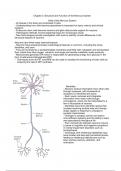
Chapter 2 of the document explores the structure and function of the nervous system, focusing on the fundamental roles of neurons and glial cells. It begins by discussing the differentiation of embryonic stem cells into neurons and glial cells, which provide essential support to neurons. The chapter outlines the major external features of neurons, including the soma, dendrites, and axon, and emphasizes the significance of the semipermeable membrane, mitochondria, and ATP synthesis in neuron func...
- Package deal
- Lecture notes
- • 13 pages's •
-
Athabasca University•PSYC 450
-
PSYC 450 Drugs and Behaviour: Part 1• Byrowanballanger
Preview 2 out of 13 pages
Getting your document ready...
Chapter 2 of the document explores the structure and function of the nervous system, focusing on the fundamental roles of neurons and glial cells. It begins by discussing the differentiation of embryonic stem cells into neurons and glial cells, which provide essential support to neurons. The chapter outlines the major external features of neurons, including the soma, dendrites, and axon, and emphasizes the significance of the semipermeable membrane, mitochondria, and ATP synthesis in neuron func...