
Chapter 1 introduction into management and organizational
behavior
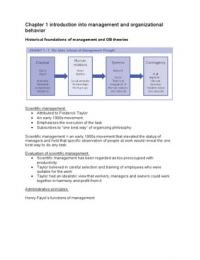
Historical foundations of management and OB theories
Scientific management
• Attributed to Frederick Taylor
• An early 1900s movement
• Emphasizes the execution of the task
• Subscribes to “one best way” of organizing philosophy
Scientific management = an early 1900s movement that elevated the status of
managers and held that specific observation of people at work would reveal the one
best way to do any task
Evaluation of scientific management
• Scientific management has been regarded as too preoccupied with
productivity
• Taylor believed in careful selection and training of employees who were
suitable for the work
• Taylor had an idealistic view that workers, managers and owners could work
together in harmony and profit from it
Administrative principles
Henry Fayol’s functions of management
, Fayol’s principles
• Division of work – specialization is to create efficiency, not just for technical
work but also for managerial work
• Authority and responsibility – if you have responsibility you must have
authority. This would be not only from position but also from personality
• Discipline – this is required at all levels and ensures the outward marks of
respect
• Unity of command – employees should receive orders from only one boss
• Unity of direction – for each group of activities there should be one boss and
one plan
• Subordination of the individual to the general interest – if there are differences
managers must reconcile them
• Remuneration – should be fair and equitable for both employees and
employer
• Centralisation – the extent to which authority is concentrated in one place or
dispersed. Who holds the power?
• Scaler chain – there should be a line of authority form highest to lowest
• Order – a place for everyone and everything and everyone and everything its
place
• Equity – through kindliness and justice which will create loyalty and devotion
• Stability of tenure – unnecessary labour turnover can be both the cause and
the effect of bad management
• Initiative – managers should encourage initiative from their employees and
nurture it
• Esprit de corps – this emphasizes the need for team work
Bureaucracy theory
• Attributed to Max Weber
• A hierarchy of command
• Specialisation and division of labour
• Explicit system of rules and policies
• Promotion based competence
• Impersonal treatment of people
Bureaucracy = Max Weber’s rational-legal authority structure for organisational
behavior
Historical foundations of management and OB theories
Scientific management
• Attributed to Frederick Taylor
• An early 1900s movement
• Emphasizes the execution of the task
• Subscribes to “one best way” of organizing philosophy
Scientific management = an early 1900s movement that elevated the status of
managers and held that specific observation of people at work would reveal the one
best way to do any task
Evaluation of scientific management
• Scientific management has been regarded as too preoccupied with
productivity
• Taylor believed in careful selection and training of employees who were
suitable for the work
• Taylor had an idealistic view that workers, managers and owners could work
together in harmony and profit from it
Administrative principles
Henry Fayol’s functions of management
, Fayol’s principles
• Division of work – specialization is to create efficiency, not just for technical
work but also for managerial work
• Authority and responsibility – if you have responsibility you must have
authority. This would be not only from position but also from personality
• Discipline – this is required at all levels and ensures the outward marks of
respect
• Unity of command – employees should receive orders from only one boss
• Unity of direction – for each group of activities there should be one boss and
one plan
• Subordination of the individual to the general interest – if there are differences
managers must reconcile them
• Remuneration – should be fair and equitable for both employees and
employer
• Centralisation – the extent to which authority is concentrated in one place or
dispersed. Who holds the power?
• Scaler chain – there should be a line of authority form highest to lowest
• Order – a place for everyone and everything and everyone and everything its
place
• Equity – through kindliness and justice which will create loyalty and devotion
• Stability of tenure – unnecessary labour turnover can be both the cause and
the effect of bad management
• Initiative – managers should encourage initiative from their employees and
nurture it
• Esprit de corps – this emphasizes the need for team work
Bureaucracy theory
• Attributed to Max Weber
• A hierarchy of command
• Specialisation and division of labour
• Explicit system of rules and policies
• Promotion based competence
• Impersonal treatment of people
Bureaucracy = Max Weber’s rational-legal authority structure for organisational



