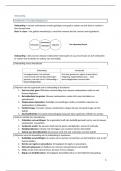
Bad Habits 04
VAN DEN AKKER, K., SCHYNS, G., & JANSEN, A. (2018). LEARNED
OVEREATING: APPLYING PRINCIPLES OF PAVLOVIAN CONDITIONING TO
EXPLAIN AND TREAT OVEREATING.
FOOD CUE REACTIVITY + PAVLOVIAN CONDITIONING
Exposure to food cues activates a central appetitive state, which consists
of 3 responses:
Psychological (craving, urge, or desire to eat)
Physiological preparatory (eg. increased salivation + insulin
release)
Neurocognitive (eg. brain activation patterns, allocation of
attentional resources)
Increased levels of food cue reactivity (eg. cue-elicited desires to eat) have
been associated with overeating, unsuccessful dieting, a higher BMI + eating
psychopathology
Food cue reactivity has a strong genetic component, BUT pavlovian conditioning
plays an important role as well every time palatable food is consumed, the
food can be associated with cues on the internal or external environment +
these cues then promote cue reactivity upon their next encounter
Pavlovian conditioning:
US: food entering the digestive system
Once a cue (CS) has become associated with the US, it can
stimulate appetitive responses, i.e. food cue reactivity
(CR), which promotes food intake example: Carl repeatedly eats
crisps in the evening, when watching his favourite TV show: this
context (CS; watching his TV show in the evening) may become
associated with eating crisps (US) + if this is the case, just the
CS (the look of his TV show) will elicit a desire for the crisps +
, promote its intake - Conditioned responding (= cue reactivity) is
reflected by:
Heightened psychological responding (eg. explicit eating
expectancies, eating desires, CS+ liking)
Psychophysiological responding (eg. salivation)
Behavioural responding (eg. approach tendencies, place
preferences, food intake/choice)
Appetitive conditioning usually occurs quickly 3-6 CS-US pairings
are sufficient, or even less
Does appetitive conditioning also occur under real-life circumstances, using
times of days as CS?
Study:
People were tested over a period of 15 days in their natural environment
Were instructed to consume chocolate at one specific time of the day (CS+)
People received a signal to complete a questionnaire + to consume chocolate
- On another time of the day, ppl only completed the questionnaire (CS-)
Results:
Heightened eating desired + eating expectancies to the chocolate-
associated time of day (vs. CS-) from the 5 th
day onwards It shows that cue-
elicited eating desires can be learned with relative ease in the natural
environment Associative learning processes might thus play a critical role in
the experience of many daily eating desires
Do overweight people differ in appetitive pavlovian learning from normal-
weight people?
Studies have shown reduced differential responding (i.e. smaller differences
in responding between the CS+ & CS-)
It might be that heightened CS- responding reflects an impaired ability to
, inhibit appetitive responses to stimuli signalling non-reward in an appetitive
context, which might increase reactivity + overeating to stimuli not associated
with food intake
Tendency towards overgeneralization in obese ppl: a reduced ability to
discriminate between predictive + nonpredictive stimuli is a core feature of
overgeneralization
example: while Carl originally learns to associate the eating of crisps to a
particular context (eg. sitting on the couch in the evening + watch his favourite
TV show), he is also cue reactive to a wider variety of stimuli that are similar to
the original CS+ but are never actually paired with eating (eg. other people's
living rooms) overgeneralization can thus easily lead to a large nr of reactivity-
evoking stimuli, promoting frequent cravings + overeating
Reduced learning about the predictive value of a CS promotes the formation
of context-US associations this can lead to contextual, rather than strong
cue-specific, reactivity (eg. to Carl’s living room)
Food cue reactivity has been shown to be related to overeating + weight
gain & can partly be learned through pavlovian learning principles
Rel. few CS-US pairings are sufficient to form CS-US associations
BOUTELLE, K. N., & BOUTON, M. E. (2015). IMPLICATIONS OF LEARNING
THEORY FOR DEVELOPING PROGRAMS TO DECREASE OVEREATING.
Family-based behavioural treatment (FBT):
-is a standard weight loss treatment program for overweight + obese
children
-is provided to parents + the target child
included nutrition + physical activity education + behaviour therapy strategies +
parent management skills
-incorporates techniques to assist the children + their parents in changing the
VAN DEN AKKER, K., SCHYNS, G., & JANSEN, A. (2018). LEARNED
OVEREATING: APPLYING PRINCIPLES OF PAVLOVIAN CONDITIONING TO
EXPLAIN AND TREAT OVEREATING.
FOOD CUE REACTIVITY + PAVLOVIAN CONDITIONING
Exposure to food cues activates a central appetitive state, which consists
of 3 responses:
Psychological (craving, urge, or desire to eat)
Physiological preparatory (eg. increased salivation + insulin
release)
Neurocognitive (eg. brain activation patterns, allocation of
attentional resources)
Increased levels of food cue reactivity (eg. cue-elicited desires to eat) have
been associated with overeating, unsuccessful dieting, a higher BMI + eating
psychopathology
Food cue reactivity has a strong genetic component, BUT pavlovian conditioning
plays an important role as well every time palatable food is consumed, the
food can be associated with cues on the internal or external environment +
these cues then promote cue reactivity upon their next encounter
Pavlovian conditioning:
US: food entering the digestive system
Once a cue (CS) has become associated with the US, it can
stimulate appetitive responses, i.e. food cue reactivity
(CR), which promotes food intake example: Carl repeatedly eats
crisps in the evening, when watching his favourite TV show: this
context (CS; watching his TV show in the evening) may become
associated with eating crisps (US) + if this is the case, just the
CS (the look of his TV show) will elicit a desire for the crisps +
, promote its intake - Conditioned responding (= cue reactivity) is
reflected by:
Heightened psychological responding (eg. explicit eating
expectancies, eating desires, CS+ liking)
Psychophysiological responding (eg. salivation)
Behavioural responding (eg. approach tendencies, place
preferences, food intake/choice)
Appetitive conditioning usually occurs quickly 3-6 CS-US pairings
are sufficient, or even less
Does appetitive conditioning also occur under real-life circumstances, using
times of days as CS?
Study:
People were tested over a period of 15 days in their natural environment
Were instructed to consume chocolate at one specific time of the day (CS+)
People received a signal to complete a questionnaire + to consume chocolate
- On another time of the day, ppl only completed the questionnaire (CS-)
Results:
Heightened eating desired + eating expectancies to the chocolate-
associated time of day (vs. CS-) from the 5 th
day onwards It shows that cue-
elicited eating desires can be learned with relative ease in the natural
environment Associative learning processes might thus play a critical role in
the experience of many daily eating desires
Do overweight people differ in appetitive pavlovian learning from normal-
weight people?
Studies have shown reduced differential responding (i.e. smaller differences
in responding between the CS+ & CS-)
It might be that heightened CS- responding reflects an impaired ability to
, inhibit appetitive responses to stimuli signalling non-reward in an appetitive
context, which might increase reactivity + overeating to stimuli not associated
with food intake
Tendency towards overgeneralization in obese ppl: a reduced ability to
discriminate between predictive + nonpredictive stimuli is a core feature of
overgeneralization
example: while Carl originally learns to associate the eating of crisps to a
particular context (eg. sitting on the couch in the evening + watch his favourite
TV show), he is also cue reactive to a wider variety of stimuli that are similar to
the original CS+ but are never actually paired with eating (eg. other people's
living rooms) overgeneralization can thus easily lead to a large nr of reactivity-
evoking stimuli, promoting frequent cravings + overeating
Reduced learning about the predictive value of a CS promotes the formation
of context-US associations this can lead to contextual, rather than strong
cue-specific, reactivity (eg. to Carl’s living room)
Food cue reactivity has been shown to be related to overeating + weight
gain & can partly be learned through pavlovian learning principles
Rel. few CS-US pairings are sufficient to form CS-US associations
BOUTELLE, K. N., & BOUTON, M. E. (2015). IMPLICATIONS OF LEARNING
THEORY FOR DEVELOPING PROGRAMS TO DECREASE OVEREATING.
Family-based behavioural treatment (FBT):
-is a standard weight loss treatment program for overweight + obese
children
-is provided to parents + the target child
included nutrition + physical activity education + behaviour therapy strategies +
parent management skills
-incorporates techniques to assist the children + their parents in changing the