Populations in ecosystems
Populations in ecosystems
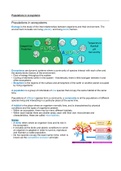
Ecology is the study of the inter-relationships between organisms and their environment. The
environment includes non living (abiotic), and living (biotic) factors.
Temperature
Competition Rainfall
Predation pH
Soil acidity
Ecosystems are dynamic systems where a community of species interact with each other and
the abiotic/biotic factors of the environment.
• Flow of energy throughout the system
• Cycling of elements within in the system - theoretically, there is little loss/gain between it and
other ecosystems
• Biosphere is the regions of the surface and atmosphere of the earth or another planet occupied
by living organisms
A population is a group of individuals of one species that occupy the same habitat at the same
time.
Populations of different species form a community: a community is all the populations of different
species living and interacting in a particular place at the same time.
A habitat is the place where an organism normally lives, and is characterised by physical
conditions and the types of organisms present.
• Within an ecosystem, there may be many different habitats.
• Within each habitat there are smaller areas, each with their own microclimate and
characteristics, these are called microhabitats.
Niches
• A niche refers where an organism lives and its role in
the ecosystem
• It includes all the biotic and abiotic conditions to which
an organism is adapted in order to survive, reproduce
and maintain a viable population.
• No two species occupy the exact same niche, which is
known as the competitive exclusion principle
, Variation in population size
Growth curves:
• When plotting curves of micro-organisms, often its hard to plot as the numbers increase so
rapidly
• It is therefore necessary to use a log scale to present the numbers, so we can see all the points
on one graph and see that the growth rate may decrease over time
• To calculate logs, just use the log button and input the original value.
• To reverse a logged value, do 10^log value to get the original
Slow growth:
• Few individuals reproducing
Exponential growth:
• No limiting factors
Stable state:
• Limiting factors limit growth rate, e.g. light, new
competition, temperatures, food
Death phase:
• Intense limiting factors, e.g. food runs out
Note that the growth rate curve is different to the above graph.
The carrying capacity of a species is the maximum population
size of the species that the environment can sustain indefinitely
given the conditions and limiting factors in the environment. This
is found at the ‘stable state’ on the graph. This is where:
Birth + Immigration = Death + Emigration
Abiotic factors
Abiotic factors are non living factors. When an abiotic factor is below the optimum for a
population, fewer individuals are able to survive as their adaptations are not suited to the
conditions. If no individuals possesses adaptations to allow survival, then the population becomes
extinct.
Temperature
Each species has a different optimum temperature where it is able to survive best. The
further away from this optimum, the fewer individuals can survive.
In cold blooded animals:
• At lower temperatures, enzymes work more slowly and the metabolic rate decreases.
This means the population has a lower carrying capacity
• At temperatures above the optimum, the enzymes are denatured and so the population
also has a lower carrying capacity
In warm blooded animals:
• They are able to maintain a fairly constant body temperature
Populations in ecosystems
Ecology is the study of the inter-relationships between organisms and their environment. The
environment includes non living (abiotic), and living (biotic) factors.
Temperature
Competition Rainfall
Predation pH
Soil acidity
Ecosystems are dynamic systems where a community of species interact with each other and
the abiotic/biotic factors of the environment.
• Flow of energy throughout the system
• Cycling of elements within in the system - theoretically, there is little loss/gain between it and
other ecosystems
• Biosphere is the regions of the surface and atmosphere of the earth or another planet occupied
by living organisms
A population is a group of individuals of one species that occupy the same habitat at the same
time.
Populations of different species form a community: a community is all the populations of different
species living and interacting in a particular place at the same time.
A habitat is the place where an organism normally lives, and is characterised by physical
conditions and the types of organisms present.
• Within an ecosystem, there may be many different habitats.
• Within each habitat there are smaller areas, each with their own microclimate and
characteristics, these are called microhabitats.
Niches
• A niche refers where an organism lives and its role in
the ecosystem
• It includes all the biotic and abiotic conditions to which
an organism is adapted in order to survive, reproduce
and maintain a viable population.
• No two species occupy the exact same niche, which is
known as the competitive exclusion principle
, Variation in population size
Growth curves:
• When plotting curves of micro-organisms, often its hard to plot as the numbers increase so
rapidly
• It is therefore necessary to use a log scale to present the numbers, so we can see all the points
on one graph and see that the growth rate may decrease over time
• To calculate logs, just use the log button and input the original value.
• To reverse a logged value, do 10^log value to get the original
Slow growth:
• Few individuals reproducing
Exponential growth:
• No limiting factors
Stable state:
• Limiting factors limit growth rate, e.g. light, new
competition, temperatures, food
Death phase:
• Intense limiting factors, e.g. food runs out
Note that the growth rate curve is different to the above graph.
The carrying capacity of a species is the maximum population
size of the species that the environment can sustain indefinitely
given the conditions and limiting factors in the environment. This
is found at the ‘stable state’ on the graph. This is where:
Birth + Immigration = Death + Emigration
Abiotic factors
Abiotic factors are non living factors. When an abiotic factor is below the optimum for a
population, fewer individuals are able to survive as their adaptations are not suited to the
conditions. If no individuals possesses adaptations to allow survival, then the population becomes
extinct.
Temperature
Each species has a different optimum temperature where it is able to survive best. The
further away from this optimum, the fewer individuals can survive.
In cold blooded animals:
• At lower temperatures, enzymes work more slowly and the metabolic rate decreases.
This means the population has a lower carrying capacity
• At temperatures above the optimum, the enzymes are denatured and so the population
also has a lower carrying capacity
In warm blooded animals:
• They are able to maintain a fairly constant body temperature